The problem isn't that label printing is inherently expensive. It becomes expensive through a series of decisions: the wrong printer for the workload, over-specified materials for simple applications, no process for managing compliance updates, and workflows that let errors multiply before anyone notices.
This article breaks down where those costs actually originate and which changes produce the greatest return — from equipment selection and material specification to workflow management and system integration.
TL;DR
- Label printing costs come from multiple sources: material waste, printer mismatches, compliance reprints, and workflow errors
- Most cost is locked in before printing starts, during equipment selection, design, and material specification
- Three strategy categories cut costs: better upfront decisions, tighter print management, and fixing workflow errors before they trigger reprints
- On-demand in-house printing typically lowers per-label cost and eliminates waste from pre-printed inventory going obsolete
- Diagnosing your specific cost driver first is what makes any strategy actually work
How Label Printing Costs Build Up in Manufacturing
The Gradual Accumulation Nobody Tracks
Label costs don't spike — they accumulate unnoticed. Reprints from smudged or delaminated labels get charged to consumables. Downtime from a failed printer gets absorbed into maintenance. Over-ordered stock that becomes obsolete when a product changes gets written off without attribution. None of it appears as "label cost" in the budget, so none of it gets managed.
This is both a gradual problem and an episodic one:
- Gradual waste: Inefficient material use, recurring consumable purchases, and routine reprints from minor errors
- Episodic spikes: A printer failure mid-shift, a label material that fails in a harsh environment, or a regulatory update that forces a redesign across dozens of SKUs
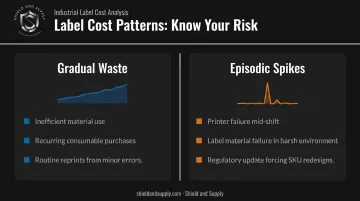
Both patterns trace back to a common source: specifications that don't match the actual deployment environment.
When Under-Specification Creates the Largest Costs
The most damaging cost pattern is under-specification. A label that gradually degrades in a high-humidity zone or loses adhesion near a chemical wash station may go unnoticed until it fails during a compliance audit or triggers a recall investigation.
ANSI/UL 969 evaluates label systems against specific environmental exposures — water immersion, elevated temperature, UV weathering, gasoline, and chemical contact. It treats the label as a complete system: face stock, adhesive, ink, and overlaminate together.
A label selected without reference to these criteria for its actual environment isn't saving money — it's deferring a larger cost down the line.
Key Cost Drivers for Manufacturing Label Printing
Material Choice
Material specification is the largest single cost driver in most facilities, for two opposite reasons:
- Over-specification: Premium adhesives, coatings, and face stocks applied to low-stress environments inflate per-unit cost without delivering any added protection
- Under-specification: Budget materials in chemical, moisture, or abrasion-heavy environments create failure costs — reprints, compliance exposure, relabeling across SKUs — that far exceed what better materials would have cost
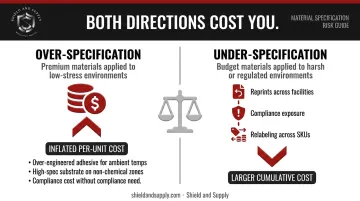
The right framework is application-specific: evaluate the actual surface, expected temperature range, exposure conditions, and regulatory durability requirements for each label type. Then select accordingly, rather than defaulting to one specification across the entire facility.
Printer Technology Fit
A printer that doesn't match the facility's actual workload compounds cost in multiple directions:
- Wrong technology for durability requirements increases label failure rates
- Mismatched volume capacity drives up per-label cost through inefficient throughput
- Poor environmental fit accelerates maintenance cycles and shortens equipment life
Thermal transfer printing — which uses ribbon to transfer resin or wax-resin ink onto the label substrate — produces durable, chemical-resistant, and abrasion-resistant output suited to compliance and long-life industrial labels. Direct thermal printing requires no ribbon but produces labels with shorter lifespans, making it less appropriate for labels that need to survive harsh environments or extended exposure.
The LabelTac® Pro X and LabelTac® 9 from Shield and Supply are thermal transfer printers built specifically for industrial environments. Both come with a Full Lifetime Warranty covering all parts, labor, and related costs — which eliminates the capital replacement cost that typically compounds when standard-warranty printers age out.
Workflow and Compliance Requirements
Workflow decisions — label size, design complexity, template management, and compliance field requirements — set the cost floor before printing begins. A label design that's oversized for its purpose wastes media on every print run. A template without compliance fields forces retroactive redesigns when an audit reveals a gap.
OSHA's 2024 HazCom final rule, effective July 19, 2024, created staggered compliance deadlines running through 2028. Facilities without a structured process for managing those updates will absorb episodic reprint costs at each deadline.
The financial exposure goes beyond reprint costs:
- Serious HazCom violations: up to $16,550 per violation
- Willful or repeated violations: up to $165,514
Designing to compliance requirements from the start is a cost-avoidance measure, not just a regulatory one.
Cost-Reduction Strategies for Manufacturing Label Printing
The right strategy depends on where costs are originating. A facility overspending on materials needs different action than one losing money to printer downtime. Below, strategies are organized by what they change.
Strategies That Change Decisions
These address choices made before printing begins — the decisions that set cost constraints at scale. (Retain this single em-dash as the one permitted per section.)
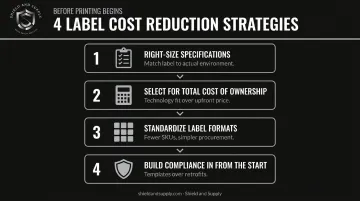
Right-size specifications to actual application demands. Audit each label type against its real environment: surface type, temperature range, chemical or moisture exposure, and regulatory durability requirements. Replace premium-across-the-board defaults with fit-for-purpose selections. LabelTac® supplies are available in vinyl, high-temperature, chemical-resistant, reflective, magnetic, and glow-in-the-dark substrates to match specific conditions rather than applied uniformly.
Select print technology based on total cost of ownership. Upfront price tells you very little about actual cost over time. A mismatch between print technology and application creates ongoing consumable waste, premature label failure, or frequent equipment replacement. For durable industrial compliance labels, thermal transfer with resin or wax-resin ribbon delivers the longevity those applications require.
Standardize label formats across the facility. Every additional label size, shape, or substrate type adds complexity: more SKUs to purchase, more risk of using the wrong stock, longer changeovers, and fewer volume purchasing advantages. Consolidating to a smaller set of standard formats reduces purchasing complexity and simplifies operator training.
Build compliance requirements into design from the start. Retrofitting OSHA, GHS, or ANSI requirements onto existing label templates forces reprints and repeated redesigns. LabelSuite™, included free with every LabelTac® printer, provides pre-built templates for OSHA 29 CFR 1910, ANSI Z535, GHS HazCom, ASME A13.1 pipe marking, NFPA 70E arc flash, and more so compliance is embedded at design time, not corrected after the fact.
Strategies That Change How Printing Is Managed
Better control and visibility during active operations can cut costs significantly. This is where waste often goes undetected the longest.
Use label software to reduce errors before they become reprints. A meaningful share of label waste in manufacturing comes from design errors, missing compliance fields, and manual data entry mistakes at the point of printing. LabelSuite™ supports variable data and serialization, CSV and Excel import, and pre-built compliance templates to break the error-to-reprint cycle that inflates consumable costs over time.
Shift from bulk pre-printed inventory to on-demand printing. Large pre-printed label orders deliver a lower per-unit price but lock in design specifics that become obsolete when products change, barcodes update, or regulations require new label content. On-demand printing with an in-house printer eliminates obsolescence waste and reduces warehousing needs.
The LabelTac® Pro X handles 1/2" to 4" labels. The LabelTac® 9 covers 4" to 9" wide formats with throughput up to 2,500 labels per day.
Monitor consumable usage rather than purchasing reactively. Ribbons and media stock ordered reactively, without tracking actual consumption, carry emergency pricing and create production gaps. Facilities that track usage per printer can identify waste patterns and negotiate based on predictable volume.
Establish preventive maintenance routines. Siemens' 2024 downtime report found that unplanned downtime costs the world's 500 largest manufacturers the equivalent of 11% of revenues annually. A printer failure mid-shift is a small version of that problem that scheduled cleaning intervals and printhead inspections can prevent. The LabelTac® Pro X's expanded ribbon capacity and drop-in supply loading design reduce the frequency of maintenance touchpoints, but they don't eliminate the need for a defined routine.
Strategies That Change the Operational Context
These address environmental, supply chain, and structural factors that raise printing costs regardless of printer management.
Match printer placement to the actual environment. A printer not rated for chemical exposure, high humidity, or temperature variation deployed in those conditions will degrade faster, require more maintenance, and produce inconsistent output. Environmental fit should be an explicit selection criterion, not something discovered after deployment.
Consolidate to fewer printer models and media types. Managing multiple printer platforms multiplies consumable inventory, complicates cross-training, and eliminates bulk purchasing leverage. Standardizing on a common platform like the LabelTac® Pro X for standard-width applications and the LabelTac® 9 for large-format needs simplifies procurement and reduces support burden.
Align sourcing strategy with production variability. High-volume, stable SKUs may benefit from volume media purchases. Highly variable or seasonal product lines benefit from on-demand printing that avoids overstocking. Applying a single procurement model across all label types typically overspends on one end or creates obsolescence waste on the other.
Connect label printing to upstream systems. When label printing is disconnected from ERP or WMS platforms, operators manually re-enter product data, batch numbers, and compliance fields creating error risk that produces reprints and, in regulated environments, compliance exposure. LabelSuite™ supports CSV and Excel import and is designed for variable-data workflows that reduce manual data handling.
Conclusion
Cutting label printing costs without knowing where they originate is how facilities reduce spending in one area while creating it in another. The strategies here only produce consistent results when they're applied to the actual cost driver — whether that's:
- Material over-specification
- Printer mismatches
- Poor workflow controls
- Environmental context misalignment
Cost reduction for label printing is ongoing. Volumes change. Compliance requirements evolve. New materials and printing technologies become available. Facilities that treat label printing as a managed operational function — with defined equipment standards, material specifications, and workflow controls — consistently outperform those that treat it as a one-time procurement decision. Reviewing your cost drivers once a year, even briefly, is enough to catch the drift before it compounds.
Frequently Asked Questions
What is the most cost-effective type of label printer for manufacturing?
It depends on durability requirements. Direct thermal costs less for short-term labels that won't face harsh conditions. Thermal transfer suits compliance labels, barcodes, and applications requiring resistance to chemicals, abrasion, or extended outdoor exposure — and matching technology to the application determines real cost-effectiveness over time.
How does label material choice affect total printing costs?
Face stock, adhesive, and coating specifications determine both per-unit material cost and failure rates. Over-specifying for low-stress environments wastes budget on unnecessary performance. Under-specifying for harsh environments creates reprint and compliance costs — including potential OSHA penalty exposure — that far exceed what better materials would have cost from the start.
Is it more cost-effective to print labels in-house or outsource?
In-house printing with the right equipment typically reduces per-label cost at moderate to high volumes, eliminates obsolescence waste from pre-printed inventory, and improves response time for compliance updates. Outsourcing may suit very low volumes or highly specialized label types where the investment in in-house equipment isn't justified.
How can label printing software reduce manufacturing costs?
Software reduces costs by preventing design errors before printing begins, enforcing compliance templates, enabling on-demand printing from variable data, and connecting to facility data systems — cutting the reprints and manual errors that inflate consumable costs without showing up as a clear line item.
What role does label design play in controlling printing costs?
Design decisions — label size, substrate, complexity, and compliance requirements — set the cost floor for every label produced. A label that's oversized for its application wastes media on every print run. A template missing required compliance fields triggers retroactive redesigns. Getting design right the first time is one of the highest-leverage cost reduction points available.
How do OSHA and compliance requirements affect manufacturing label printing costs?
Compliance requirements drive both material durability standards and update frequency. OSHA requires HazCom labels to be revised within six months of significant new hazard information, and the 2024 HazCom rule created deadlines running through 2028 — facilities without a structured update process absorb large episodic reprint costs at each cycle.