OSHA cited Floor & Decor under 29 CFR 1910.176(a) after an inspection found permanent aisles weren't appropriately marked — an initial penalty of $5,683 for what amounts to a maintenance oversight. That's the real cost of floor tape that fails.
This guide covers how long floor marking tape actually lasts across different tape types and environments, what cuts lifespan short, and the practical steps facilities can take to get the most out of their investment.
TL;DR
- Standard vinyl floor tape in active industrial settings typically lasts 6–12 months before showing significant wear
- Heavy-duty industrial-grade tape can last 3–5+ years with proper application and maintenance
- Four variables drive lifespan: traffic intensity, surface preparation, cleaning practices, and tape quality
- Surface prep is the single most controllable factor — poor prep guarantees early failure regardless of tape grade
- Replace tape at the first sign of peeling edges, faded color, bubbling, missing segments, or any raised edge that creates a trip hazard
How Long Does Floor Marking Tape Last?
Lifespan varies considerably by tape grade and environment. Here's a practical breakdown:
| Tape Grade | Typical Lifespan | Best For |
|---|---|---|
| Budget/standard vinyl | 6–12 months | Light foot traffic, office corridors |
| Mid-grade vinyl | 1–2 years | Mixed-use areas, moderate traffic |
| Heavy-duty industrial | 3–5+ years | Warehouses, forklifts, manufacturing floors |
These are general ranges — actual longevity depends heavily on the specific environment. A 3M Vinyl Tape 471, for example, is a 5.2-mil standard vinyl tape with an 18-month shelf life from manufacture — it's suited for lane marking in light-duty settings, not daily forklift traffic. At the other end, Mighty Line's 50-mil industrial tape carries a 3-year limited warranty, and Brady positions its ToughStripe Max specifically for forklift and heavy vehicle zones.
Industrial vs. Light-Duty Environments
The gap between a quiet office corridor and a warehouse floor with daily forklift crossings is significant. In a pedestrian-only hallway, even mid-grade tape holds up well because there's no shear force from wheels repeatedly crossing the same point. In an active distribution center, that same tape can fail within weeks.
Heavy-duty tape in demanding environments earns its higher price through abrasion-resistant backing, stronger adhesive systems, and physical construction designed to absorb impact rather than peel under it.
Floor Tape vs. Floor Paint
Paint is frequently the comparison point for facilities evaluating marking options. In high-traffic industrial zones, quality tape consistently outlasts paint. Paint chips, fades, and erodes from cleaning chemicals — often requiring touch-ups within months of application. Tape installs without curing downtime, is easy to reconfigure when layouts change, and heavy-duty variants hold up for years where paint would need repeated reapplication.
Shield and Supply's SafetyTac® line was built for this use case — peel-and-stick installation with no facility downtime, designed to withstand forklift traffic, chemical exposure, and temperature extremes.
Specialty Tape Lifespan Considerations
Beyond standard tape grades, specialty variants face their own stressors. Anti-slip, reflective, glow-in-the-dark, and freezer-grade formats each degrade through different mechanisms:
- Anti-slip tape faces more surface abrasion from foot traffic than smooth tape
- Freezer-grade tape must maintain adhesive bond through repeated thermal cycling
- Reflective tape can lose retroreflective properties from UV exposure or surface abrasion
- Cold storage variants of SafetyTac® are rated for extreme temperature environments
Shelf Life of Unused Rolls
Improper storage degrades adhesive before tape ever reaches the floor. 3M specifies that Vinyl Tape 471 and Durable Floor Marking Tape 971 should be stored at 60–80°F / 16–27°C, at 40–60% relative humidity, in original packaging, and used within 18 months of manufacture.
Heat, sunlight, and humidity accelerate adhesive degradation. Tape stored in an unconditioned warehouse corner may perform poorly even on day one.
Key Factors That Affect Floor Marking Tape Lifespan
Traffic Type and Volume
Wheel traffic is the biggest accelerant of tape failure. The repeated shear force from forklifts, pallet jacks, and heavy rolling equipment physically stresses both the tape backing and the adhesive bond in ways that foot traffic simply doesn't replicate.
Even premium tape fails prematurely when placed directly in forklift turning zones. The pivot motion creates concentrated lateral force that degrades adhesion fast. Mighty Line explicitly warns that dragging or pulling skids across tape can void warranty coverage, and recommends routing to minimize that contact.
Surface Preparation
Unlike traffic load, surface prep is entirely within your control — and poor prep causes more premature failures than any other factor. Tape applied to oily, damp, or dusty floors will peel regardless of product quality.
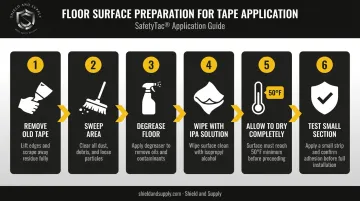
Proper prep follows a clear sequence:
- Remove old tape and any adhesive residue completely
- Sweep the area free of debris and dust
- Degrease with a heavy-duty cleaner
- Wipe with isopropyl alcohol — 3M recommends a 50:50 IPA/water solution for most substrates
- Allow to dry completely — Mighty Line specifies the floor should be above 50°F before application
- Test a small section before full installation
Floor Surface Type and Texture
Tape adheres differently across surface types. Smooth sealed concrete provides ideal contact. Textured, pitted, or rough concrete reduces the adhesive contact area. Epoxy-coated floors introduce their own compatibility considerations depending on the epoxy formulation.
Applying standard tape to an incompatible surface shortens lifespan significantly. Some tapes are formulated specifically for irregular surfaces — when in doubt, test before committing to a full installation.
Environmental Conditions
Moisture, temperature cycling, and cleaning chemicals all attack the adhesive layer over time. Facilities with regular floor washing programs face compounded risk when aggressive products are used near tape.
Key chemical threats to watch for:
- Acidic cleaners — residue reduces adhesion and can void warranty coverage (per Mighty Line)
- Ketones — cause backing swelling in vinyl tapes
- Chlorinated hydrocarbons — lead to curling and delamination
Tape Material and Mil Thickness
Mil thickness drives durability. The range across common products tells the story:
- 3M Vinyl Tape 471: 5.2 mil — light-duty, lane marking
- 3M Durable Floor Marking Tape 971: 19 mil — high-traffic industrial
- Mighty Line industrial tape: 50 mil — heavy-duty, forklift-rated
Thicker tape resists scuffing, absorbs impact better, and gives the adhesive layer more structural support. For active industrial environments, tape in the 50+ mil range is the practical threshold for multi-year performance.
How to Make Floor Marking Tape Last Longer
Apply Tape Correctly and Activate the Adhesive
Pressure-sensitive adhesive requires proper activation at installation. Tamping the tape down with firm, even pressure eliminates air pockets and ensures full contact with the floor surface.
SafetyTac® installation follows a clean/mark/peel/stick/weight sequence. That final tamping step activates the adhesive and determines how well the tape holds up under traffic. For best results:
- Use a tamper weighing at least 150 lbs
- Make a minimum of 3 passes along the entire marking
- Use a tamping wheel at least 2 inches wider than the tape to cover the edges
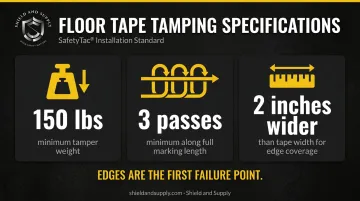
Edges are the first failure point. Give them extra attention during application.
Use Compatible Cleaning Agents
Harsh cleaning chemicals degrade adhesive over time, even on chemically resistant tape. In areas with floor markings:
- Switch to mild or neutral cleaners where possible
- Neutralize acid-based cleaner residue before it contacts tape
- Avoid directing high-pressure steam or hot water directly at tape edges
- Never use cleaners containing ketones or chlorinated solvents near vinyl tape
Adjust Operational Habits
Heavy-duty tape handles incidental forklift contact. Repeated use as a pivot point or dragging pallets across it is a different story — and a common cause of early failure.
Low-cost habit changes that extend tape life:
- Route forklifts around marked zones when possible
- Avoid using tape-marked areas as equipment turning points
- Use corner markers or segment markers in pallet storage areas instead of full continuous tape lines
Signs It's Time to Replace Your Floor Marking Tape
Visual Warning Signs
Watch for these during safety walkthroughs:
- Peeling or curled edges — especially in corners and high-traffic zones
- Faded or discolored markings — color degraded to the point where aisle boundaries or hazard zones aren't clearly distinguishable
- Surface bubbling or blistering — indicates adhesive failure beneath the backing
- Torn or missing segments — gaps in safety-critical zones require immediate attention
Safety and Compliance Triggers
When visual deterioration crosses into compliance territory, immediate action is required — not just a note for the next walkthrough:
- Trip hazard threshold — U.S. Access Board guidance requires ramp treatment for vertical changes above ½ inch. Raised tape approaching that height must come up immediately.
- Unreadable color — tape that no longer reads as its intended color has failed its compliance function under OSHA 1910.22 and 1910.176. Yellow that looks beige isn't marking anything.
Inspection Frequency
Build floor tape checks into regular safety walkthroughs. High-traffic zones warrant more frequent review than low-traffic corridors. Catching edge lift early allows for spot repair rather than full-section replacement — typically a fraction of the labor and material cost.
Choosing the Right Floor Marking Tape for Long-Term Durability
The most common mistake facilities make is selecting tape by price rather than performance requirements. Light-duty vinyl tape in a warehouse doesn't fail because it's a bad product — it fails because it was the wrong product for the application.
Match Tape Grade to Environment
Before selecting a product, assess:
- Traffic type — pedestrian only, pallet jacks, forklifts, or heavy vehicle crossings
- Chemical exposure — cleaning agents, oils, acids, or caustic chemicals present in the facility
- Floor surface — smooth sealed concrete, epoxy-coated, textured, or cold storage
- OSHA color requirements — red and yellow for specific hazards under 29 CFR 1910.144; other colors follow recognized industry guides
Features That Signal Durability
For industrial environments, look for:
- 50+ mil thickness for forklift-rated applications
- Beveled or tapered edges so wheels and pallets ride over rather than catch and peel
- High-strength pressure-sensitive adhesive formulated for industrial floor contact
- Specific resistance ratings for abrasion, moisture, and chemicals — not just general durability claims
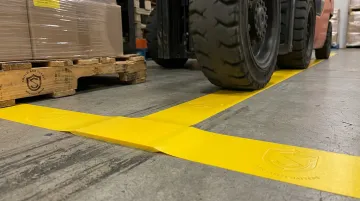
If you want a product built to these specifications, Shield and Supply's SafetyTac® line is worth evaluating. The standard SafetyTac® features beveled edges and pressure-sensitive industrial adhesive rated for forklift, pallet jack, and foot traffic. SafetyTac® 2.0 uses denser material, a more aggressive adhesive, and a forklift-resistant profile engineered to pass forklift pivot testing.
Both options come in OSHA- and ANSI Z535.1-compliant colors across multiple widths for aisle marking, hazard zones, and 5S facility organization.
Facilities that need help matching tape grade to specific environment demands can contact Shield and Supply at info@shieldandsupply.com or 877-514-0727 — their team can match tape grade to your specific application before purchasing.
Frequently Asked Questions
Frequently Asked Questions
How long does floor marking tape last?
Standard vinyl tape typically lasts 6–12 months in active industrial settings before showing significant wear. Heavy-duty industrial-grade tape can last 3–5+ years with proper surface prep and maintenance. Lifespan depends heavily on traffic intensity, tape quality, and whether the floor was properly prepared before application.
What is the best tape for marking floors?
For industrial and warehouse environments, heavy-duty vinyl tape with beveled edges, strong pressure-sensitive adhesive, and 50+ mil thickness is the right choice. Specialty variants cover specific needs: anti-slip for pedestrian zones, freezer-grade for cold storage, and hazard-striped for perimeter marking around equipment.
How do I know when floor marking tape needs to be replaced?
Key replacement signals: peeling or curled edges, faded color, surface bubbling, gaps or missing sections, and any raised edge that has become a trip hazard. For OSHA compliance, color degradation alone is sufficient reason to replace. Faded aisle markings no longer serve their safety function.
Does floor marking tape work on all types of floors?
Most floor marking tapes are designed for smooth sealed or painted concrete. Textured, pitted, or epoxy-coated floors may require specialty tape formulations with higher adhesive strength. Always test a small section before full installation, particularly on non-standard surfaces.
Can floor marking tape withstand forklift traffic?
Heavy-duty industrial tape (50+ mils, beveled edges) is designed to handle regular forklift traffic. However, tape that is repeatedly used as a pivot or turning point wears faster regardless of grade. Product selection and routing habits both factor into long-term performance.
How does floor marking tape compare to floor paint in terms of lifespan?
Quality floor marking tape outlasts paint in high-traffic industrial environments. Paint often chips and fades within months, while heavy-duty tape can last years. Tape also installs without downtime, requires no curing period, and can be reconfigured easily when facility layouts change.