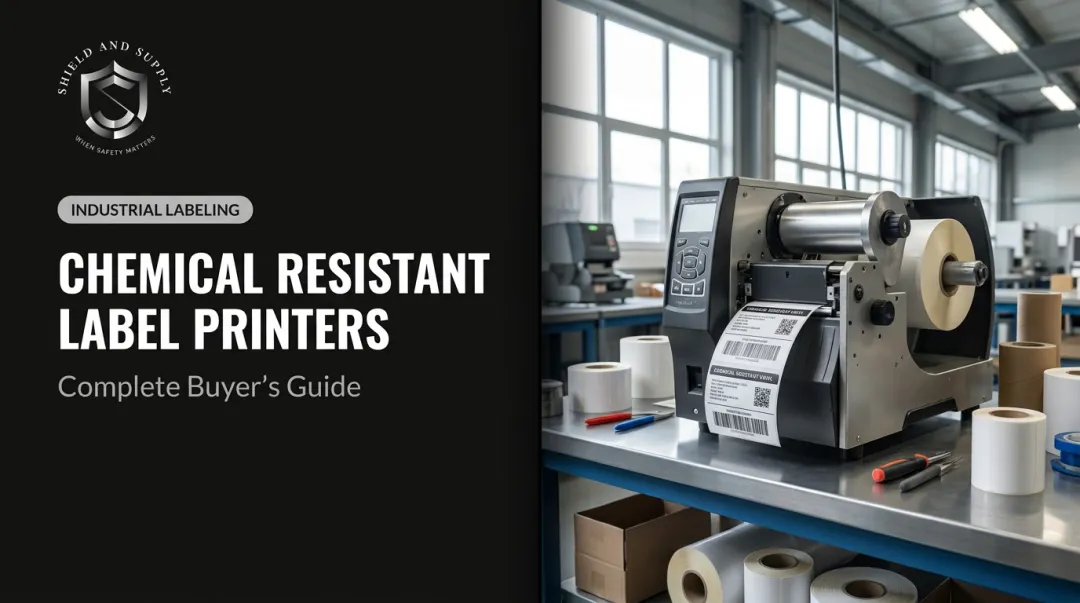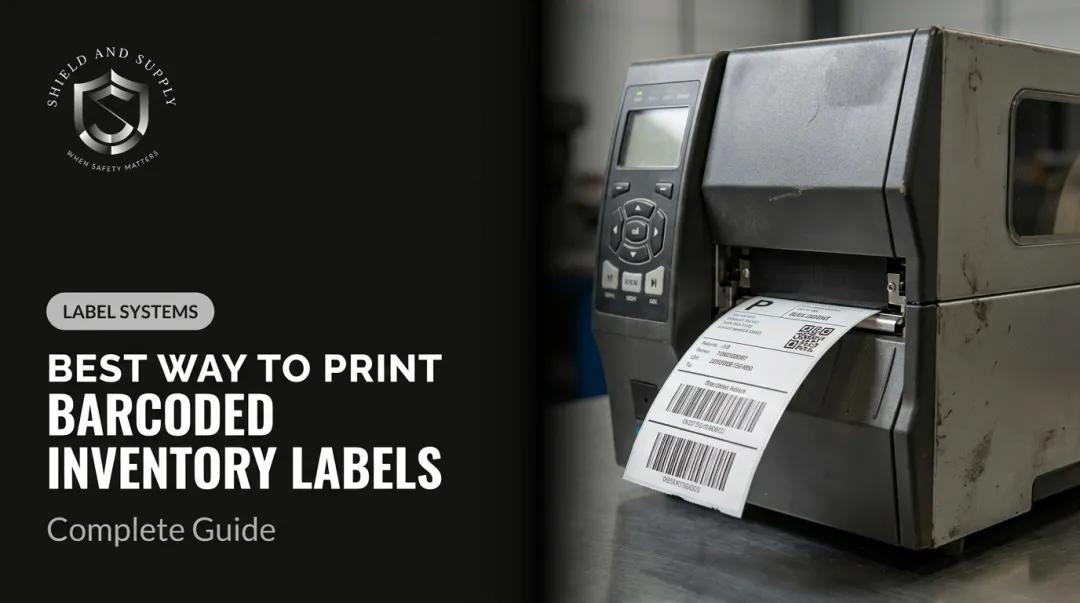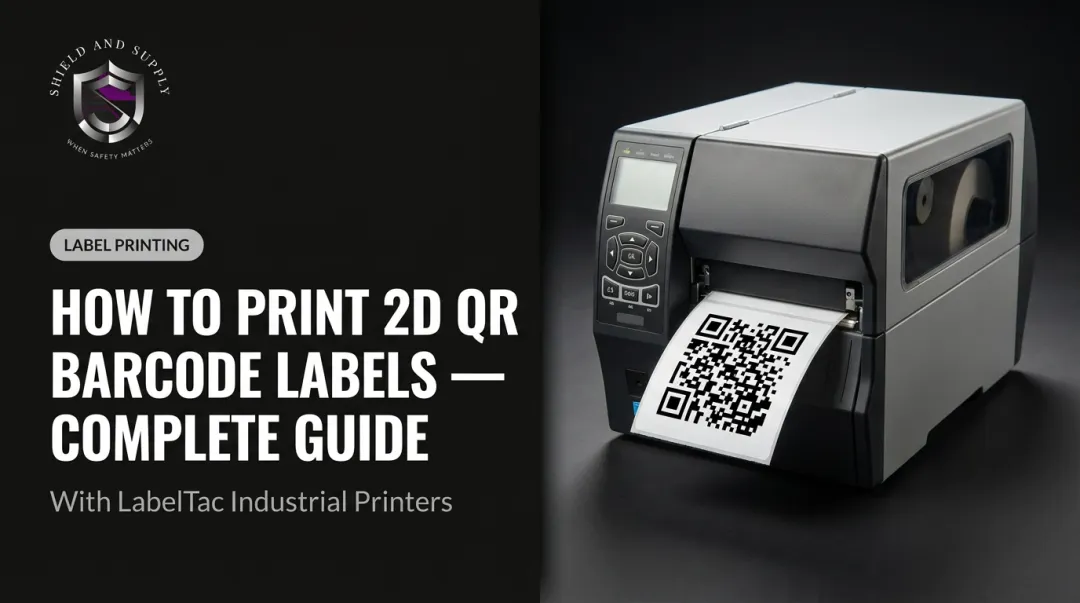
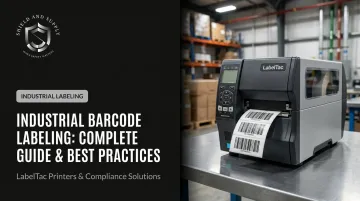
The problem is usually not the barcode design — it's that the wrong material, print method, or symbology was chosen for the environment. A label that works fine in a warehouse office fails fast on the production floor.
This guide covers everything industrial facility managers need to get it right: how to match symbologies to data requirements, select materials for specific environments, print durable labels, and maintain a barcode system that holds up under real industrial conditions.
TL;DR
- Industrial barcode labels must survive heat, chemicals, abrasion, and UV while remaining scannable — standard paper labels fail in these conditions
- Code 128 and GS1-128 dominate supply-chain labeling; Data Matrix handles small-part traceability where space is tight
- Polyester (PET) is the most durable face stock for harsh environments; match adhesive to the actual substrate, not just general guidance
- Thermal transfer printing with a resin ribbon is the industrial standard — direct thermal fades and fails in demanding conditions
- Verify print quality with ISO grading before deployment, then inspect labels periodically throughout their service life
What Are Industrial Barcode Labels?
Industrial barcode labels combine three layers: encoded data, a barcode symbology, and a physical label construction engineered for the operating environment. GS1 defines barcodes as symbols scanned by proper systems and used across supply chains. In industrial settings, the physical label must survive conditions that would destroy a standard retail label within days.
Every barcode label shares four core components:
- Bars or modules — the encoded pattern the scanner reads
- Quiet zones — mandatory blank margins on each side; cover them and the label fails
- Check digits — mathematical validation built into the symbology
- Human-readable text — the decoded data printed beneath the barcode for manual verification
What Sets Industrial Labels Apart
Standard paper labels work in offices and retail because conditions are controlled. Industrial environments are not. The differences show up in material, adhesive, print method, and tested durability:
- Engineered face stocks — polyester, polypropylene, and vinyl instead of paper
- Aggressive adhesives — formulated for metal, powder-coat, low-surface-energy plastics, and rubber
- Durable print methods — thermal transfer with resin ribbons instead of inkjet or direct thermal
- Tested resistance — to solvents, heat, abrasion, salt fog, and UV
Industrial barcode labels also carry an operational function that retail labels don't. They connect physical assets and inventory to ERP, WMS, and CMMS platforms. In manufacturing or regulated supply chains, a failed label doesn't just cause a missed scan — it breaks traceability entirely.
Types of Industrial Barcode Labels: 1D vs. 2D Symbologies
The fundamental split is how each type stores data. 1D (linear) barcodes encode data in the width and spacing of parallel bars — fast to scan with laser scanners, but limited in data capacity. 2D (matrix) barcodes store data in a two-dimensional pattern of dots or squares, carrying far more information in a smaller footprint — but requiring imaging scanners to read.
Industrial operations often use both, depending on the workflow.
Key 1D Symbologies for Industrial Use
Code 128 / GS1-128 is the dominant choice for industrial and supply-chain labeling. It supports full ASCII encoding and can carry structured data attributes — lot numbers, serial numbers, dates, and more. GS1-128 encodes GS1 Application Identifiers and can carry up to 48 characters of attribute data, making it the standard for warehouse bin labels, shipping labels, and any label that must travel through trading partners.
For automotive part IDs, tool tracking, and DoD-compliant labels, Code 39 remains the legacy workhorse. ISO/IEC 16388:2023 specifies its characteristics and decoding parameters, and its near-universal scanner compatibility makes it a safe choice for customer-mandated or government applications. Lower data density than Code 128, but extremely well-supported.
ITF-14 handles one job — numeric case and carton identification. GS1 US identifies ITF-14 as optimized for product identification of cases — it's not the right tool for variable lot or serial data, but it's the standard for GTIN identification on corrugated packaging.
Key 2D Symbologies for Industrial Use
Data Matrix is the go-to for high-density part traceability. Its L-shaped finder pattern and Reed-Solomon error correction allow the symbol to be reconstructed even when part of the label is damaged — critical for small parts, PCBs, and automotive components where space is tight.
MIL-STD-130 (U.S. military item marking) and AIAG automotive part marking standards both reference Data Matrix for durable item identification.
QR codes take a different role in industrial settings. With higher data capacity and multi-mode encoding, QR codes work well when a label needs to connect physical equipment to maintenance records, inspection logs, or digital manuals. Maintenance teams can scan them with smartphones — no dedicated scanner required. Where the smallest possible mark is the priority, Data Matrix wins; where linking people to information matters, QR is the practical choice.
One critical hardware note: 2D codes require imaging scanners. Legacy laser scanners cannot read Data Matrix or QR. Cognex and Zebra both position their industrial imaging readers explicitly for 1D and 2D code reading. If your facility runs laser-only scanners, account for a hardware upgrade before specifying 2D symbologies.
Choosing the Right Industrial Label Material
Material selection is where most industrial barcode programs fail. A well-designed barcode on the wrong substrate will degrade in weeks. The right approach is a matching exercise: environment first, then surface type, then label construction.
Common Industrial Face Stocks
| Material | Durability Level | Key Strengths | Best Applications |
|---|---|---|---|
| Polyester (PET) | Highest | Heat, chemical, abrasion resistance | Metal surfaces, outdoor use, high-temp environments |
| Vinyl | Mid-range | Flexible, conformable, weatherproof | Curved surfaces, pipes, irregular shapes |
| Polypropylene (PP) | Mid-range | Moisture and chemical resistance | General warehouse, light manufacturing |
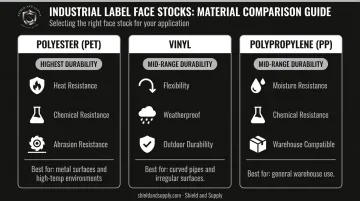
Brady's B-423 polyester stock — tested and published in 2022 — demonstrates PET's upper performance range: no visible degradation after 30 days at 95% relative humidity and salt fog exposure, barcode legibility maintained after 100 Taber abrasion cycles, and resistance to isopropyl alcohol, mineral spirits, and JP-8 jet fuel. Acetone and toluene can degrade the print/topcoat under rubbing, which reinforces the need to test against the actual chemicals present in the facility.
For facilities that print labels in-house, vinyl and polyester stocks compatible with LabelTac® printers — including those available from Shield and Supply — are rated for 5–10 years of indoor/outdoor service, with scratch and chemical resistance built into the face stock construction.
Adhesive Selection
The face stock gets most of the attention, but adhesive failure is just as damaging. Edge lift blocks quiet zones and kills scan performance. Match the adhesive to the actual surface:
- Permanent aggressive adhesives — for clean metal and standard painted surfaces
- High-tack adhesives (e.g., Avery Dennison S2060) — for low-surface-energy plastics like PE and PP
- Rough-surface adhesives (e.g., S8049) — for contaminated or textured substrates
- Specialty adhesives (e.g., DS128) — for powder-coated and enamel-painted metals
- Low-temperature adhesives — for cold-chain and freezer environments
Test adhesives after dwell time on the actual substrate — not on a representative sample. Powder coat formulations vary, and what holds on one brand won't necessarily hold on another.
Matching Materials to Conditions
| Environment | Face Stock | Adhesive | Additional Protection |
|---|---|---|---|
| High heat (ovens, foundries) | Polyester | Acrylic permanent | Resin ribbon required |
| Chemical exposure (solvents, oils) | Polyester or laminated vinyl | Match to substrate | Consider overlaminate |
| Outdoor / UV exposure | UV-stable vinyl or polyester | Aggressive permanent | UV-resistant overlaminate |
| Cold chain / freezer | Vinyl or PP | Low-temp adhesive | — |
| Curved/irregular surfaces | Vinyl | Conformable aggressive | — |
Overlaminates — clear polyester or polypropylene films applied over the printed label — extend service life by shielding barcodes from abrasion, chemical splash, and handling. A 1.0 mil polyester overlaminate (like Brady B-674) adds a meaningful durability layer for labels in high-contact or chemical-adjacent locations.
Printing Industrial Barcode Labels: Methods, Equipment, and Software
Thermal Transfer Is the Industrial Standard
Thermal transfer printing uses a heated printhead to melt resin or wax-resin ink from a ribbon onto the face stock. The result is a sharp, high-contrast barcode that resists smearing, moisture, and chemicals — far beyond what direct thermal (heat-sensitive paper) can deliver. Direct thermal output fades with heat and UV exposure; it's unsuitable for any label expected to last more than a few weeks in an industrial environment.
Ribbon selection determines durability:
- Wax ribbons offer the lowest cost but minimal durability — only appropriate where abrasion and chemical exposure are not a concern
- Wax-resin ribbons hit the mid-range sweet spot, handling general warehouse and handling environments well
- Full-resin ribbons provide maximum resistance to chemicals, heat, and abrasion; required for polyester labels in demanding applications
Mismatching ribbon to face stock is a common cause of barcode smearing. Resin ribbon on polyester is the industrial-standard combination for demanding applications.
Industrial Label Printers
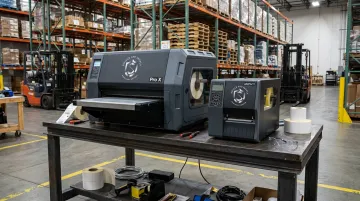
Shield and Supply's LabelTac® Pro X ($1,299.99) handles media from ½" to 4" wide at 300 DPI, with built-in Ethernet and a rugged industrial chassis suited for manufacturing floors, MRO labeling, asset tagging, and production line identification. The LabelTac® 9 ($3,999.00) scales up to 9"-wide media with throughput of up to 2,500 labels per day — the right choice for high-volume warehouse or distribution environments. Both printers carry a Full Lifetime Warranty covering all parts and labor, and both ship with LabelSuite™ software included.
Label Design and Software
The right hardware only gets you so far — software drives barcode accuracy. LabelSuite™ comes included with both LabelTac® models and supports a full range of symbologies and production features:
- Code 39, Code 128, GS1, ITF, Data Matrix, and QR code formats
- Variable data printing and serialization for batch label runs
- CSV and Excel import for automated generation from ERP or WMS data
- Built-in validation that eliminates manual re-entry, a common source of encoding errors
Print resolution matters for small 2D codes. Both LabelTac® models print at 300 DPI, which supports Data Matrix codes for most part-marking applications. When module size requirements are unusually small, verify minimum feature dimensions against the printer spec before finalizing a label design.
Industrial Barcode Labeling Best Practices
Label Placement
- Test labels on curved, recessed, or irregular surfaces for scanner line-of-sight before finalizing placement
- Never cover, trim, or encroach on quiet zones — the blank margins are part of the symbology specification, not wasted space
- Avoid placement near edges or corners where abrasion from handling or transport is highest
- For labels on pipes or cylindrical surfaces, confirm the scanner angle accommodates the curvature
Barcode Verification
Scanning a label and getting a beep is not verification. ISO/IEC 15416:2016 specifies measurement methodology for linear barcode print quality, evaluating parameters like contrast, modulation, and edge definition. GS1's 2D verification guideline grades print quality against ISO/IEC 15415 on a 4-to-0 scale.
For serialized labels or any label entering a regulated supply chain, require formal ISO grading before deployment — not just a successful test scan. Skipping this step risks scan failures and relabeling campaigns that are far more disruptive than the verification process itself.
Ongoing Maintenance
Even verified labels degrade. Build these checks into facility routines to catch problems before they cause scan failures:
- Inspect labels periodically for edge lift, chemical degradation, or abrasion damage
- Establish a replacement schedule for high-wear locations (forklift paths, high-traffic pick faces)
- Test scanner performance at the actual distances and angles used in the facility — not bench conditions
- Replace degrading labels before they cause scan failures, not after
Frequently Asked Questions
What is the industry standard barcode format?
There's no single universal standard. Code 128 and GS1-128 are the most widely used in industrial and supply-chain environments. GS1 standards (including Data Matrix) govern pharmaceutical and food supply chains, while internal standards drive most manufacturing and warehouse operations. The right format is determined by what trading partners, customers, or regulatory bodies require.
What are the main types of barcode labels?
1D (linear) barcodes like Code 128 and ITF are fast to scan and widely compatible but hold limited data. 2D (matrix) barcodes like Data Matrix and QR codes store more in less space, include error correction for damaged labels, and require imaging scanners.
What is the difference between a SKU and a barcode?
A SKU is an internal company-specific identifier used for inventory classification. A barcode is the machine-readable physical representation of an identifier — which could be a SKU, serial number, or standardized GS1 code. Many facilities use both: SKUs for internal organization, barcodes for scanning and supply chain tracking.
What label material is best for industrial environments?
Polyester (PET) is the strongest general-purpose choice — it resists heat, chemicals, and abrasion, particularly when printed with a resin ribbon. The best material depends on the specific surface, temperature range, and chemical exposure present. Always validate using manufacturer test data, not generic claims.
What is the difference between thermal transfer and direct thermal printing?
Thermal transfer uses a ribbon to bond durable ink to the label surface, resisting chemicals, heat, and abrasion — the standard for industrial use. Direct thermal requires no ribbon but uses heat-sensitive media that fades over time and isn't suited for harsh conditions.
How do I keep barcode labels readable in harsh conditions?
Three practices make the biggest difference:
- Match face stock to exposure type (PET for heat/chemicals, UV-stable for outdoor)
- Use resin ribbon with thermal transfer printing for maximum durability
- Verify print quality with ISO grading before deployment, and replace labels showing edge lift or print degradation promptly