Introduction
According to data cited by NFPA, arc flash incidents cause an estimated 7,000 burns, 2,000 hospitalizations, and 400 deaths in U.S. workplaces each year. Each incident unfolds in milliseconds, leaving no time for reaction.
Workers approaching unlabeled or mislabeled electrical equipment have no way to know required PPE, safe approach distances, or incident energy levels. That knowledge gap is the core safety problem.
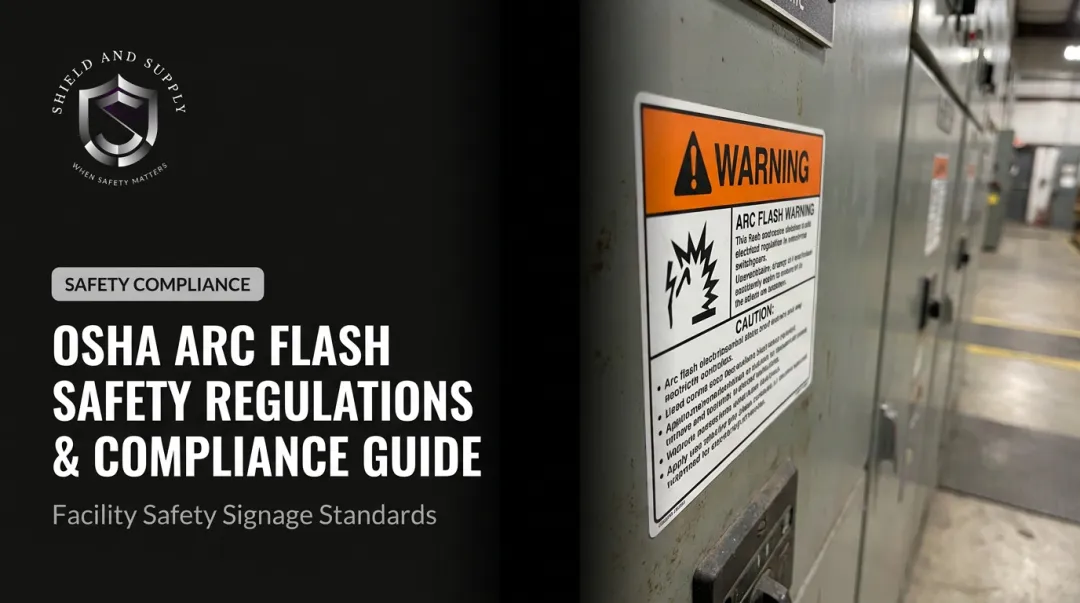
The legal exposure runs parallel. Employers who skip arc flash labels don't just create hazards — they invite enforcement action, even though OSHA has no regulation that specifically says "you must have arc flash labels."
That distinction is widely misunderstood — and it shapes every labeling decision a safety manager makes. What follows breaks down what OSHA actually requires, what a compliant arc flash label must include, and how to stay protected and inspection-ready through the 2026 NEC cycle.
TL;DR
- OSHA has no dedicated arc flash label standard — enforcement relies on the General Duty Clause and regulations 29 CFR 1910.303(e), 1910.335(b), and 1910.132(d)(1)
- NFPA 70E defines required label content — OSHA treats it as the benchmark for a compliant electrical safety program
- Compliant labels must include nominal system voltage, arc flash boundary, and either incident energy/working distance or PPE category
- NEC 2026 adds a mandatory assessment date requirement and removes the prior 1,000A threshold
- Getting the content right is only part of the job — durability, placement accuracy, and updates after system changes matter just as much
Understanding OSHA's Role in Arc Flash Labeling
OSHA is a federal enforcement agency that creates binding law. NFPA is a standards-developing organization whose guidelines are voluntary consensus standards. OSHA has never formally incorporated NFPA 70E into its regulations — meaning an inspector cannot write a citation for "Violation of NFPA 70E Article 130.5(H)" directly.
That distinction matters in practice: facilities that treat NFPA 70E compliance as optional can still face OSHA citations — just through different regulatory pathways.
OSHA's 2006 Letter of Interpretation (Foulke, November 14, 2006) confirmed there is no specific OSHA arc flash labeling requirement — but also affirmed that NFPA 70E is a recognized industry practice that OSHA uses as a benchmark. The agency's own guidance publication, Protecting Employees from Electric-Arc Flash Hazards (OSHA 4472), states clearly that OSHA's standards follow NFPA 70E, even though NFPA 70E hasn't been incorporated by reference.
NFPA 70E compliance is voluntary. Eliminating arc flash hazards is a legal obligation under federal law, regardless of which standard you use to get there.
How OSHA Enforces Arc Flash Hazards Without Citing NFPA 70E
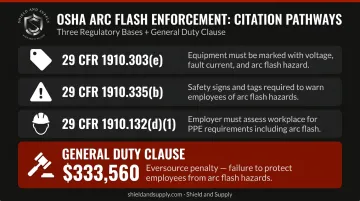
OSHA's performance-based standards give inspectors multiple citation pathways for the underlying hazards that arc flash labels are designed to address:
- 29 CFR 1910.303(e) — covers equipment marking: voltage, current, wattage, and other necessary ratings must be present, with markings durable enough for the operating environment
- 29 CFR 1910.335(b) — mandates alerting techniques — safety signs and symbols — to warn employees about electrical hazards including arc flash
- 29 CFR 1910.132(d)(1) — requires employers to assess the workplace for hazards and select appropriate PPE; a missing arc flash label is direct evidence this assessment was never communicated to workers
The most powerful tool is the General Duty Clause (Section 5(a)(1)), which requires employers to provide a workplace free from recognized hazards. In a real 2022 enforcement case, OSHA cited Eversource Energy Service Company following a fatal arc flash in Boston, issuing willful violations totaling $333,560. One willful citation specifically alleged the employer failed to make a "reasonable estimate of the incident heat energy" to which workers were exposed — the core output of any arc flash program.
NEC 2026 adds another layer to this enforcement picture. Starting with Section 110.16, permanent arc flash labels become mandatory on specific equipment — giving inspectors in jurisdictions that adopt this code cycle a more direct citation path than the General Duty Clause alone.
What Must Appear on an Arc Flash Label
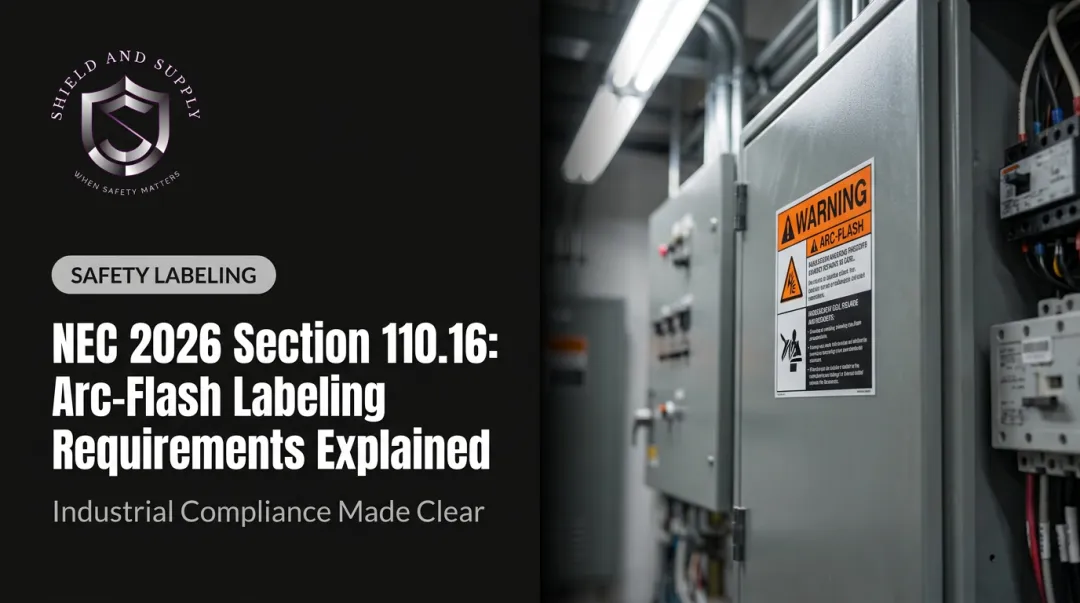
NFPA 70E Section 130.5(H) is the practical guide for label content. It applies to nonresidential equipment likely to require examination, adjustment, servicing, or maintenance while energized — specifically switchboards, panelboards, industrial control panels, meter socket enclosures, and motor control centers.
Required Label Elements per NFPA 70E and NEC 2026
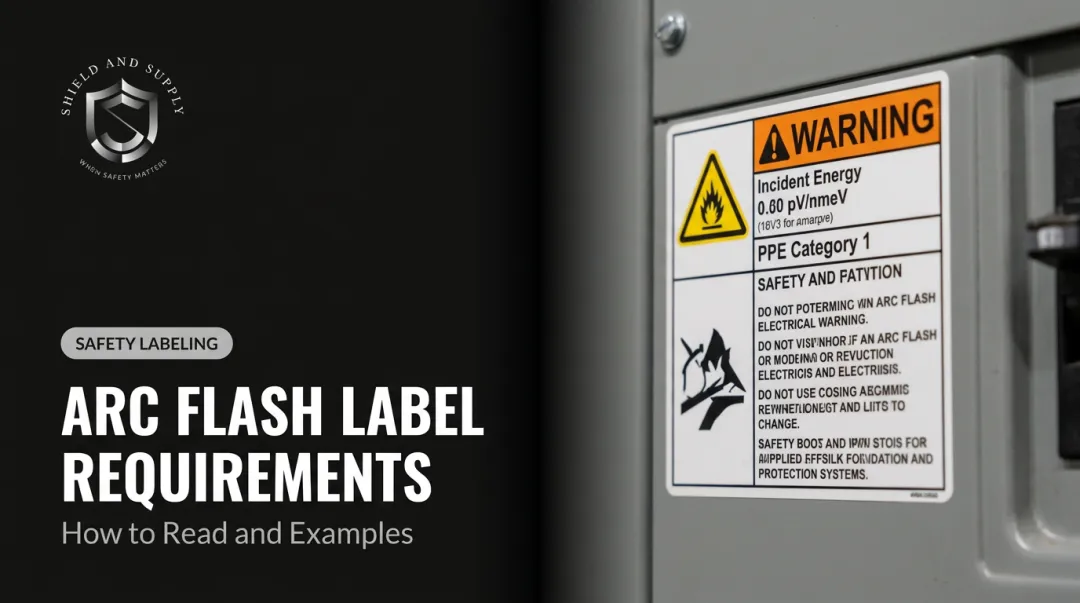
A compliant label must include all of the following:
| Element | What It Means |
|---|---|
| Nominal System Voltage | The voltage rating of the system |
| Arc Flash Boundary | Distance at which incident energy equals 1.2 cal/cm² — the threshold for a second-degree burn |
| Available Incident Energy + Working Distance or Arc Flash PPE Category | One or the other — not both on the same label |
| Minimum Arc Rating of Clothing | The cal/cm² rating required for FR clothing |
| Site-Specific PPE Level | The full PPE ensemble required for the task |
| Assessment Date (NEC 2026 addition) | The date the arc flash assessment was completed |
Generic pre-printed "DANGER: Arc Flash Hazard" stickers don't meet this standard. They cannot convey actual hazard levels, incident energy, or required PPE. Labels must come from a site-specific assessment — every piece of equipment is different.
Two Methods for Determining Label Data
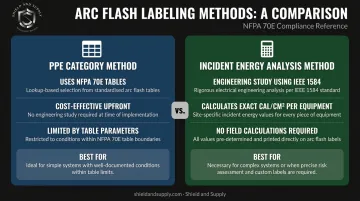
PPE Category Method (Tables Method) Workers use NFPA 70E tables to identify the required PPE category for a specific task. It's cost-effective upfront, but workers must verify parameters like maximum available fault current and upstream protective device clearing time on-site. If system parameters fall outside the table limits, this method can't be used.
Incident Energy Analysis Method (Arc Flash Study) An engineering analysis — performed with specialized software using IEEE 1584 methodology — calculates exact incident energy in cal/cm² at each piece of equipment. Results are printed directly on the label, so workers simply match their PPE arc rating to the printed value. No field calculations required.
This method requires more upfront investment but produces more accurate labels. For industrial facilities with complex power systems, it's the stronger choice.
Arc Flash Label Best Practices
Label Placement and Visibility
Per NFPA 70E requirements, labels must be positioned so they are clearly visible to a qualified person before they examine, adjust, service, or maintain the equipment.
The standard practice: mount the label on the outside face of the panel door or enclosure cover, at approximately eye level. Labels placed inside panel doors, behind conduit runs, or on the back of equipment fail the visibility requirement. Workers encounter the hazard before they can read the warning. OSHA's alerting technique requirements under 29 CFR 1910.335(b) specifically require warnings to be seen before the hazard is encountered.
Label Durability and Material Requirements
Arc flash labels must survive the industrial environments they're installed in: heat, UV exposure, moisture, cleaning chemicals, and physical contact can all degrade the substrate and printed information over time. NEC 2026 specifically requires labels to be permanent, not temporary tags or paper printouts.
For facilities that print labels in-house, the LabelTac® Pro X from Shield and Supply handles this application directly. It prints NFPA 70E arc flash labels on industrial-grade vinyl rated for 5–10 years of indoor or outdoor use. Key material and software specs include:
- Print resolution: 300 DPI for clear, readable output
- Substrate: Chemical-resistant, scratch-resistant, and UV-stable vinyl
- Pre-built templates: NFPA 70E arc flash layouts in LabelSuite™ software
- Template fields: Incident energy, arc flash boundary, working distance, PPE category, and glove rating
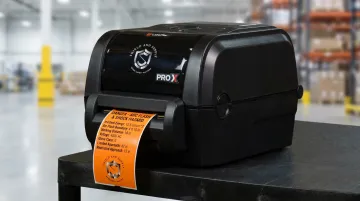
Facilities produce site-specific, compliance-ready labels on demand, with no outsourcing required.
Keeping Labels Current
Arc flash labels are not a one-time installation. NFPA 70E requires arc flash risk assessments to be reviewed at intervals not exceeding five years, and updated any time changes in the electrical distribution system render existing labels inaccurate.
Common triggers for label updates:
- New transformer or additional electrical equipment installed
- Protective device settings changed
- Utility service upgraded
- Fault current levels modified
When any of these changes occur, previously accurate labels may now understate the actual hazard. Workers who rely on outdated labels to select PPE may be dangerously underprotected. Documenting the assessment date on every label — a requirement added in NEC 2026 — makes it straightforward to identify which labels need review during inspections or after system changes.
Common Arc Flash Labeling Mistakes to Avoid
Three compliance failures appear more often than any others in real facility audits:
Generic labels with no site-specific data. A label reading "DANGER: Arc Flash Hazard" with no incident energy value, boundary distance, or PPE requirement gives workers nothing actionable. It doesn't satisfy NFPA 70E, it won't satisfy NEC 2026, and it provides no real protection. This is the most widespread compliance gap in the field — and the easiest to fix with an in-house printing solution.
Outdated labels after system changes. Adding a transformer or upgrading service changes incident energy levels throughout the system. Existing labels become inaccurate immediately, and workers may select PPE rated for a lower hazard than what actually exists. Arc flash labeling is an ongoing program management responsibility, not a one-time project at initial installation.
Labels placed where workers can't see them. Labels inside panel doors are only visible after opening a potentially energized enclosure. Labels behind conduit or on equipment backs may never be seen at all. Both scenarios put workers in front of the hazard before they receive any warning, which is exactly what 29 CFR 1910.335(b) is designed to prevent.
Conclusion
Arc flash label compliance isn't just about avoiding citations. It's the output of a complete electrical safety process: hazard assessment, incident energy analysis, and PPE selection. Together, these steps determine whether a worker has the right protection before touching energized equipment. The label is the last line of communication between the safety program and the worker in the field.
Treat arc flash labeling as a living program: assess the system, print accurate, site-specific labels, train workers to read and act on them, and update when anything changes.
Keeping labels current gets easier when you can produce them in-house. Shield and Supply's LabelSuite™ software simplifies the design of compliant arc flash labels, and LabelTac® printers let facilities generate durable, NFPA 70E-formatted labels on demand — no waiting on outside vendors when systems change or new equipment arrives.
Frequently Asked Questions
What are the 6 required OSHA arc flash label elements?
OSHA itself does not specify six label elements — that structure comes from NFPA 70E and NEC 2026 together. The six required elements are: nominal system voltage, arc flash boundary, available incident energy with working distance or arc flash PPE category (not both), minimum arc rating of clothing, site-specific PPE level, and (per NEC 2026) the date of the most recent arc flash assessment.
What does NFPA 70E provide for arc flash labels?
NFPA 70E is the voluntary consensus standard that defines arc flash label content. It specifies which data must appear on the label, establishes the two labeling methods (PPE Category Method and Incident Energy Analysis Method) for generating that data, and identifies which equipment types must be labeled.
Can OSHA cite you for not having an arc flash label?
Yes, though not by citing NFPA 70E directly. OSHA uses 29 CFR 1910.303(e), 1910.335(b), 1910.132(d)(1), and the General Duty Clause to cite employers for failing to warn and protect workers from arc flash hazards. The 2022 Eversource case resulted in willful violation penalties exceeding $333,000.
How often should arc flash labels be updated?
NFPA 70E requires arc flash risk assessments (and therefore labels) to be reviewed at a maximum interval of five years, and updated any time system changes make existing labels inaccurate. NEC 2026 requires the assessment date to appear on every label, making outdated labels immediately identifiable during inspections.
Where on equipment should an arc flash label be placed?
Labels must be clearly visible to a qualified worker before they service or maintain the equipment — placed on the outside face of the panel door or enclosure at eye level. Labels placed inside doors or in obscured locations do not satisfy NFPA 70E or OSHA's alerting technique requirements under 29 CFR 1910.335(b).
What is the difference between the PPE Category Method and the Incident Energy Analysis Method?
The PPE Category Method uses NFPA 70E lookup tables to assign protection levels by equipment type and task, but cannot be used when site conditions fall outside the table limits. The Incident Energy Analysis Method is an engineering study that calculates incident energy in cal/cm² for each piece of equipment, producing label data without requiring field calculations by workers.