They won't. Power failures, fires, and grid disruptions happen. And when they do, the facilities most exposed are the ones that built their entire safety signage strategy around electricity.
Photoluminescent safety signs are often treated as an afterthought — a low-priority line item that gets cut or deferred. That's a mistake. Their value doesn't show up on a normal Tuesday. It shows up in the first 90 seconds of a power failure, when smoke fills a corridor and a worker is trying to find the exit.
This article covers what photoluminescent signs are, three operational advantages they deliver, and the specific risks that come with ignoring them.
TL;DR
- Photoluminescent signs absorb ambient light and glow in the dark — no batteries, no wiring, no power required
- Code minimums require 90-minute luminance performance; quality products exceed this significantly
- They draw 0 watts — eliminating the ongoing energy costs of electric exit signs (~$28/year per incandescent sign)
- Compliant photoluminescent signs satisfy OSHA 29 CFR 1910.37, IBC/IFC, and NFPA 101 requirements
- Skipping them means relying entirely on powered systems during the exact events those systems are most likely to fail
What Is a Photoluminescent Safety Sign?
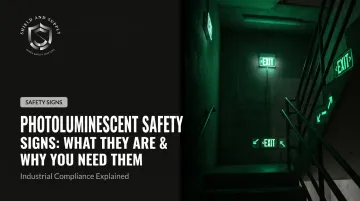
A photoluminescent safety sign is made from a phosphorescent material — typically a strontium aluminate compound — that absorbs ambient light during normal operations and re-emits it as a visible glow when surrounding light is removed. No batteries. No wiring. No power source of any kind.
Doped strontium aluminate (such as SrAl₂O₄:Eu²⁺,Dy³⁺) ranks among the brightest persistent luminescence materials available, storing light energy and releasing it gradually as an afterglow after excitation. ASTM E2072-24 is the governing standard specification for these materials in safety markings used to identify escape routes under blackout conditions.
Where These Signs Are Used
That combination of self-powered glow and regulatory backing makes these signs applicable across a wide range of industrial and commercial locations:
- Exit route identification and egress path marking
- Stairwell step edges, handrails, and door frames
- Fire extinguisher and fire hose locations
- Hazard markers and assembly points
- Underground or windowless areas without reliable backup lighting
Under IBC/IFC Section 1025, luminous egress path markings are required in high-rise buildings across several occupancy groups (A, B, E, I, M, and R-1). Required components include step edge stripes 1–2 inches wide, handrail stripes at least 1 inch wide, and low-location exit symbols on egress doors positioned no more than 18 inches above the finished floor.
These signs are a failsafe layer, not a replacement for other signage. They exist specifically for the conditions — power failure, smoke, disorientation — where electric systems are most likely to be compromised.
Key Advantages of Photoluminescent Safety Signs
The advantages below aren't theoretical. Each one has a direct effect on safety outcomes, cost management, or compliance standing in facilities where emergencies are a real operational risk.
Always-On Reliability When It Matters Most
Photoluminescent signs cannot be switched off, unplugged, or knocked offline by a power failure. They activate automatically the moment surrounding light drops — no human intervention, no electrical trigger, no backup battery that may or may not be charged.
During normal operations, the signs are passively absorbing light. The moment an outage occurs, they're already functional.
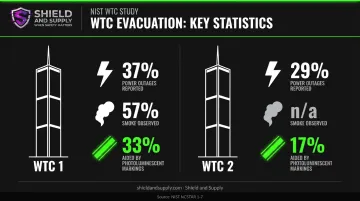
The evidence for why this matters comes from NIST's investigation of the World Trade Center evacuations. NIST NCSTAR 1-7 documented that 37% of WTC 1 survivors and 29% of WTC 2 survivors reported power outages or flickering lights during the evacuation. Smoke was observed by 57% of WTC 1 evacuees.
In that same evacuation, 33% of WTC 1 survivors and 17% of WTC 2 survivors identified photoluminescent markings as an aid — markings installed on handrails, stair treads, and stair centerlines after the 1993 bombing.
Documented survivor evidence from one of the most analyzed evacuations in history.
This matters most for:
- Facilities with complex floor plans or multiple levels
- Underground or windowless spaces
- Manufacturing plants, warehouses, and oil and gas environments prone to smoke or power disruption
- Large workforces where evacuation coordination is difficult
Facilities that rely solely on electric exit signs carry a single point of failure — precisely during the events where failure is most costly.
Significantly Lower Total Cost of Ownership
Photoluminescent signs draw 0 watts of electricity. That's not a rounding error — it's a genuine $0 line item on the energy cost side of the ledger.
For context, ENERGY STAR's LED exit sign tech sheet documents older incandescent exit signs at 30–40 watts with approximately $28/year in operating costs per sign. Photoluminescent signs are listed at 0 W direct energy in the same federal decision framework. Across a facility with 100 signs, that's a meaningful annual difference — and it compounds every year the signs are in service.
The cost picture looks even better across a full lifecycle:
| Cost Factor | Electric (Incandescent) | Photoluminescent |
|---|---|---|
| Annual energy cost per sign | ~$28 | $0 |
| Bulb/lamp replacement | Frequent (incandescent lamps: ~2.8 months) | None |
| Battery backup systems | Required | Not required |
| Wiring and installation | Required | Minimal |
| Maintenance labor | Ongoing | Near-zero |
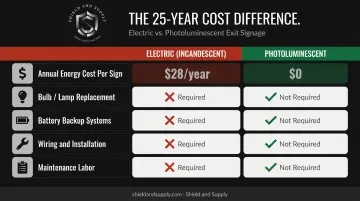
Vendor and manufacturer documentation supports lifespan claims of 20–25 years for quality photoluminescent signs — verify specific ratings against product documentation before purchasing. The upfront cost is generally comparable to electric alternatives, making the lifecycle ROI case clear for any facility with a significant sign count.
When this advantage matters most: Facilities with high sign counts, operations under budget pressure to reduce maintenance overhead, and facilities in the middle of safety upgrades where lifecycle cost matters more than lowest-possible unit price.
Compliance Without Complexity
Photoluminescent signs — when properly specified and installed — satisfy the same code requirements as electric signage, without the installation complexity of hardwired systems.
The key standards that apply:
- OSHA 29 CFR 1910.37 requires exit routes to be adequately lit, exits marked "Exit," and directional signs placed where travel isn't obvious. Self-luminous signs are explicitly permitted at a minimum of 0.06 footlamberts (0.21 cd/m²), and exit letters must be at least 6 inches high with principal strokes ¾ inch wide
- IBC/IFC Section 1025 governs luminous egress path markings in high-rise buildings and requires photoluminescent exit signs to be listed and labeled under UL 924, with luminous materials complying with UL 1994 or ASTM E2072
- NFPA 101 (2024 edition) is the active Life Safety Code standard and requires visual inspection of exit markings at intervals not exceeding 30 days
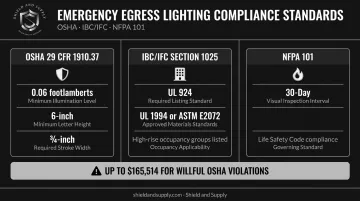
The compliance threshold for luminance performance under ICC Section 1025 is: charged at 1 footcandle of fluorescent light for 60 minutes, signs must reach 30 mcd/m² at 10 minutes and maintain 5 mcd/m² after 90 minutes in darkness. That's the code floor — many quality products significantly exceed it.
Photoluminescent signs also reduce inspection complexity. There's no wiring to test, no backup battery that can fail an audit, and no electrical components requiring certification. For facilities with large sign inventories, fewer inspection points per sign means less audit preparation time and fewer compliance gaps.
OSHA penalties for egress-related violations are real exposure: violations assessed after January 15, 2025 carry up to $16,550 per Serious or Other-Than-Serious violation, and up to $165,514 for Willful or Repeated violations.
Shield and Supply carries OSHA-compliant photoluminescent safety signs — including exit and egress signage and fire equipment identification signs — built to OSHA 29 CFR 1910.37 and NFPA 101 standards, simplifying selection for facilities that need to meet code without navigating complex spec sheets.
What Happens When Photoluminescent Signs Are Missing
Without photoluminescent markings, a power failure leaves occupants with three options: memory, phone flashlights, and whatever emergency lighting wasn't knocked out by the same event that cut the power.
The NIST WTC investigation puts a real face on that risk. After WTC 2 collapsed, the concourse and lower stairwells of WTC 1 filled with debris and smoke, and the lights went out. Remaining occupants navigated in near-total darkness. Where photoluminescent markings had been installed, they were noticed and used. Where they weren't, there was nothing.
Beyond the immediate safety risk, there are two other consequences:
- Facilities without compliant egress marking face OSHA fines and failed inspections. If an evacuation incident occurs in an area that lacked required signage, liability exposure compounds significantly.
- Skipping photoluminescent signs to cut upfront costs results in higher cumulative costs — repeated inspections, compliance remediation, and reactive replacement of failed electric components all add up faster than the signs would have.
How to Get the Most Value from Your Photoluminescent Signs
Installation quality determines whether individual signs perform as advertised or underperform from day one.
Placement and charging:
- Signs must receive consistent ambient light to maintain full charge — position near natural light sources or overhead fluorescent fixtures
- Signs placed in low-light areas or behind obstructions will have reduced glow duration and luminance
- Avoid mounting in locations that are routinely blocked by equipment, shelving, or stored materials
Coverage consistency:
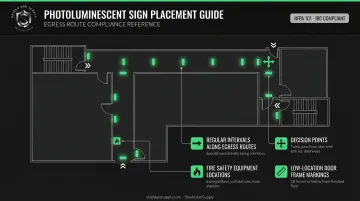
Signs installed at isolated points don't create a reliable evacuation system. What does:
- Regular intervals along all egress routes
- Every decision point: turns, corridor junctions, stairwell entries, doorways
- All key safety equipment locations (fire extinguishers, pull stations, hose stations)
- Low-location marking at door frames, 18 inches or below, where smoke accumulates last
Ongoing maintenance:
Getting placement right is only half the equation — keeping signs in working condition is what sustains a compliant system over time.
- NFPA 101 requires visual inspection at intervals not exceeding 30 days — build this into your regular safety walk routine
- Inspect for physical damage, obstructions, and signs that have been repositioned away from ambient light sources
- Replace any sign that shows visible degradation of the photoluminescent surface
Shield and Supply carries industrial-grade photoluminescent safety signs with same-day order processing and nationwide shipping, so facilities can source, spec, and deploy a complete compliant signage system without waiting on back-orders or long lead times.
Conclusion
Photoluminescent safety signs earn their keep in the 90 seconds after the lights go out — when a worker is disoriented, smoke is filling a corridor, and the only thing guiding them toward an exit is the faint green glow they barely noticed during last month's safety walk.
The operational case is clear: zero electricity draw, lower lifecycle cost than electric alternatives, and simplified compliance with OSHA, IBC, and NFPA requirements. Those advantages compound over time and across a facility with dozens or hundreds of signs.
Treat these signs as an ongoing safety practice, not a one-time purchase. Correct placement, adequate ambient light exposure, and monthly visual inspection are what keep the system reliable year after year — so that when an emergency does happen, your exit path is lit and your workers know exactly where to go.
Frequently Asked Questions
What is the meaning of photoluminescent signs?
Photoluminescent signs are made from a phosphorescent material that absorbs and stores ambient light during normal conditions, then releases it as a visible glow when surrounding light is removed. They function as self-powered emergency guidance tools that require no electricity, batteries, or wiring.
What are the requirements for a photoluminescent exit sign?
In the US, photoluminescent exit signs must comply with OSHA 29 CFR 1910.37 (exit route marking visibility), be listed under UL 924, and meet luminance performance standards in ASTM E2072 or UL 1994. They must also be installed near sufficient ambient light — at least 1 footcandle for 60 minutes — to maintain proper charging per ICC Section 1025.
Is photoluminescence safe?
Yes. Strontium aluminate, the primary compound used in photoluminescent safety signs, is classified as non-hazardous under the OSHA Hazard Communication Standard. These signs work purely through light absorption and emission — unlike tritium exit signs, which contain radioactive gas and are regulated by the NRC.
How long do photoluminescent safety signs glow in the dark?
Code minimums require signs to maintain 5 mcd/m² after 90 minutes of darkness following a 60-minute charge at 1 footcandle. Quality products exceed this threshold significantly — some manufacturer documentation cites glow durations well beyond 90 minutes under full charge conditions.
Can photoluminescent signs replace traditional electric exit signs?
Yes. Properly specified and installed photoluminescent signs are code-compliant alternatives to electric signs under OSHA, IBC, and NFPA 101, provided they meet UL 924 listing requirements and are placed near adequate ambient light sources. They eliminate wiring and battery backup maintenance while meeting the same egress marking performance requirements.
What environments are photoluminescent safety signs best suited for?
These signs are particularly valuable in manufacturing plants, warehouses, underground spaces, marine and offshore environments, and facilities prone to power failures or smoke — anywhere evacuation guidance must remain functional independent of the electrical system.