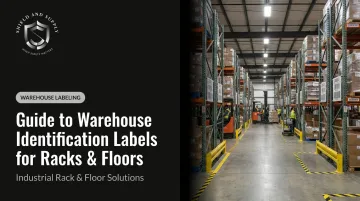
The core problem isn't usually a lack of labels. It's poor labeling: inconsistent naming conventions, worn floor markings, rack labels that peel in cold storage, or no system connecting physical locations to the WMS. Those gaps compound quickly.
This guide covers the main types of warehouse identification labels, what rack and floor labels each require, how to select the right materials by environment, and how to build a labeling system from the ground up.
TL;DR
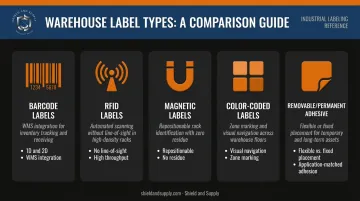
- Label types: Barcodes (1D/2D), RFID, magnetic, color-coded, and removable adhesive each serve different needs
- Rack labels need unique location codes (aisle-rack-level format), scannable barcodes, and environment-matched materials
- Floor labels must withstand forklift traffic, mark aisles per OSHA 29 CFR 1910.176(a), and follow OSHA color standards
- Match materials to environment — standard vinyl, freezer-grade adhesive, and thick polyester each cover different warehouse conditions
- System setup starts with mapping locations and defining naming conventions before printing a single label
Why Warehouse Identification Labels Matter
Accuracy and Speed
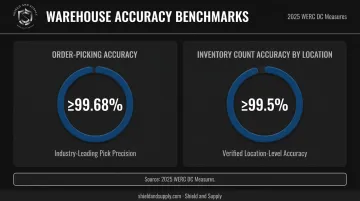
According to 2025 WERC DC Measures data republished by Yale, best-in-class distribution centers reach ≥99.68% order-picking accuracy and ≥99.5% inventory count accuracy by location. Hitting those benchmarks requires that every physical location — rack, bin, aisle, zone — carries a reliable, scannable identifier workers and software can trust.
When labels are missing, faded, or inconsistent, pickers default to memory or guesswork. Mispicks follow, inventory records drift, and fulfillment speed drops.
Safety and Compliance
Labels aren't only operational tools. OSHA 29 CFR 1910.176(a) explicitly requires that permanent aisles and passageways be appropriately marked wherever mechanical handling equipment is used. OSHA 29 CFR 1910.144 establishes that:
- Red designates fire protection equipment and danger areas
- Yellow designates caution and physical hazard zones (striking, tripping, caught-in-between hazards)
Beyond floor marking, RMI (Rack Manufacturers Institute) recommends that every rack row carry a load capacity plaque showing maximum unit load per level, maximum total bay load, and number of storage levels — critical safety information in any racking environment.
The WMS Connection
Those same labels also tie directly into your warehouse software. When every rack, bin, and floor zone carries a scannable identifier, your WMS or ERP captures location data automatically, reducing errors and saving time compared to manual entry. RFID goes further: GS1 US states that RFID warehouse management can raise item-level inventory accuracy to over 95% without requiring line-of-sight scanning.
Common Types of Warehouse Identification Labels
Barcode Labels (1D and 2D)
The most widely used warehouse label type. Key differences:
| Type | Data Capacity | Best For |
|---|---|---|
| 1D barcode (e.g., GS1-128) | Up to 48 characters | Location codes, product IDs, pallet/carton tracking |
| 2D barcode (e.g., GS1 DataMatrix) | Up to 2,335 characters | Lot numbers, expiration dates, richer item data |
Both require compatible scanners. Shield and Supply's LabelTac® printers with LabelSuite™ software support Code 39, Code 128, Data Matrix, and QR codes (ISO/IEC 18004 compliant) for any warehouse barcode application.
RFID Labels
RFID tags transmit data without line-of-sight scanning, letting readers capture multiple items simultaneously. That makes them ideal for high-throughput operations where scanning individual labels creates bottlenecks. Cost per label runs higher than standard barcodes, so RFID is typically reserved for high-value goods or targeted use cases — not facility-wide rack labeling.
Magnetic Labels
Magnetic rack labels attach to ferrous beam-rack systems and reposition instantly without leaving adhesive residue. Shield and Supply's magnetic warehouse rack labels are specifically built for reconfigurable layouts — useful for 3PL facilities, seasonal reorganizations, or any operation that changes rack configurations regularly.
Color-Coded Labels
Color adds a visual layer that speeds up navigation before a scanner is even raised. Colors can designate:
- Zones or departments
- Product categories or priority levels
- Handling requirements (hazardous, fragile, cold chain)
Color-coding works best alongside barcodes — workers use color to navigate fast and scan to confirm accuracy. Shield and Supply's vinyl supply rolls are available in over a dozen colors (yellow, red, white, green, orange, blue, and more) to support 5S visual management systems.
Removable vs. Permanent Adhesive Labels
- Removable adhesive: Peels cleanly without residue — use on racks, bins, and pallets where location assignments change
- Permanent adhesive: Bonds firmly for the long haul — better suited to fixed locations like aisle markers, dock signs, and entry points
Rack Labels: What You Need to Know
What Rack Labels Must Include
Every rack label should display:
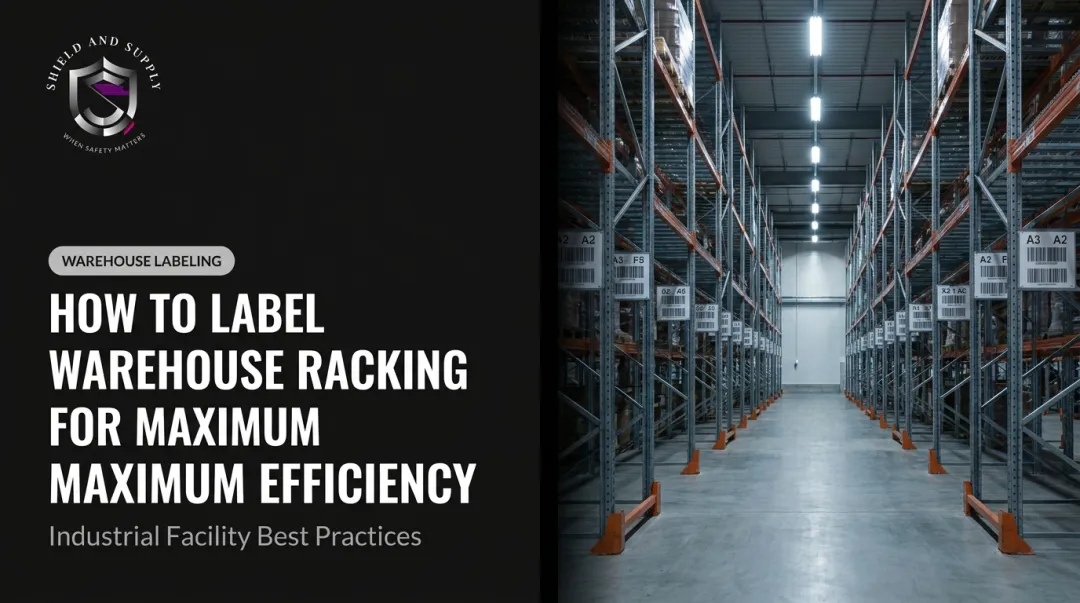
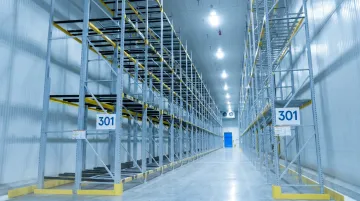
- A unique location code — typically Aisle / Rack / Level format (e.g., B-03-2 = Aisle B, Rack 03, Level 2)
- A scannable barcode or QR code for WMS integration
- Weight capacity information where applicable, per RMI best practice — load plaques are normally mounted at the end of each rack row
Naming Convention Logic
A consistent alphanumeric system directly affects WMS scan accuracy and pick error rates. Warehouse location-coding guidance recommends a segmented structure: Aisle → Bay/Rack → Level → Position. Practical rules:
- Letter aisles (A, B, C), number racks sequentially
- Count levels from the floor up — Level 1 is always the lowest
- Leave numbering gaps (skip even numbers, for example) to allow later expansion without renumbering the whole facility
- Keep codes short enough to read at a glance and scan without ambiguity
When the system works, new workers navigate with just the label — no memorization required.
Multi-Level Racking: Totem Labels
In high-bay warehouses, totem (vertical) labels stack barcodes for every shelf level on the side of the rack upright. Workers get a vertical snapshot of the entire rack at a glance — valuable when pick paths span multiple levels.
Shield and Supply's warehouse rack labels support multi-level pick face configurations with variable-data location codes for aisle, rack, level, and bin.
Material by Environment
- Standard dry warehouse: Industrial vinyl or polypropylene with permanent adhesive
- Cold storage/freezer: Freezer-grade adhesive with moisture-resistant face stock — Camcode's cold-storage rack labels, for reference, specify a minimum application temperature of -20°F on most surfaces
- Reconfigurable racks: Magnetic substrate, no adhesive needed
Choosing the right substrate upfront prevents label failure and avoids relabeling entire rack rows after the first cold season.
Floor Labels: Marking Zones, Aisles, and Safety Areas
Applications
Floor labels serve distinct purposes across the warehouse:
- Aisle identification — directional guides and location anchors for workers
- Forklift traffic lanes — separate powered equipment from foot traffic
- Pallet staging zones — define where loads wait without blocking throughput
- Safety walkways — protect pedestrians in mixed-traffic areas
- Hazard zones and emergency exits — OSHA-required markings per 29 CFR 1910.176(a) and 1910.144
Adhesive Floor Labels vs. Paint
Both work, but they serve different situations:
| Factor | Adhesive Floor Tape/Labels | Painted Markings |
|---|---|---|
| Installation speed | Immediate use after application | 48 hours to 7 days cure time (vendor guidance) |
| Layout changes | Peels cleanly, repositionable | Requires scraping and repainting |
| Durability | Rated for forklift and pallet jack traffic | Can chip, scuff, or wear unevenly |
| Best for | Active warehouses with changing layouts | Large permanent areas where repaint cost is acceptable |
3M notes that floor marking tape avoids cure time entirely and removes cleanly when layouts change — a real advantage in operations that reorganize frequently.
Material Requirements for High-Traffic Floors
Layout flexibility only matters if the label holds up. Floor labels in forklift zones need to handle serious punishment — look for these specs:
- Beveled edges that resist lifting and curling under pallet drag
- Anti-slip surface texture for pedestrian safety
- Industrial pressure-sensitive adhesive rated for concrete or epoxy floors
- Chemical and solvent resistance compatible with floor cleaning equipment
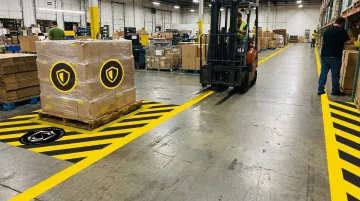
Shield and Supply's SafetyTac® line meets these requirements across two variants. SafetyTac® 2.0 uses denser material and a more aggressive adhesive, rated to withstand forklift pivot loads without lifting. SafetyTac® Hazard adds striped and chevron patterns in ANSI-aligned color combinations — Black/Yellow, Red/White, Black/White, and Green/White — for hazard zone communication.
Both products comply with OSHA 29 CFR 1910.22 and align with ANSI Z535.1 safety color standards.
How to Choose the Right Label Material
A quick decision framework by environment:
| Environment | Face Stock | Adhesive Type |
|---|---|---|
| Standard dry warehouse (racks/bins) | Vinyl or polypropylene | Permanent or removable |
| Cold storage / freezer racks | Moisture-resistant polyester | Freezer-grade (rated to -20°F) |
| High-traffic floor zones | Thick polyester or laminated PVC | Industrial-grade, concrete-rated |
| Reconfigurable racks | Magnetic substrate | No adhesive needed |
Removable vs. permanent adhesive comes down to how often a location changes:
- Removable: Racks, bins, and pallets that get relabeled seasonally or with every layout shift
- Permanent: Fixed aisle markers, dock numbers, and structural signage that shouldn't shift or be accidentally removed
For harsh industrial exposure — chemicals, abrasion, moisture, temperature swings — the right move is matching face stock directly to those specific conditions rather than defaulting to a generic material.
Shield and Supply's warehouse rack label line covers all three mounting types (adhesive, magnetic, hanging) with materials built for those demands. For specific temperature ratings or adhesive specs for cold storage applications, reach their support team at 877-514-0727.
Setting Up a Warehouse Labeling System Step by Step
Step 1 — Map and Plan
Before printing anything:
- Walk the full facility and document every zone: aisles, racks, levels, bins, floor areas, docks, and staging zones
- Define your naming convention (Aisle letter → Rack number → Level from floor up → Bin position)
- Leave expansion gaps in your numbering sequence
- Confirm the convention maps to your WMS location fields
Location codes should follow natural pick paths — left-to-right, ground-up — so workers move through the warehouse in sequence without backtracking.
Step 2 — Print and Apply
Use an industrial label printer sized for your needs:
- LabelTac® Pro X ($1,299.99): prints 1/2" to 4" wide labels, 300 DPI thermal transfer, ideal for rack and bin labels
- LabelTac® 9 ($3,999.00): prints 4" to 9" wide labels, up to 2,500 labels/day for large facilities
Both printers include LabelSuite™ software (free, $299.99 value) with:
- Barcode and QR code generation
- Auto-numbered location codes in sequence
- CSV/Excel import for batch-creating codes from a WMS export
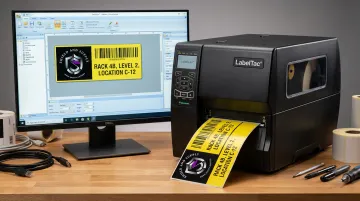
Every LabelTac® printer also includes a full lifetime warranty.
When applying labels, keep heights and orientations consistent across the facility. Check each rack for obstructions that could block a scanner beam before finalizing placement.
Step 3 — Train Staff and Maintain the System
A labeling system only works if people use it correctly and keep it current:
- Run hands-on training so workers understand the naming convention and know how to flag damaged or missing labels
- Establish a quarterly audit to check for fading, peeling, or illegible barcodes
- Update codes whenever layouts change, and keep the WMS synchronized
- High-traffic floor labels may need replacement more frequently — build that into the maintenance calendar
Frequently Asked Questions
What is an example of a warehouse label?
A common rack label displays the location code "B-03-2" (Aisle B, Rack 03, Level 2) alongside a scannable barcode. When a picker scans it, the WMS confirms the exact location and the inventory assigned to it.
What is the best way to label a warehouse?
Map all locations first and define an alphanumeric naming convention. From there:
- Select materials rated for your specific environment (freezer, high-humidity, outdoor)
- Print using an industrial label printer for durability and barcode accuracy
- Integrate scanned location data with your WMS for real-time inventory tracking
What material is best for warehouse floor labels?
High-traffic floor areas need thick polyester or PVC labels with beveled edges, anti-slip surfaces, and industrial adhesive rated for concrete. Freezer floors require moisture-resistant face stock and cold-temperature adhesives — look for ratings down to at least -20°F.
How do I create a warehouse location labeling system?
Assign aisles a letter, racks a sequential number, and levels a count from the floor up. Every location then gets a unique code — for example, A-01-1 — that maps directly to a WMS record and can be printed as a barcode for scanning.
How often should warehouse labels be replaced?
A quarterly visual audit is the minimum. Check for fading, peeling, or barcodes that scanners struggle to read. Floor labels in active forklift zones often need replacement every one to two months in high-traffic areas.
Do warehouse rack labels need to be OSHA compliant?
OSHA doesn't mandate barcode labels on racks, but OSHA 29 CFR 1910.176(a) requires permanent aisles and passageways to be clearly marked. Floor safety markings and hazard communication signage do carry compliance requirements, and RMI best practice calls for load capacity plaques at each rack row end.