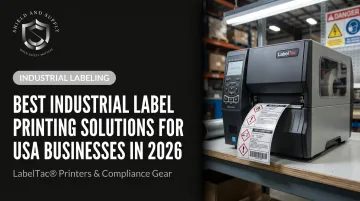
Choosing the right industrial label printing solution in 2026 goes well beyond print speed. Compliance support, label material durability, software integration, and total cost of ownership all determine whether a printer pays for itself or creates ongoing headaches.
This guide covers five leading industrial label printing solutions available to US businesses — what each does best, who it's built for, and how to evaluate them against your facility's real operational needs.
TL;DR
- Industrial label printers must handle chemical resistance, high-volume output, and regulatory compliance with OSHA, GHS/HazCom, NFPA, and ANSI standards
- The global label printer market is projected to grow from $552.9 million in 2025 to $826.1 million by 2035, with North America leading in demand
- Top 2026 solutions range from compliance-ready all-in-one ecosystems (LabelTac® 9) to enterprise thermal transfer workhorses (Zebra ZT610, Honeywell PX Series)
- The right choice depends on print durability, material compatibility, compliance template support, connectivity, and total cost of ownership
- Five solutions covered below, with specs and differentiators for each
Overview of Industrial Label Printing in the US Market
Industrial label printing covers high-volume, high-durability output for safety labels, asset tags, pipe markers, floor markings, barcodes, and compliance labels. It differs from office or shipping label printing in two key ways:
- Materials: vinyl, polyester, reflective, and high-temperature substrates built for harsh environments
- Regulatory stakes: compliance with OSHA safety labeling, GHS chemical labeling, and NFPA arc flash requirements — where errors carry real citation risk
North America leads global demand for industrial label printing equipment, driven by OSHA compliance mandates, warehouse automation expansion, and ongoing manufacturing growth. With dozens of hardware options on the market, the five solutions below represent the strongest choices for US industrial facilities in 2026 — selected for proven durability, compliance support, and operational reliability.
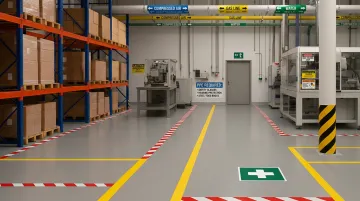
Top Industrial Label Printing Solutions for USA Businesses in 2026
These solutions were evaluated across seven criteria:
- Industrial durability and build quality
- Print quality and resolution
- Label material versatility
- Software ecosystem and template support
- Connectivity and IT integration
- Compliance support (OSHA, ANSI, GHS, NFPA)
- Total cost of ownership
LabelTac® 9 by Shield and Supply
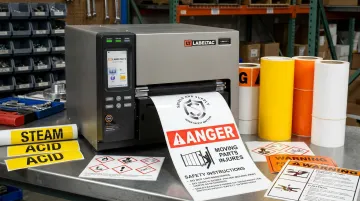
For manufacturing plants, warehouses, and facilities that need on-demand compliance labels — OSHA safety labels, floor markers, pipe labels, arc flash, and GHS/HazCom — the LabelTac® 9 is Shield and Supply's flagship large-format solution.
Two things set it apart. First, it ships with LabelSuite™ pre-loaded with templates aligned to OSHA 29 CFR 1910, ANSI Z535, GHS HazCom, NFPA 70E arc flash, and ASME A13.1 pipe marking — no design experience required.
Second, it's backed by a Full Lifetime Warranty covering all parts, labor, and related costs, transferable at no extra charge. That combination — compliance-ready software plus lifetime coverage — is rare at this price point.
The printer handles labels from 4" to 9" wide at 300 DPI, up to 2,500 labels per day, via USB 2.0 and built-in Ethernet. LabelSuite™ also supports barcode and QR code generation and CSV/Excel data import for variable data printing.
| Spec | Detail |
|---|---|
| Print Width | 4" to 9" wide format; 300 DPI resolution |
| Throughput | Up to 2,500 labels per day |
| Compatible Materials | Vinyl, polyester, magnetic, reflective, glow-in-the-dark, high-temperature supplies; 5–10 year indoor/outdoor durability rating |
| Software | LabelSuite™ with OSHA, GHS, arc flash, pipe marker, and ANSI templates — included free ($299.99 value) |
| Connectivity | USB 2.0 and built-in Ethernet |
| Warranty | Full Lifetime Warranty (parts, labor, related costs) — transferable |
| Price | $3,999.00 USD (includes software, starter ribbon, lifetime warranty) |
| Best For | Facilities needing on-demand compliance labeling across multiple OSHA/ANSI standards with large-format capability |
Zebra ZT610 Industrial Printer
Few industrial printers match the Zebra ZT610 for raw deployment scale in the US. It's built for high-volume, 24/7 manufacturing and distribution environments where any unplanned downtime carries real operational cost.
Native WMS and ERP integration is the primary differentiator for enterprise buyers. The ZT610 fits into existing IT infrastructure through multi-protocol connectivity and ZPL command language support — no middleware required.
| Spec | Detail |
|---|---|
| Print Technology | Direct Thermal and Thermal Transfer; up to 14 ips; 203 or 300 DPI |
| Connectivity | Ethernet, USB, Serial, Bluetooth — enterprise-grade WMS/ERP integration |
| Interface | 4.3" color touchscreen |
| Best For | High-volume manufacturing, distribution centers, and facilities with existing enterprise IT infrastructure |
Brady i5300 Industrial Label Printer
Brady specializes in safety and compliance labeling, and the i5300 reflects that focus entirely. It's engineered for lockout/tagout labels, pipe markers, arc flash warning labels, and safety signs — not general-purpose barcode printing.
The i5300 is locked to Brady-certified label materials. That limits supply flexibility, but it's a deliberate trade-off: every printed label meets Brady's chemical resistance and durability specifications — which matters for OSHA and NFPA compliance in harsh environments.
| Spec | Detail |
|---|---|
| Label Compatibility | Brady-certified polyester, vinyl, and aggressive-adhesive substrates for chemical, heat, and UV resistance |
| Compliance Focus | Pre-loaded templates for OSHA LOTO, GHS/HazCom, NFPA 70E arc flash, pipe marking |
| Connectivity | Wi-Fi available on select configurations |
| Best For | Safety officers and EHS managers prioritizing certified material performance and regulatory pre-compliance |
Honeywell PX Series Industrial Printer
The Honeywell PX Series (PX45/PX65) is a heavy-duty thermal printer built for demanding logistics, manufacturing, and warehouse environments. All-metal construction and tool-free media loading cut downtime — a practical advantage in 24/7 operations where a printhead swap shouldn't require a technician.
It fits best in facilities already running Honeywell scanning, data capture, or WMS tools. The hardware earns its place through that ecosystem fit, not standalone compliance labeling.
| Spec | Detail |
|---|---|
| Build Quality | All-metal construction; rated for continuous industrial operation |
| Media Handling | Tool-free printhead and platen roller access; supports labels, tags, and tickets |
| Connectivity | Ethernet, USB, Wi-Fi (select models) |
| Best For | Logistics hubs and distribution centers within existing Honeywell automation ecosystems |
SATO CL4NX Plus
The SATO CL4NX Plus covers a wide operational range — manufacturing, food processing, healthcare, and logistics — without requiring separate units for different media types. One printer handles varying label sizes, thicknesses, and materials without reconfiguration.
Multi-protocol support (ZPL, EPL, and SATO's native command language) simplifies cross-brand migration, which matters for facilities retiring mixed-brand fleets rather than starting fresh.
| Spec | Detail |
|---|---|
| Print Versatility | Direct Thermal and Thermal Transfer; up to 10 ips; 203/305/609 DPI options |
| Connectivity & Protocols | Multiple interface options; supports ZPL, EPL, and SATO native command language |
| Compliance Focus | Traceability and audit-ready labeling for regulated industries |
| Best For | Food processing, pharmaceutical manufacturing, and compliance-heavy sectors requiring cross-brand flexibility |
How We Chose These Solutions
Many buyers make the mistake of selecting an industrial label printer based solely on upfront hardware cost — then discover the real costs later through supply costs, software licensing fees, and printer downtime.
The evaluation criteria used here prioritize long-term operational fit:
- Industrial durability — Can the printer handle continuous operation in your environment (temperature extremes, dust, chemical exposure)?
- Label material compatibility — Are the required substrates (reflective, high-temp, aggressive adhesive) available and reliably sourced in the US?
- Compliance support — Does the printer ship with OSHA, GHS, NFPA, and ANSI-ready templates, or does your team need to build those from scratch?
- Software and connectivity — Does it integrate with existing WMS, ERP, or plant systems?
- Total cost of ownership — Hardware + supplies + maintenance + warranty terms over a 3–5 year horizon
- User experience in real industrial settings — Touch interfaces, tool-free loading, and intuitive software matter when the operator isn't an IT professional
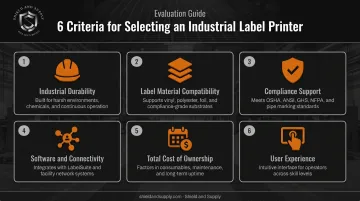
OSHA compliance capability carries extra weight across all six criteria. Printers that ship with pre-built GHS, NFPA, and ANSI templates — backed by certified label materials — reduce compliance risk and cut engineering time on the shop floor.
Conclusion
Choosing the right industrial label printing solution in 2026 comes down to matching your specific compliance requirements, output volume, environment, and existing IT infrastructure — not defaulting to the most familiar name on the market.
Before committing, evaluate total cost of ownership, warranty terms, supply chain reliability for label materials, and the quality of bundled software. A printer that ships with compliance-ready templates and certified industrial supplies — and carries a lifetime warranty — saves more than it costs over its operational lifespan.
Shield and Supply's LabelTac® printer line is built to meet those criteria. Backed by a Full Lifetime Warranty covering all parts, labor, and related costs, and powered by LabelSuite™ software with pre-built OSHA, GHS, arc flash, and pipe marker templates, it gives US industrial facilities a complete, compliance-ready labeling ecosystem from day one.
To find the right configuration for your facility, contact Shield and Supply at 877-514-0727 or info@shieldandsupply.com.
Frequently Asked Questions
What is the best label maker for industrial use?
It depends on your use case. For OSHA safety labels, pipe marking, and floor markers, a compliance-ready printer like the LabelTac® 9 with built-in labeling software is a strong fit. High-volume production environments typically need enterprise thermal transfer systems with WMS/ERP integration.
What is the difference between direct thermal and thermal transfer printing for industrial labels?
Direct thermal uses heat-sensitive media with no ribbon — lower cost upfront, but labels fade faster and aren't suited for harsh environments. Thermal transfer uses a ribbon to transfer ink onto label stock, producing durable, chemical- and heat-resistant output that holds up in industrial settings.
What OSHA requirements affect industrial label printing in the USA?
Key standards driving industrial label requirements include HazCom 2012/GHS (chemical labels), NFPA 70E (arc flash warning labels), OSHA 29 CFR 1910.147 (lockout/tagout), and ANSI/ASME A13.1 (pipe marking). Non-compliance with these standards can result in citations and per-violation fines.
What label materials should I use for harsh industrial environments?
Use vinyl or polyester for chemical resistance, aggressive-adhesive substrates for rough or textured surfaces, and reflective or UV-resistant materials for outdoor or high-visibility safety marking. For high-temperature areas, confirm the material's rated temperature range before specifying.
How much does an industrial label printer typically cost for a manufacturing facility?
Entry-level industrial thermal printers start around $300–$800; mid-range units run $800–$2,500; enterprise-grade systems exceed $5,000. Supply costs, software licensing, and warranty coverage all affect total cost of ownership — the LabelTac® 9, for instance, includes a full lifetime warranty, which meaningfully reduces long-term risk.
Can industrial label printers integrate with warehouse management or ERP systems?
Most enterprise-grade printers support standard connectivity protocols and are compatible with major WMS and ERP platforms via ZPL or other command languages. This enables automated, real-time label printing triggered directly by inventory or production events. The LabelTac® 9 connects via USB and Ethernet, with LabelSuite™ supporting CSV/Excel data import for variable data printing workflows.