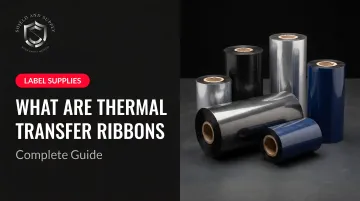
Choosing the right ribbon sounds like a minor procurement decision, but it directly affects whether your labels survive the environments they're placed in. This guide covers what thermal transfer ribbons are, how they work, the three main types, how they compare to direct thermal printing, and how to match the right ribbon to your application.
Key Takeaways
- Thermal transfer ribbons (TTRs) transfer ink onto label materials using heat — producing durable, smudge-resistant prints
- The three types are wax, wax-resin, and resin — each suited for different durability and environmental demands
- Thermal transfer printing outlasts direct thermal when labels need to survive chemicals, heat, or long-term use
- Matching ribbon type to your label substrate is the single most critical selection factor
- In industrial settings, choosing the right ribbon-printer combination directly affects label lifespan, OSHA compliance, and print reliability
What Is a Thermal Transfer Ribbon and How Does It Work?
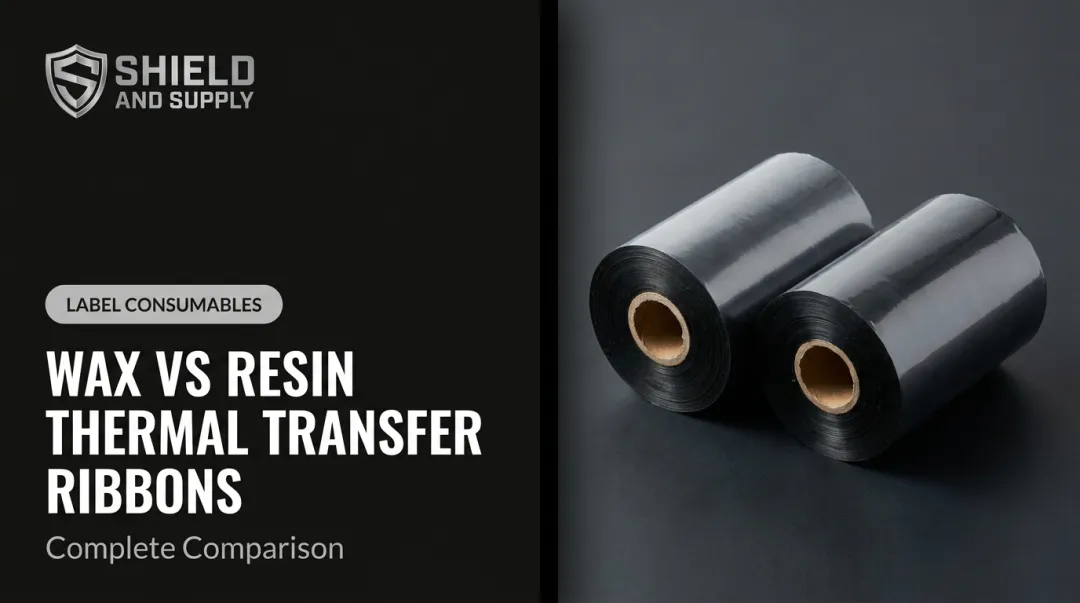
A thermal transfer ribbon (TTR) is a consumable printing supply — a thin polyester film roll coated with heat-activated ink. Thermal transfer printers use these ribbons to print text, barcodes, and graphics onto label materials.
The Printing Mechanism
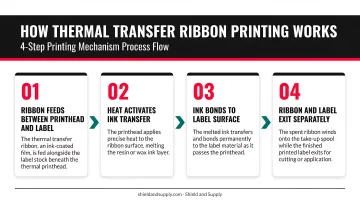
The process works like this:
- The print head activates — tiny heating elements fire selectively based on the image data
- Heat melts the ink coating on the ribbon's surface
- Ink transfers to the label substrate directly below, bonding permanently to the material
- Single-pass design — the used ribbon winds onto a take-up spool and is discarded; each section prints exactly once
That single-pass design directly affects output quality. Every label receives consistent 100% ink density — no variation, no degraded output as the ribbon ages.
The Three-Layer Anatomy of a TTR
| Layer | Function |
|---|---|
| Polyester base film | Structural support; typically 4–5 micrometers thick |
| Ink layer | Wax, resin, or blend that melts and transfers during printing |
| Backcoat | Applied to the underside; reduces friction against the print head, extends print head life |
The ink physically bonds to the label surface, which is why thermal transfer prints resist smudging, moisture, and fading — a durability advantage that makes them well-suited for industrial labeling, barcodes, and any label expected to last.
The 3 Types of Thermal Transfer Ribbons
TTRs come in three formulations: wax, wax-resin, and resin. The right choice depends on what you're printing on, what conditions the label will face, and your budget. Using the wrong type is one of the most common causes of label failure in industrial settings — a mismatch can even melt ribbon onto labels and cause internal printer damage.
Wax Ribbons
Wax ribbons are the most widely used and cost-effective option. They melt at relatively low temperatures, making them compatible with standard desktop and industrial label printers.
Best for:
- Shipping labels and address labels
- General inventory tags
- Retail price tags
- Plain paper label stock
Wax prints smear when scratched, degrade under direct heat or sunlight, and won't hold up on synthetic materials like polypropylene or polyester. If a label will face chemical exposure or physical abrasion, wax isn't the right choice.
Wax-Resin Ribbons
Wax-resin ribbons blend wax and resin to deliver a balance of affordability and improved durability. They bond more firmly to label surfaces, offering better resistance to smudging, scratching, and moisture than pure wax — without the cost of full resin.
Best for:
- Product barcodes and compliance labels
- Food and beverage labels
- Medical device labels
- Coated paper and some synthetic materials
Resin Ribbons
Resin ribbons are composed entirely of synthetic resin, require the highest heat to transfer, and produce the most durable prints of the three options. They resist chemicals, solvents, extreme heat, UV light, and abrasion.
Best for:
- Safety and hazmat labels
- Chemical drum identification
- Outdoor asset tags
- PCB component labels
- Laboratory specimen labels
- Any label that must survive harsh manufacturing or warehouse environments
Critical requirement: Resin ribbons must be paired with synthetic label stock — polyester, polypropylene, or polyimide. They won't bond properly to standard paper labels.
Quick Comparison
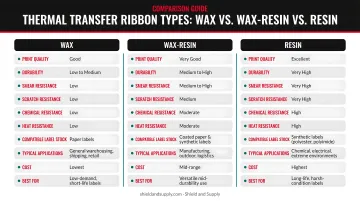
| Ribbon Type | Durability | Best Label Stock | Typical Use Case |
|---|---|---|---|
| Wax | Basic | Plain paper | Shipping, retail, inventory |
| Wax-Resin | Moderate | Coated paper, some synthetics | Barcodes, food/beverage, medical |
| Resin | High | Polyester, polypropylene, polyimide | Hazmat, outdoor, chemical, PCB |
Thermal Transfer vs. Direct Thermal: Key Differences
Both printing methods use thermal print heads — which is why they're frequently confused. The difference is what gets heated.
Direct thermal (DT) applies heat directly to chemically treated label stock, which darkens at the heated points. No ribbon required. Simpler setup, lower per-label cost upfront. The tradeoff: DT labels are prone to fading after six to nine months and aren't well-suited to heat, sunlight, or abrasion.
Thermal transfer (TT) uses a ribbon to transfer ink onto standard label materials — producing prints that can last years in demanding conditions.
Side-by-Side Comparison
| Factor | Thermal Transfer | Direct Thermal |
|---|---|---|
| Durability | Months to years depending on ribbon type | Up to ~6–9 months before fading |
| Label materials | Paper, coated synthetics, polyester, polypropylene | Specially coated heat-sensitive paper only |
| Chemical/UV resistance | Excellent (resin) to moderate (wax) | Poor — degrades quickly |
| Ribbon required? | Yes | No |
| Print head lifespan | Longer — ribbon acts as a buffer | 25%–50% shorter than TT print heads |
| Best use case | Labels lasting months or years | Short-lived labels: receipts, shipping |
On cost: DT labels generally run 5%–50% more than the combined cost of TT labels plus ribbon, largely because fading drives higher reprint frequency. That gap widens further when you factor in the labor cost of replacing degraded safety labels or reissuing non-compliant asset tags.
In short, DT works for transient labels — receipts, short-haul shipping, temporary signage. Where a label needs to survive heat, chemicals, or more than a year on the floor, thermal transfer is the practical choice.
Where Thermal Transfer Ribbons Are Used
TTRs are the foundation of industrial labeling across a wide range of applications.
Industrial and Warehouse Applications
- Barcode labels for inventory management and asset tracking
- Pallet and bin labels that survive forklift traffic and warehouse conditions
- Safety warning labels and OSHA-required signage
- Hazardous material identification — OSHA's HazCom standard requires chemical labels to remain legible throughout each work shift, with violations carrying penalties up to $16,550 per serious violation
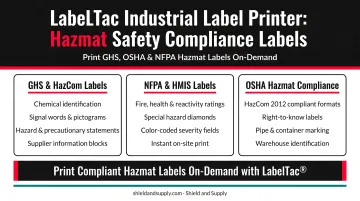
Shield and Supply's LabelTac® printers are built specifically for these environments, handling everything from pipe marking and GHS labeling to Arc Flash and 5S compliance.
Healthcare and Manufacturing
- Patient wristbands and specimen tracking labels
- Medical device identification
- Chemical-resistant component labels for PCBs and assemblies
In healthcare settings, an unreadable label isn't a minor inconvenience — it's a direct patient safety risk. Resin ribbons are the standard choice here, given their resistance to chemicals, sterilization processes, and handling.
Retail and Logistics
Wax ribbons handle most retail and logistics work well: price tags, shipping labels, product barcodes. When outdoor durability or chemical resistance enters the picture, wax-resin or resin is the better call.
How to Choose the Right Thermal Transfer Ribbon
Step 1: Match Ribbon Type to Label Substrate
This is the most critical decision. A mismatch here causes poor adhesion, smearing, and premature failure.
| Ribbon Type | Compatible Substrates |
|---|---|
| Wax | Coated or uncoated paper |
| Wax-Resin | Coated paper, some synthetics |
| Resin | Polyester, polypropylene, polyimide |
Step 2: Assess Environmental Conditions
Ask these questions before selecting a ribbon:
- Will the label contact chemicals or solvents?
- Will it be exposed to outdoor conditions or UV light?
- Does it need to survive temperature extremes?
- Will it be scratched, abraded, or handled frequently?
One "yes" answer pushes you toward wax-resin. Multiple "yes" answers point to resin.
Step 3: Verify Printer Compatibility
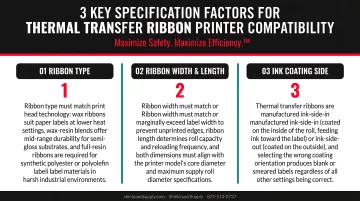
Three specifications matter:
- Ribbon width must match or slightly exceed the printer's print head width — a narrower ribbon exposes the print head to friction and accelerated wear
- Ribbon length determines how many labels you print before swapping rolls; longer rolls reduce changeover frequency in high-volume lines
- Winding direction (coating side in vs. coating side out) must match your printer model's specification — check your printer manual
For LabelTac® printers, Shield and Supply offers purpose-matched ribbons: the LabelTac® Pro X takes 4.33" × 984' or 2.4" × 984' ribbons (SKU: LPR06), while the LabelTac® 9 uses 8.66" × 984' ribbons (SKU: L9R03). Both are rated for scratch and chemical resistance, making them a reliable match for demanding industrial print environments.
Step 4: Calculate Total Cost of Ownership
Resin ribbons cost more per roll than wax. But consider what a failed label actually costs:
- Reprinting and re-applying labels
- Downtime during audits triggered by illegible safety signage
- OSHA penalties for non-compliant hazmat labels — up to $165,514 for willful or repeated violations
In demanding environments, resin ribbons are typically more cost-effective over time, even at a higher upfront price. LabelTac® printers from Shield and Supply carry a Full Lifetime Warranty, which removes printer replacement from your TCO calculation altogether.
Ribbon Colors, Sizes, and Shelf Life
Color Options
Black is the standard for barcodes and most text labels — but TTRs are available in a wide range of colors for specific applications:
- Red, orange, yellow — hazard warnings and GHS chemical labeling
- Green, blue — nutraceutical labels and facility color-coding systems
- White, silver, gold — best-by dates or identification on dark label stock and flexible packaging
Shield and Supply's LabelTac® ribbons are available in black, white, red, green, orange, blue, and yellow, covering the full range of OSHA pipe marking, 5S, and color-coded safety labeling requirements.
Once you've selected the right color, ribbon dimensions are the next variable to get right.
Sizing
- Width should match or slightly exceed the printer's print head width (measured in inches or millimeters)
- Length typically ranges from 300–450 meters or 600–900 meters per roll; a standard 450-meter roll yields about 2,800 six-inch labels
- Longer rolls reduce changeover frequency — important in high-volume production environments
Knowing how long your ribbons stay usable is just as important as picking the right size.
Shelf Life and Storage
- Unopened rolls: Up to two years from receipt when stored below 80°F / 27°C at 60% relative humidity or less, in original packaging
- Storage conditions: Keep between 40°F–95°F (5°C–35°C), 20%–80% humidity, away from direct light, heat sources, and moisture
- Opened rolls: Use within approximately 12 months for optimal print quality; store in controlled conditions
Frequently Asked Questions
What does a thermal transfer ribbon do?
A TTR is a coated polyester film that sits between the print head and the label material. When the print head heats up, the ribbon's ink melts and bonds permanently to the label surface, creating durable, smudge-resistant text, barcodes, or graphics that outlast direct thermal or inkjet alternatives.
What is the difference between DT and TT printing?
Direct thermal uses chemically treated label stock that darkens under heat with no ribbon needed. Thermal transfer uses a ribbon to deposit ink onto standard label materials, producing prints that resist heat, light, and fading far better. DT labels typically degrade within 6–9 months; TT labels can last years.
What is the difference between wax and resin thermal transfer ribbons?
Wax ribbons are lower cost and best for paper labels in standard conditions. Resin ribbons are fully synthetic, more expensive, and required when labels must withstand chemicals, extreme temperatures, or outdoor exposure on synthetic substrates like polyester or polypropylene.
How long does a thermal transfer ribbon last?
Unopened rolls last approximately two years under proper storage conditions. Once printed, label lifespan depends on ribbon type : resin-printed labels on synthetic stock can last 5+ years in harsh environments, while wax-printed paper labels may fade within months if exposed to heat or chemicals.
What colors are thermal transfer ribbons available in?
TTRs are most commonly available in black, but specialty colors including red, blue, green, white, orange, gold, and silver are available. These are commonly used for color-coded safety labeling, OSHA pipe marking, GHS chemical labeling, and facility identification systems.
What are the different types of thermal labels?
Thermal labels fall into two categories: direct thermal (chemically coated, no ribbon required) and thermal transfer (paper, coated paper, or synthetics like polyester or polypropylene). Matching the label type to your printer and ribbon formulation is critical — a mismatch is the leading cause of poor print adhesion and early label failure.