That distinction matters more than most facilities realize. According to OSHA's LOTO fact sheet, proper compliance with 29 CFR 1910.147 prevents an estimated 120 fatalities and 50,000 injuries annually — with injured workers losing an average of 24 workdays to recover. In FY 2025, the Control of Hazardous Energy standard ranked among OSHA's top 10 most frequently cited standards, with 2,443 total violations and 1,688 serious citations. Each serious violation carries a maximum penalty of $16,550 — willful or repeat violations reach $165,514.
A LOTO tag that's unreadable, incomplete, or improperly attached isn't just a paperwork problem. It's a potential single point of failure in the chain that prevents accidental re-energization. This article covers OSHA's tag requirements, what information belongs on every tag, the real limitations of tagout-only programs, and the practices that keep facilities both compliant and safe.
Key Takeaways
- LOTO tags are required under 29 CFR 1910.147 whenever energy-isolating devices are locked or tagged out during servicing
- Tags must meet four OSHA criteria: durability, standardization, substantiality, and identifiability
- The two OSHA-required minimum fields are the authorized employee's identity and a warning legend (e.g., "Do Not Operate")
- Tagout alone provides no physical restraint — use it only when locking out is not feasible, and never as the default approach
- ANSI Z535.5 recommends red or red-and-white tags for LOTO applications
- OSHA requires facility-wide standardization in tag format and print
OSHA Requirements for Lockout/Tagout Tags
The governing standard is 29 CFR 1910.147(c)(5), which sets four non-negotiable criteria for all lockout and tagout devices: durability, standardization, substantiality, and identifiability. These apply to every facility where hazardous energy servicing occurs — no exceptions for facility size, industry, or maintenance frequency.
Durability
Tags must remain legible for the entire expected exposure period, regardless of environmental conditions. OSHA specifies that:
- Tags used in wet or damp areas must not deteriorate or become illegible
- Tags in corrosive environments (acid or alkali chemical areas) must resist chemical degradation
- Standard paper labels and adhesive stickers are not compliant — the standard requires materials that hold up in real industrial conditions
In practice, this means industrial-grade plastic or laminated polyester tags. Materials like polypropylene or laminated polyester are built to stay legible through heat, moisture, and chemical exposure — which is the entire point.
Substantiality and Attachment Requirements
Under 1910.147(c)(5)(ii)(C), the tag and its attachment must together resist accidental removal. OSHA specifies that attachment means must be:
- Non-reusable — once applied and removed, the tie must be cut and discarded
- Attachable by hand — no tools required for application
- Self-locking and non-releasable
- Rated for a minimum unlocking strength of no less than 50 pounds, equivalent to a one-piece, all-environment nylon cable tie
That non-reusable requirement has real consequences in practice. Reusing tags — even clean, legible ones — creates ambiguity about whether a new lockout has been applied or the previous device is still active. A January 2002 OSHA interpretation letter confirms this explicitly: tagout devices must be non-reusable and self-locking. Twist ties, string, and low-tension cable ties are all non-compliant.
Standardization and ANSI Color Guidelines
OSHA requires all lockout and tagout devices within a facility to be standardized by at least one of three criteria: color, shape, or size. For tagout devices specifically, print and format must also be standardized so every employee recognizes them immediately.
OSHA does not mandate a specific tag color. That said, ANSI Z535.5-2022 (Safety Tags and Barricade Tapes) and ANSI Z535.1-2022 (Safety Colors) provide clear guidance on signal words and color assignments:
| Signal Word | Background Color | Hazard Level |
|---|---|---|
| DANGER | Red (white text) | Will result in death or serious injury |
| WARNING | Orange | Could result in death or serious injury |
| CAUTION | Yellow | Could result in minor or moderate injury |
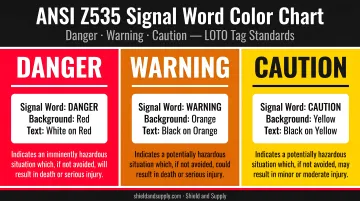
For LOTO applications, DANGER is the appropriate signal word in most cases, on a red background. Consistent color use across a facility means workers recognize a lockout device on sight, without reading a single word.
What Information Must Be Written on a Lockout/Tagout Tag
OSHA sets two hard minimums for tag content under 1910.147(c)(5)(ii)(D) and (c)(5)(iii):
- The authorized employee's identity — the person who applied the device
- A warning legend — such as "Do Not Start," "Do Not Open," "Do Not Close," "Do Not Energize," or "Do Not Operate"
These are the floor, not the ceiling. A fully compliant and operationally useful tag should include:
- Authorized employee's full name and department
- Date and time the tag was applied
- Reason for lockout (repair, inspection, cleaning, etc.)
- Expected duration of the lockout
- Warning legend matched to the specific energy source
Why Complete Information Matters
During shift changes or multi-technician jobs, an incomplete tag creates dangerous ambiguity. If a tag shows only a name and "Do Not Operate" — but no date, no reason, and no expected duration — the next shift has no way to assess whether the lockout is still active or was inadvertently left on from a completed job.
The identity requirement also establishes the removal chain: under 1910.147(e)(3), only the authorized employee who applied the tag may remove it (with a documented exception process when that person is unavailable).
For facilities managing many machines or high maintenance frequency, pre-printed industrial-grade LOTO tags with all required fields built in — like those available from Shield and Supply — help teams maintain consistent documentation without relying on guesswork in the field.
Per ANSI Z535.5, tags should also meet these visual communication standards:
- Signal word header: "DANGER" for life-threatening hazards, "WARNING" for serious but less immediate risks
- Hazard pictogram: reinforces the message at a glance
- Concise action language: one clear instruction, not a paragraph
In multilingual workplaces, pictograms carry particular weight — they communicate the hazard even when language is a barrier.
Limitations of Tagout Devices
This point is stated plainly in 29 CFR 1910.147(c)(7)(ii)(A): tags are warning devices. They do not physically prevent equipment from being energized. A padlock physically holds an energy-isolating device in a safe position. A tag only asks people not to operate it.
OSHA codifies several specific limitations:
- Tags may evoke a false sense of security — their meaning must be reinforced through training, not assumed (1910.147(c)(7)(ii)(E))
- Tags must not be bypassed, ignored, or defeated — but unlike a lock, there is no physical mechanism preventing this
- Tags provide no protection if they become detached, are overlooked, or are misread
When Tagout-Only Is Permitted
Tagout without lockout is only permitted when the energy-isolating device cannot be locked out. Even then, OSHA requires the employer to demonstrate equivalent employee protection through additional measures : removing an isolating circuit element, blocking a controlling switch, opening an additional disconnecting device, or removing a valve handle (1910.147(c)(3)(ii)).
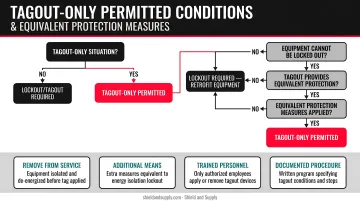
If the device can be locked, locking is required — no exceptions. Tagout-only is not a cost-saving shortcut. OSHA treats it as a last resort with specific, non-negotiable conditions.
Understanding these limitations shapes how tagout procedures should be written, trained, and audited — which is where tag design and durability become operationally relevant.
Best Practices for LOTO Tag Use in Your Facility
Tag compliance breaks down at the program level, not the product level. These four practices target the most common failure points.
1. Standardize facility-wide Designate one tag format, one color (red or red-and-white), and one attachment method. Stock tags at every workstation and LOTO station. When tags aren't readily available, workers improvise — and improvised tags don't meet OSHA requirements.
Stock tags at every workstation and LOTO station so workers never have a reason to reach for something unofficial.
1. Standardize facility-wide Designate one tag format, one color (red or red-and-white), and one attachment method. Stock tags at every workstation and LOTO station. Without ready access, workers improvise — and improvised tags don't meet OSHA requirements.
2. Integrate tags into written Energy Control Procedures (ECPs) Each machine's ECP should specify where tags attach, which warning legend to use, and which information fields must be completed before the tag is considered applied. This eliminates guesswork during high-pressure maintenance situations where shortcuts happen most.
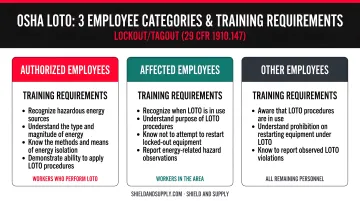
3. Train all three employee categories OSHA recognizes authorized employees (those who apply and remove lockout/tagout devices), affected employees (those who operate the equipment), and other employees (anyone who works in areas where LOTO procedures are in use). Each group needs different training:
- Authorized: full application and removal procedures
- Affected: what a LOTO tag means and the prohibition on removal
- Other: awareness of LOTO procedures and the prohibition on restart
Document all training for annual inspection records.
4. Conduct annual program inspections 1910.147(c)(6)(i) requires at least yearly review of each ECP. For tagout programs, the inspection must include a review with each authorized and affected employee of their responsibilities and the limitations of tags. Inspection records must identify the machine, date, employees included, and the inspector. Document everything.
Common LOTO Tag Mistakes to Avoid
Most LOTO tag failures aren't the result of carelessness — they're the result of systems that allow shortcuts. Here are the most consequential ones:
Incomplete tags — Blank required fields create accountability gaps. During shift changes, ambiguity about whether a lockout is still active is exactly the condition that leads to accidental restart.
Improvised or reused tags — Masking tape, paper labels, and reused cable ties violate OSHA's substantiality requirements. Each violation can reach $16,550, and inspectors look specifically at attachment methods.
Tagout-only when lockout is feasible — If the device can be locked, relying on a tag alone is not compliant without documented proof of equivalent protection. This is the most operationally dangerous mistake on this list.
Tag normalization — Routine application without proper training turns tags into visual background noise. OSHA explicitly names this failure mode under 1910.147(c)(7)(ii)(E), and it remains one of the hardest to audit.
Incomplete energy isolation — Machines with multiple energy types (electrical, hydraulic, pneumatic, thermal, chemical) require a separate LOTO device on each isolating point. Tagging only the primary source while leaving stored pressure or thermal energy unaddressed is a common and serious gap.
Frequently Asked Questions
What information must be on a lockout tag?
OSHA requires two minimum fields: the authorized employee's identity and a warning legend such as "Do Not Operate" or "Do Not Start." Best practice adds department, date and time of application, reason for lockout, and expected duration — all of which improve accountability and reduce ambiguity during shift changes.
What is the purpose of a tag in a lockout/tagout procedure?
A LOTO tag communicates to all workers that equipment has been isolated and must not be re-energized or restarted. It supplements the physical lockout by identifying who applied the device and why, establishing accountability and the correct removal chain.
What are OSHA's lockout/tagout rules?
29 CFR 1910.147 requires employers to establish an energy control program covering written ECPs for each machine, training for authorized, affected, and other employees, and compliant lockout/tagout devices. Employers must also conduct annual program inspections with documented certification records.
What is the golden rule of lockout/tagout?
If the energy-isolating device can be locked out, it must be locked — not just tagged. Lockout physically prevents re-energization; tagout only warns against it. Tagout-only is permitted exclusively when locking out is not feasible, with additional protective measures required.
Do lockout/tagout tags need red or black labeling?
OSHA doesn't mandate a specific color, but ANSI Z535.1 recommends red or red-and-white for LOTO tags to signal immediate danger. Warning text and employee information are typically printed in black for legibility against the red background.
What are the types of lockout/tagout?
The two primary types are lockout (a physical lock holds the energy-isolating device in a safe position) and tagout (a warning tag is attached when locking is not feasible). Group lockout/tagout applies when multiple authorized employees work the same equipment — each attaches a personal device to a shared hasp.