Introduction
Most safety and facility managers know OSHA's name — but struggle to answer a deceptively simple question: what does a "workplace safety program" actually require versus what's just considered good practice? The distinction matters. Missing a required written plan is a citable violation, regardless of your incident history.
OSHA is a federal agency under the Department of Labor, and it derives its enforcement authority from the Occupational Safety and Health Act of 1970. That authority includes setting standards, conducting workplace inspections, and levying fines up to $165,514 per willful or repeat violation (effective January 15, 2025).
This guide covers what industrial, manufacturing, and warehouse employers must have in place: mandatory written plans, training obligations, signage standards, and recordkeeping rules that hold up during an audit.
Key Takeaways
- Federal OSHA has no single universal written safety program requirement, but the General Duty Clause effectively mandates one
- About 22 states run OSHA-approved programs; some (like California) explicitly require written programs for all employers
- Five written plans apply to most industrial facilities: Emergency Action Plan, HazCom Program, PPE Assessment, LOTO Program, and Fire Prevention Plan
- Training must occur before exposure and be delivered in a language workers understand
- Training records must be retained; fatalities reported within 8 hours; hospitalizations, amputations, or eye loss within 24 hours
What Is an OSHA Workplace Safety Program?
A workplace safety and health program is a systematic, documented approach to identifying, preventing, and responding to workplace hazards. Federal OSHA doesn't mandate a single universal program standard for all private employers — but don't let that create a false sense of security.
The General Duty Clause
OSH Act Section 5(a)(1) requires every employer to furnish "employment and a place of employment free from recognized hazards that are causing or likely to cause death or serious physical harm." This clause functionally requires a functional safety program even when no specific OSHA standard prescribes one for your industry.
Federal vs. State Plan Requirements
OSHA currently recognizes 22 State Plans covering private-sector and state/local government workers, plus 7 additional plans covering state/local workers only. Several states go further than federal requirements:
| State | Requirement |
|---|---|
| California | Every employer must establish a written Injury and Illness Prevention Program (Title 8, Section 3203) |
| Washington | Every employer must create a written Accident Prevention Program |
| Minnesota | Covered employers must maintain a written AWAIR program |
| Nevada | Written safety programs required; employers with 10 or fewer employees generally exempt |
If you operate in multiple states, check each State Plan before assuming federal OSHA is your only compliance benchmark.
The Business Case
OSHA's 2012 white paper on injury and illness prevention programs documented a 19% net decrease in injuries and illnesses in California within five years of its 1991 written program mandate, and a 63% average annual injury reduction among Texas employers required to implement prevention programs between 1992 and 1995. Those numbers translate directly to lower workers' compensation costs and less lost production time — outcomes safety managers can take to leadership with confidence.
To help employers act on this evidence, OSHA's Safe + Sound Campaign provides a practical framework that inspectors commonly reference when evaluating whether a safety program meets the General Duty Clause standard.
Core Elements Every OSHA Safety Program Must Include
OSHA's recommended practices (OSHA Publication 3885) outline seven core elements. These are formal recommendations, not mandates — but they're what inspectors use as a benchmark, and State Plan states may treat them as requirements.
Management Leadership
OSHA expects visible, documented commitment from top management. In practice, that means:
- Designating a safety officer or program administrator with clear authority
- Funding safety activities with a dedicated budget
- Setting measurable safety goals in writing
A program without documented management involvement is considered inadequate during inspections.
Worker Participation
Workers must have meaningful involvement — not just a safety poster on the wall. Required elements include:
- The right to report hazards without retaliation (protected under OSH Act Section 11(c), which prohibits discrimination against employees who file complaints or participate in proceedings)
- Participation in safety committees or inspections
- Access to injury and illness records
Workers on the floor often identify hazards before formal inspections do — their reporting channels need to be open and accessible.
Hazard Identification and Assessment
Regular workplace inspections and Job Hazard Analyses (JHAs) are expected before incidents occur. Inspections must cover:
- Physical hazards (machinery, electrical, fall risks)
- Chemical hazards
- Biological and ergonomic hazards
All findings must be documented — undocumented inspections carry no weight during an OSHA review.
Hazard Prevention and Control
When hazards are identified, OSHA expects employers to work through the NIOSH hierarchy of controls in order:
- Elimination — remove the hazard entirely
- Substitution — replace it with something less hazardous
- Engineering controls — isolate people from the hazard
- Administrative controls — change work procedures
- PPE — last resort only
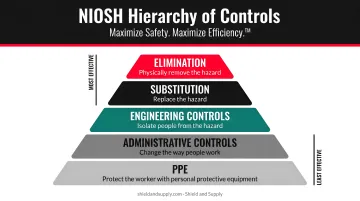
Relying on PPE without addressing root causes is one of the most common compliance gaps OSHA cites.
Education and Training
Training must occur before exposure, in a language and vocabulary workers understand. Required documentation for each training session includes:
- Topic covered
- Date of training
- Trainer's name
- Employee acknowledgment signature
During inspections, missing records are treated as evidence the training never occurred.
Program Evaluation and Improvement
OSHA recommends reviewing the program periodically — initially and at least annually — and after any incident, near-miss, or significant change in equipment or processes. Annual audits provide documented evidence of continuous improvement.
Required Written Safety Plans for OSHA Compliance
OSHA requires written safety plans for dozens of workplace activities — and a clean incident record offers no protection if a required plan is missing. These five written programs appear most frequently in citations across industrial facilities.
Emergency Action Plan (29 CFR 1910.38)
Required in writing for employers with more than 10 employees. Must include:
- Procedures for reporting fires and emergencies
- Evacuation routes and assignments
- Process for accounting for all employees post-evacuation
- Contact information for plan administrators
- Rescue and medical duties where applicable
Hazard Communication Program (29 CFR 1910.1200)
Any employer with hazardous chemicals on-site must maintain a written HazCom program. It must describe how the facility manages:
- Chemical labeling
- Safety Data Sheets (SDS), maintained and accessible to all employees
- Employee training
- A list of all hazardous chemicals present, identified by product identifier matching the SDS
HazCom ranked #2 on OSHA's FY 2025 Top 10 Most Frequently Cited Standards list. For most industrial facilities, that makes it the written plan most likely to generate a citation.
PPE Hazard Assessment and Certification (29 CFR 1910.132)
Employers must conduct and document a formal PPE hazard assessment before requiring employees to use PPE. The written certification must include:
- Location(s) assessed
- Assessor's name and date
- Confirmation it was completed prior to PPE use requirements
Lockout/Tagout Energy Control Program (29 CFR 1910.147)
Where PPE addresses what workers wear, LOTO governs how machinery is made safe to work on. This program is required for any workplace with machinery having more than one energy source, and must include:
- Step-by-step energy control procedures for each piece of equipment
- Employee training requirements
- Documentation of periodic inspections — conducted at least annually, certified with the machine name, date, employees involved, and inspector's identity
Fire Prevention Plan (29 CFR 1910.39)
Required in writing for employers with more than 10 employees. Must include:
- A list of major fire hazards and their controls
- Procedures for handling and storing flammable/combustible materials
- Maintenance protocols for ignition-source equipment
- Named employees (or job titles) responsible for fuel-source hazard control
OSHA Safety Signage and Hazard Communication Requirements
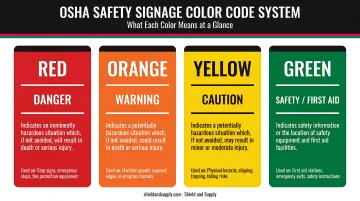
OSHA requires employers to use color codes, labels, posters, and signs to alert workers to hazards. Under 29 CFR 1910.144 and 1910.145, the color-coding system works as follows:
| Color | Meaning |
|---|---|
| Red | Danger, stop, fire protection equipment |
| Orange | Warning (hazardous machinery, equipment) |
| Yellow | Caution — physical hazards, slip/trip/fall risks |
| Green/White | Safety instructions, emergency exits |
GHS Label Requirements Under HazCom
All containers of hazardous chemicals must carry compliant labels including:
- Product identifier
- Hazard pictogram(s)
- Signal word (Danger or Warning)
- Hazard statement(s)
- Precautionary statement(s)
- Manufacturer/importer name, U.S. address, and phone number
Unlabeled or improperly labeled containers fall under the HazCom standard — the same #2 most-cited OSHA violation in FY 2025.
Producing Compliant Labels In-House
The LabelTac® printer line from Shield and Supply is designed specifically for industrial compliance labeling. The LabelTac® Pro X ($1,299.99) handles supplies from 1/2" to 4" wide and functions as a dedicated GHS printer — producing chemical labels with pictograms, signal words, and hazard statements on industrial-grade vinyl rated for 5–10 years indoors or outdoors.
Larger facilities can step up to the LabelTac® 9 ($3,999.00), which prints labels and signs from 4" to 9" wide at up to 2,500 labels per day. Both printers include LabelSuite™ labeling software (a $299.99 value, free with purchase) — supporting OSHA compliance labels, GHS labels, lockout/tagout labels, pipe marking, and 5S labeling.
Print ribbons are scratch- and chemical-resistant, keeping labels legible in caustic or high-traffic environments.
Shield and Supply also carries SafetyTac® floor marking tape in OSHA-relevant colors — including red, yellow, orange, green, white, and black — available in hazard-stripe patterns for aisle and boundary marking. Producing labels and floor markings in-house eliminates vendor lead times and gives safety managers direct control over compliance gaps as they arise.
Recordkeeping and Reporting Obligations
OSHA Forms 300, 300A, and 301
Employers with more than 10 employees (in most industries) must log work-related injuries and illnesses. Key dates and requirements:
- Form 300A (annual summary) must be posted February 1 through April 30 each year
- Electronic submission via OSHA's Injury Tracking Application is required for establishments with 20–249 employees in listed high-hazard industries and all establishments with 250+ employees — deadline is March 2 following the covered year
- Establishments with 100+ employees in higher-hazard industries must also submit Forms 300 and 301 annually
Low-hazard industries and employers with 10 or fewer employees at all times during the prior calendar year are generally exempt from routine recordkeeping unless notified by OSHA or BLS.
Mandatory Reporting Timelines
Missing either deadline is itself a citable violation:
- Work-related fatality: Report to OSHA within 8 hours
- In-patient hospitalization, amputation, or loss of an eye: Report within 24 hours
Employee Access Rights
Workers, former employees, and their authorized representatives are entitled to the following:
- OSHA 300 Log access: Employers must provide a copy by the end of the next business day
- Medical and exposure records: Employees may access their own records under 29 CFR 1910.1020
- Enforcement: Obstructing either form of access is a direct violation of the OSH Act
Frequently Asked Questions
What are OSHA's requirements for a workplace safety and health program?
Federal OSHA doesn't mandate a single written program for all private employers, but the General Duty Clause requires eliminating recognized hazards — which functionally demands one. OSHA's recommended framework covers management leadership, worker participation, hazard identification, hazard control, and training. Many State Plan states go further with explicit written program mandates.
What are the 4 elements of VPP?
OSHA's Voluntary Protection Program (VPP) recognizes worksites with exemplary programs built on: management leadership and worker involvement, worksite analysis, hazard prevention and control, and safety and health training. VPP Star status means injury and illness rates are well below industry averages, verified through a rigorous on-site OSHA evaluation.
What are OSHA's safety signage requirements?
OSHA requires color-coded signs, labels, and posters to alert workers to hazards — red for danger, orange for warning, yellow for caution. All hazardous chemical containers must carry GHS-compliant labels with pictograms, signal words, and hazard statements under 29 CFR 1910.1200.
What records and documentation does OSHA require employers to maintain?
Most employers with 10 or more employees must maintain OSHA Form 300 (injury and illness log), Form 300A (annual summary), and Form 301 (incident report). Written programs for HazCom, lockout/tagout, and emergency action plans must be kept on-site and available to employees on request.
How often does OSHA require employee safety training?
Frequency varies by standard. PPE and lockout/tagout training must occur before first exposure. Bloodborne pathogen and hearing conservation training must be repeated annually. Retraining is required whenever job duties change, new hazards are introduced, or prior training proves inadequate. Check the specific standard for each topic.
What are the penalties for not having required written safety plans?
Missing required written plans — such as a HazCom program or Emergency Action Plan — are citable violations. Current OSHA penalties (effective January 15, 2025): $16,550 per serious violation, and up to $165,514 per willful or repeat violation. State Plan states must maintain penalties at least as effective as these federal amounts.