Introduction
Manufacturing is one of the most hazardous industries in the U.S. — and the numbers reflect it. According to 2024 BLS data, manufacturing recorded 355,800 nonfatal injuries and illnesses, with a total recordable incidence rate of 2.7 per 100 full-time workers. The Bureau of Labor Statistics also reported 353 fatal occupational injuries in manufacturing that same year.
OSHA compliance isn't just a legal checkbox. It's the system that keeps those numbers from climbing. The cost of non-compliance — citations, penalties, litigation, lost productivity — consistently exceeds the cost of getting it right.
This guide covers the core regulatory standards under 29 CFR 1910, the violations that trigger the most citations, how to build a working compliance program, and what to expect when an OSHA inspector walks through your door.
TLDR: Key Takeaways
- Manufacturing facilities fall primarily under 29 CFR 1910 General Industry standards
- Top violations include hazard communication, lockout/tagout, machine guarding, powered industrial trucks, and respiratory protection
- Serious violations cost up to $16,550 per citation; willful or repeated violations reach $165,514 per violation
- A compliance program requires written safety plans, documented training, proper signage, and complete recordkeeping
- OSHA offers free, confidential on-site consultations for small manufacturers — no penalties, no citations
OSHA and Manufacturing: Understanding Your Legal Obligations
OSHA was established under the Occupational Safety and Health Act of 1970 with a clear mandate: protect workers from recognized hazards on the job. Today, OSHA oversees approximately 130 million workers at more than 8 million workplaces — and nearly every private-sector manufacturing facility is covered.
Federal OSHA vs. State Plans
Not every facility answers directly to federal OSHA. There are 29 OSHA-approved State Plans: 22 cover private-sector and state/local government workers, while 7 cover only state and local government employees. State Plans must be "at least as effective" as federal OSHA — and many are stricter. Check your state's jurisdiction before finalizing any compliance procedures.
Which Standards Apply to You
Two primary regulatory codes matter for manufacturers:
- 29 CFR 1910 (General Industry) — covers most manufacturing operations: chemicals, machinery, electrical systems, PPE, fire safety, and more
- 29 CFR 1926 (Construction) — applies to construction-specific work; not general manufacturing
Most manufacturing facilities fall under 29 CFR 1910 — but if your facility performs any construction or renovation work on-site, 29 CFR 1926 may apply to those activities as well.
The General Duty Clause
Even where no specific OSHA standard exists, employers can still be cited under Section 5(a)(1) of the OSH Act. This provision requires a workplace "free from recognized hazards" likely to cause death or serious physical harm — and OSHA has applied it to ergonomic risks, robotics, and automation equipment.
The key word is "recognized." If the hazard is known in your industry — including through equipment manufacturer warnings or industry association guidance — the General Duty Clause applies, regardless of whether a specific regulation addresses it.
Key OSHA Standards for Manufacturing Facilities (29 CFR 1910)
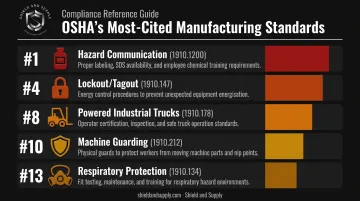
29 CFR 1910 is the regulatory backbone for most manufacturing operations. Its subparts span machinery, chemicals, electrical systems, walking and working surfaces, fire safety, PPE, and more. Below are the four standards most frequently cited in manufacturing.
Hazard Communication (HazCom) — 29 CFR 1910.1200
HazCom requires employers to:
- Maintain a written hazard communication program
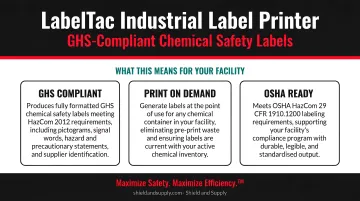
- Ensure all hazardous chemical containers carry GHS-compliant labels — including product identifier, signal word, hazard statements, pictograms, precautionary statements, and supplier contact information
- Keep Safety Data Sheets (SDS) accessible for every chemical in the facility
- Train workers on chemical hazards and how to read GHS label elements
Secondary containers — portable containers filled from labeled stock and not for immediate use — must also be labeled with at least a product identifier and general hazard information. Note that pipes are not classified as HCS "containers" and don't require GHS labels, but employees must still be trained on pipe hazards.
Keeping secondary container labels current is a recurring compliance gap, particularly when chemical inventory turns over frequently. Shield and Supply's LabelTac® industrial label printers address this directly: facilities can print durable, GHS-compliant labels on demand rather than waiting on pre-printed stock.
Control of Hazardous Energy — Lockout/Tagout (LOTO) — 29 CFR 1910.147
Before any employee services or maintains equipment, all hazardous energy sources must be isolated and locked out. The standard covers electrical, hydraulic, pneumatic, thermal, and mechanical energy.
Specific requirements include:
- Written energy control procedures developed and documented for each machine
- Employee training so authorized, affected, and other employees understand the program
- Annual inspection of each energy control procedure — not just a review of the written document, but a field verification
LOTO ranked #4 on OSHA's FY 2025 most-cited standards list. The gap between documented procedures and actual shop-floor execution is one of the most common citation triggers.
Machine Guarding — 29 CFR 1910.212
All machinery with moving parts must have guards that protect employees from point-of-operation hazards, ingoing nip points, rotating parts, flying chips, and sparks. Common violations:
- Guards removed for maintenance and never replaced
- Improper guard type for the specific hazard
- Unguarded nip points and rotating parts
Machine guarding ranked #10 on OSHA's FY 2025 list — it has appeared in the top 10 consistently for years.
Powered Industrial Trucks (Forklifts) — 29 CFR 1910.178
Forklift compliance has four key components:
- Operator certification based on successful completion of training and evaluation — written tests alone don't satisfy the requirement; practical performance evaluation in the workplace is mandatory
- Pre-shift inspections before each use (or each shift when forklifts run continuously)
- Refresher training required after any observed unsafe operation, accident, near-miss, or change in truck type or facility conditions
- Recurring evaluation at least every three years
Powered industrial trucks ranked #8 on OSHA's FY 2025 most-cited standards list.
Building Your OSHA Compliance Program: A Practical Checklist
A compliance program isn't a binder on a shelf. It's an active system with five foundational elements:
- Written safety and health program
- Regular hazard assessments and safety audits
- Documented employee training records
- Up-to-date emergency action plan
- Recordkeeping and reporting system
Conduct Hazard Assessments and Safety Audits
Walk the floor systematically and identify physical, chemical, biological, and ergonomic hazards for each work area and job task. Document findings, assign corrective actions, and track completion.
Audit frequency recommendations:
- Minimum annually for standard operations
- Quarterly for high-risk areas or processes
- After any incident or near-miss, regardless of scheduled intervals
Develop and Maintain Written Safety Programs
OSHA requires specific written programs for HazCom, LOTO, respiratory protection, and emergency action plans, and others. Generic templates aren't sufficient for inspections — programs must reflect your actual equipment, chemical inventory, and workflows.
Update programs whenever equipment changes, chemicals are added or removed, or personnel responsibilities shift.
Safety Signage and Labeling Requirements
Written programs set the rules — signage and labeling make them visible on the floor. Visual communication is a compliance requirement across multiple 29 CFR 1910 standards, covering:
- Chemical container labels and SDS accessibility
- Equipment warnings and LOTO procedural labels
- PPE requirement signs at entry points to hazardous areas
- Exit routes, floor markings, and restricted area warnings
Labels in manufacturing environments must withstand heat, moisture, chemical exposure, and abrasion. Shield and Supply's LabelTac® printers use weatherproof vinyl rolls rated for 5–10 years and come with LabelSuite™ software (a $299.99 value, free with every printer) that covers pipe marking, arc flash, LOTO, and GHS labels. The LabelTac® Pro X ($1,299.99) prints up to 4" wide; the LabelTac® 9 ($3,999.00) scales to 9" wide with output up to 2,500 labels per day — both backed by a full lifetime warranty on parts and labor.
OSHA Recordkeeping Requirements
Three core obligations:
| Requirement | Deadline/Frequency |
|---|---|
| Maintain OSHA 300 log of work-related injuries/illnesses | Ongoing |
| Post OSHA 300A summary | February 1 – April 30 annually |
| Submit data electronically via OSHA's Injury Tracking Application | By March 2 annually (for covered establishments) |
Electronic submission is required for establishments with 250+ employees that must keep OSHA records, and for those with 20–249 employees in listed high-hazard industries (manufacturing qualifies). Retain all 300, 300A, and 301 records for at least five years.
Employee Training, Recordkeeping, and Safety Culture
OSHA mandates training for virtually every major standard — but "we trained them" isn't enough. Training must be verifiable.
Building a Training System That Holds Up
A functional training program includes:
- A training matrix tracking which employees need which modules, completion dates, and evaluation results
- Practical components for standards like LOTO and forklift operation — OSHA requires workplace performance evaluation, not just written assessments
- Language-accessible training — OSHA's policy is explicit that required training must be delivered in a language and vocabulary workers understand
A solid training system is the foundation — but documentation alone won't prevent incidents.
Beyond Minimum Compliance: Building Safety Culture
Compliance programs that exist only on paper tend to fail at the worst moments. The elements that distinguish effective safety cultures:
- Leadership visibility — managers and supervisors who participate in safety walks and drills, not just sign off on paperwork
- Employees who feel safe flagging hazards without fear of retaliation report problems before they become incidents — build that channel deliberately
- Tabletop exercises build awareness, but live drills reveal execution gaps that paper-only exercises miss
- Documented SOPs with clear ownership and scheduled annual reviews prevent procedures from going stale
If any of these gaps feel overwhelming to address internally, there's a no-cost option worth knowing about.
OSHA's Free Consultation Program
OSHA's On-Site Consultation Program provides confidential safety and health services to smaller manufacturers — completely separate from enforcement. Consultants identify hazards and help improve safety programs with no citations and no penalties. Employers must correct serious hazards identified, but the process is entirely collaborative.
Preparing for an OSHA Inspection and Understanding Penalties
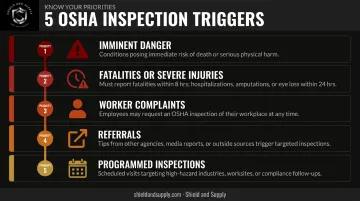
Five Triggers for an OSHA Inspection
- Imminent danger — highest priority; inspector can arrive without notice
- Fatalities or severe injuries — fatalities must be reported within 8 hours; inpatient hospitalization, amputation, or eye loss within 24 hours
- Worker complaints — OSHA investigates formal complaints from employees
- Referrals — from other agencies, media reports, or law enforcement
- Programmed inspections — scheduled under national or local emphasis programs targeting high-hazard industries
Have a documented inspection protocol ready: trained gatekeepers at the facility entrance, a designated management escort, and a clear policy on what documents to provide. Only produce records directly related to the matter under investigation.
Current OSHA Penalty Structure
Per OSHA's current penalty schedule (effective January 15, 2025, with no 2026 inflation adjustment):
| Violation Type | Maximum Penalty |
|---|---|
| Serious | $16,550 per violation |
| Other-than-serious | $16,550 per violation |
| Failure to abate | $16,550 per day beyond abatement deadline |
| Willful or repeated | $165,514 per violation |
A willful violation that results in an employee's death can also trigger criminal prosecution under Section 17(e) of the OSH Act.
Citations don't end the process — what you do next determines whether the same hazards resurface.
Post-Inspection Best Practices
- Conduct a root cause analysis for every cited hazard — not just the cited machine or area, but facility-wide
- Document corrective actions taken and retain that documentation
- Use citation data to proactively audit similar hazards before the next inspection cycle
Frequently Asked Questions
What are OSHA standards for the manufacturing industry?
Manufacturing facilities primarily fall under 29 CFR 1910 (General Industry), which covers hazard communication, machine guarding, lockout/tagout, PPE, powered industrial trucks, emergency action plans, and more. Specific subparts apply based on the hazards present in your facility.
Which companies have to comply with OSHA?
Virtually all private-sector employers in the U.S., including manufacturers of all sizes. Federal government workers are covered under a separate program. Some states operate their own OSHA-approved State Plans with requirements at least as strict as federal OSHA.
What are OSHA's most commonly cited violations?
The perennial top violations include fall protection, hazard communication, lockout/tagout, machine guarding, powered industrial trucks, and respiratory protection. Check OSHA's annually updated top-10 list for the most current rankings.
Can OSHA shut down a factory?
OSHA cannot directly order a facility-wide shutdown as a routine enforcement tool. In imminent danger situations, OSHA may petition a U.S. district court for a temporary restraining order. The more common outcome of inspections is citations, fines, and required abatement timelines.
What does 29 CFR stand for?
29 CFR is Title 29 of the Code of Federal Regulations (Labor). Part 1910 contains OSHA's General Industry standards for most manufacturing operations; Part 1926 covers Construction.
What are the 7 basic general industry safety rules?
The seven core rules under 29 CFR 1910 are: wear required PPE, follow lockout/tagout procedures, never bypass machine guards, know emergency procedures, report hazards immediately, follow HazCom protocols when handling chemicals, and complete all required safety training.