Introduction
Forklifts are common equipment in warehouses, manufacturing plants, and distribution centers — but common doesn't mean low-risk. According to the National Safety Council, 84 workers died in forklift-related incidents in 2024, and there were 25,110 DART cases (days away, restricted, or transferred) in 2023–2024, including 15,460 cases involving days away from work.
Each incident carries real operational costs: workers' compensation claims, equipment repairs, OSHA investigations, and lost productivity while a forklift sits out of service. A single citation under OSHA 29 CFR 1910.178 can run $16,131 per violation — and repeat violations reach $161,323.
Forklift compliance requires three things working together: properly trained operators, well-maintained equipment, and a correctly configured work environment. Most incidents trace back to a failure in one of these three areas — often an easily preventable one. This guide breaks down OSHA's forklift requirements, what training must cover, and how your facility can stay audit-ready.
Key Takeaways
- All forklift operators must be trained, evaluated, and certified by their employer before operating independently — OSHA places this obligation entirely on the employer
- Pre-operation inspections are required before every shift; defective forklifts must be removed from service immediately
- Operators must always wear a seatbelt, observe speed limits, keep loads low during travel, and yield to pedestrians
- OSHA penalties reach $16,550 per serious violation and $165,514 per willful or repeat violation
- Compliance covers more than operator training: floor layout, aisle markings, pedestrian separation, and signage all carry their own requirements
OSHA Forklift Safety: What the Standard Requires
The governing regulation is 29 CFR 1910.178, titled "Powered Industrial Trucks." It covers all types of powered industrial trucks — forklifts, pallet jacks, order pickers, reach trucks, and more — across warehouses, manufacturing facilities, retail distribution, and any other general industry setting.
The standard is built around three interconnected areas: how operators are trained, how equipment is maintained, and how the physical work environment is set up. Weaknesses in any one area create real compliance risk and real injury potential.
General Safety Precautions
Several baseline rules apply any time a forklift is in use:
- Seatbelts must be worn — forklift tip-overs are the leading cause of operator fatalities, and an unsecured operator can be crushed by the overhead guard
- Speed limits must be observed; under all travel conditions, a forklift must be driven at a speed that allows it to stop safely (§1910.178(n)(1) and (n)(8))
- Horns must be sounded at cross aisles and anywhere vision is obstructed (§1910.178(n)(4))
- Passengers are prohibited unless a safe, designated riding position exists (§1910.178(m)(3))
- Age and authorization: operators must be at least 18 years old and must complete employer-required training and evaluation before working independently
Pre-Operation Inspection Requirements
Under §1910.178(q)(7), every forklift must be inspected before each shift — or after each shift for equipment running around the clock. This isn't optional paperwork. OSHA's eTool specifies what a proper inspection covers:
- Fluid levels and visible leaks
- Tire condition and pressure
- Fork integrity and retaining pins
- Horn, lights, and backup alarm (if equipped)
- Brakes and steering response
- Seat belt and operator restraint devices
- Overhead guard and load backrest
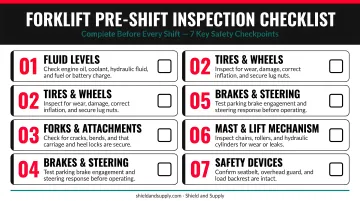
If a defect is found, §1910.178(p)(1) is clear: the forklift must be removed from service until it's restored to safe operating condition. Operators must not use equipment they know to be defective.
Safe Operating Practices
Load handling rules under the standard include:
- Never exceed the forklift's rated load capacity (displayed on the nameplate)
- Keep forks 6–12 inches off the ground during travel
- Ensure loads are properly balanced and secured before moving
Pedestrian safety is equally non-negotiable. Operators must yield to pedestrians at all times, never drive toward anyone standing in the travel path, and slow down at intersections and in congested areas.
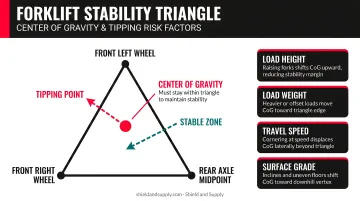
Tip-over risk warrants close attention. NIOSH data shows forklift overturns cause approximately 25% of all forklift-related fatalities — the single leading cause of forklift deaths.
The stability triangle (the three-point suspension system on most counterbalanced trucks) means the vehicle becomes unstable the moment its center of gravity moves outside that triangle. Turning too fast, overloading, or operating on uneven surfaces all shift that center of gravity dangerously. Three habit changes prevent most tip-overs: reduce speed before turns, stay within rated capacity, and slow down on grades and uneven surfaces.
Workplace and Environmental Safety Requirements
OSHA holds employers responsible for the physical work environment, not just the operators in it. Key requirements include:
- Aisle marking: per 29 CFR 1910.176(a), permanent aisles and passageways must be appropriately marked where mechanical handling equipment operates
- Lighting: where general lighting falls below 2 lumens per square foot, auxiliary lighting must be added to the truck (§1910.178(h)(2))
- Pedestrian separation: forklift traffic zones must be separated from pedestrian walkways using floor markings or physical barriers
Meeting those aisle marking and pedestrian separation requirements means keeping floor markings current — and waiting on outside contractors slows that down. Shield and Supply's LabelTac® printers — including the LabelTac® Pro X and the large-format LabelTac® 9 — let facilities print durable floor marking tape and safety signage on-site, on demand. Their SafetyTac® floor marking tape is available in OSHA-standard colors (yellow for traffic lanes, white for storage areas, red for hazard zones) and is rated to withstand forklift traffic, pallet drops, and industrial cleaning.
OSHA Forklift Training & Certification Requirements
OSHA does not issue forklift certifications. Under 29 CFR 1910.178(l)(1)(i), that responsibility falls entirely on the employer — who must ensure each operator is competent to operate safely, as demonstrated by completing required training and evaluation.
A card from a third-party training provider confirms classroom attendance — it doesn't satisfy OSHA's full requirement. The employer still owns the evaluation and certification.
What Forklift Training Must Include
Under §1910.178(l)(2)(ii), training must cover all three of these components:
- Formal instruction — classroom sessions, video-based training, or online courses covering required topics
- Practical hands-on training — supervised operation of the actual equipment in the actual work environment
- Performance evaluation — a qualified person assesses the operator's competence in the workplace
Online training alone does not fulfill OSHA's requirement. The hands-on and evaluation components cannot be completed remotely.
Required training topics under §1910.178(l)(3) include:
- Operator controls, instrumentation, and operating limitations
- Load handling, capacity limits, and stability
- Vehicle stability and the stability triangle
- Workplace hazards: pedestrians, ramps, blind spots, narrow aisles
- Refueling or battery charging procedures
- Site-specific conditions and environmental hazards
Training is also type-specific. An operator trained on a counterbalanced sit-down truck is not automatically qualified to operate an order picker, reach truck, or narrow-aisle vehicle. OSHA interpretations confirm that operators must be trained and evaluated for the specific type of truck they'll actually use.
Operator Certification and Recordkeeping
Proper certification records must include:
- Operator name
- Training date
- Evaluation date
- Identity of the trainer or evaluator
These records must be maintained by the employer and available during OSHA inspections. If a third-party trainer holds the records, the employer must be able to access them immediately.
Certification is also facility-specific and equipment-specific. An operator who transfers to a new site, switches to a different forklift type, or encounters significantly changed workplace conditions must be re-evaluated before operating independently.
One misconception worth addressing directly: a standard motor vehicle license does not qualify anyone to operate a forklift. OSHA requires a separate employer-issued certification based on documented training and evaluation — no substitutes.
When Retraining Is Required
Per §1910.178(l)(4)(iii), every operator must be formally evaluated at least once every three years. If the evaluation reveals unsafe habits or skill gaps, retraining must be completed before the operator continues.
Certain events trigger immediate retraining, regardless of where the operator is in that three-year cycle:
- Involvement in an accident or near-miss
- Observed unsafe operation
- Assignment to a different type of forklift
- A significant change in workplace conditions that could affect safe operation
Common OSHA Forklift Violations to Avoid
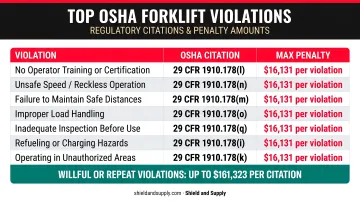
29 CFR 1910.178 ranked 8th on OSHA's FY2025 Top 10 Most Frequently Cited Standards — meaning forklift violations are showing up in inspections across the country on a regular basis. The most common gaps aren't unusual situations; they're predictable failures that facilities repeat.
Frequently cited violations:
| Violation | Regulatory basis |
|---|---|
| Untrained or uncertified operators | §1910.178(l)(1)(i) |
| Missing or incomplete training records | §1910.178(l)(6) |
| No daily pre-shift inspection logs | §1910.178(q)(7) |
| Unsafe load handling or overloading | §1910.178(l)(3) training topics |
| Inadequate pedestrian separation | OSHA eTool / 1910.176(a) |
| Unauthorized riders | §1910.178(m)(3) |
Two behavioral patterns create violations even in facilities with formal programs:
- Operators who skip inspections or ignore speed limits because the environment feels familiar — a pattern OSHA inspectors know to look for
- Supervisors who assume experienced workers don't need documentation or periodic retraining
Both are citable, and both show up in citations that could have been avoided with consistent documentation.
Those documentation failures carry a direct financial cost. Current OSHA penalty levels (no 2026 inflation adjustment per Federal Register, May 27, 2026):
- Serious, other-than-serious, or posting violations: $16,550 per violation
- Failure to abate: $16,550 per day beyond the abatement date
- Willful or repeat violations: $165,514 per violation
Penalties compound. A facility cited for multiple simultaneous violations faces cumulative fines, and a history of violations increases both the likelihood of future inspections and their severity.
One real-world example: OSHA issued four serious citations and $46,096 in proposed penalties to an airport services company after a forklift operator died when the mast struck an overhead structure and the truck tipped — the operator was not wearing a seatbelt, had not been trained and certified, and the damaged forklift had not been inspected before use.
Conclusion
OSHA forklift compliance runs on three parallel requirements: trained operators, maintained equipment, and a properly configured work environment. A gap in any one of them creates real exposure — for workers and for the business.
Treat compliance as an ongoing operational practice:
- Schedule and document pre-shift inspections every shift
- Keep training records current and accessible
- Evaluate operators at least every three years — and immediately after any triggering event
- Audit your floor markings, aisle signage, and pedestrian separation regularly
That last bullet deserves attention. Floor markings fade, signs get covered or removed, and aisles that were once clearly designated drift into congestion over time. Shield and Supply's SafetyTac® floor tape and LabelTac® printers let facilities reprint and reapply OSHA-compliant markings in-house, on demand, without coordinating outside vendors.
Frequently Asked Questions
What are OSHA requirements for forklifts?
Under 29 CFR 1910.178, the three core requirements are: all operators must be trained, evaluated, and certified by their employer; forklifts must pass a daily pre-shift inspection and be removed from service if defective; and the work environment must be properly configured with marked aisles, adequate lighting, and pedestrian separation.
What are the OSHA violations for forklifts?
The most commonly cited violations include untrained or uncertified operators, missing inspection and training records, unsafe load handling, excessive speed, and failure to separate forklift from pedestrian traffic. Serious violations carry fines up to $16,550 per citation.
Is OSHA forklift certification legit?
OSHA doesn't issue its own certifications — the agency requires employers to certify that each operator has been trained, evaluated, and found competent. Third-party training cards confirm classroom completion but cannot replace the employer's hands-on evaluation and site-specific sign-off.
What are 5 safety rules for a forklift?
Always wear your seatbelt, never exceed the forklift's rated load capacity, keep the load 6–12 inches off the ground during travel, yield to pedestrians at all times, and complete a full pre-shift inspection before operating.
How often do forklift operators need to be retrained?
OSHA requires a formal performance evaluation at least once every three years. Immediate retraining is required after any accident or near-miss, observed unsafe operation, switch to a different forklift type, or significant change in workplace conditions.
Can forklift training be completed entirely online?
Online training can satisfy the formal instruction component of OSHA's three-part requirement. However, hands-on practical training and an in-person performance evaluation must be completed in person before an operator is certified.