The financial exposure is just as serious. OSHA penalties for serious LOTO violations reach $16,550 per violation, with willful or repeated violations climbing to $165,514 per violation. And that's before accounting for production downtime, workers' compensation claims, and the investigations that follow a serious incident.
LOTO ranked #4 on OSHA's FY 2025 Top 10 Most Cited Standards list, with Safety+Health reporting 2,177 violations in FY 2025 — nearly 1,700 of them classified as serious. The procedure itself isn't complicated. What makes LOTO dangerous is how consistently facilities skip steps, misapply devices, or treat the program as paperwork rather than practice.
This guide covers everything required to implement LOTO correctly: the regulation, the devices, the seven-step procedure, and the program elements OSHA inspectors look for.
Key Takeaways
- LOTO is federally required under OSHA 29 CFR 1910.147 and covers all forms of hazardous energy, not just electrical
- The procedure follows seven steps: preparation, notification, shutdown, isolation, stored energy dissipation, lockout/tagout application, and verification
- Lockout physically secures the energy source; tagout warns others not to re-energize — use both whenever possible
- Compliance requires written energy control procedures, employee training, and annual program inspections
- The most dangerous LOTO errors are skipping stored energy release and using shared or duplicate keys
What Is Lockout Tagout (LOTO)?
LOTO is a formal safety procedure that ensures hazardous equipment is completely de-energized and cannot be restarted during servicing or maintenance. Under OSHA 29 CFR 1910.147, it applies to workplace activities including installing, adjusting, cleaning, lubricating, unjamming, and maintaining machines where workers may be exposed to unexpected startup or energy release.
The standard covers all energy sources — not just electrical. OSHA defines "energy source" as any source of electrical, mechanical, hydraulic, pneumatic, chemical, thermal, or other energy.
Why Stored Energy Is the Hidden Danger
A machine that's been switched off isn't necessarily safe. Stored or residual energy remains in systems after shutdown — and it causes injuries just as severe as a fully running machine.
Common examples of stored energy hazards:
- Pressurized hydraulic lines that haven't been bled down
- Charged capacitors in electrical systems
- Elevated machine members held up by gravity
- Compressed springs under tension
- Steam or thermal energy in pipes and vessels
A NIOSH review of 185 lockout-related fatalities found that failure to completely de-energize, block, or dissipate energy was a factor in 77% of incidents. Stored energy alone was identified in 13 fatalities.
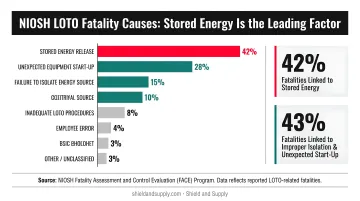
That risk profile explains why LOTO demands more than a switched breaker — it requires trained personnel, documented procedures, proper equipment, and regular audits.
Lockout vs. Tagout: Understanding the Difference
These two terms are often used interchangeably, but they represent different levels of protection.
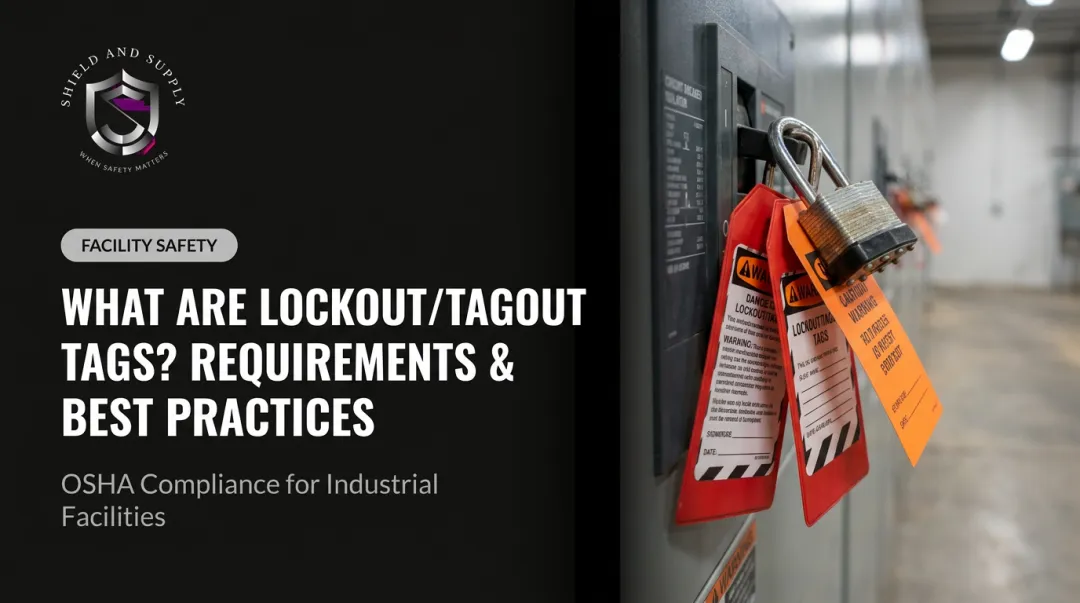
Lockout places a physical locking device — typically a padlock — directly on an energy-isolating device. That mechanical barrier means no one can re-energize the equipment without physically removing the lock.
Tagout attaches a visible warning tag to the same device, but provides no physical restraint. As OSHA states directly, tags "do not provide the physical restraint on those devices that is provided by a lock." They are warning devices, not prevention devices.
OSHA's decision rule comes down to one question:
- If the energy-isolating device can be locked out → use lockout (with a tag)
- If it cannot be locked out → use tagout, supplemented by an additional protective measure such as removing a circuit element, opening an extra disconnecting device, or removing a valve handle
LOTO Devices: Locks, Tags, and Lockout Equipment
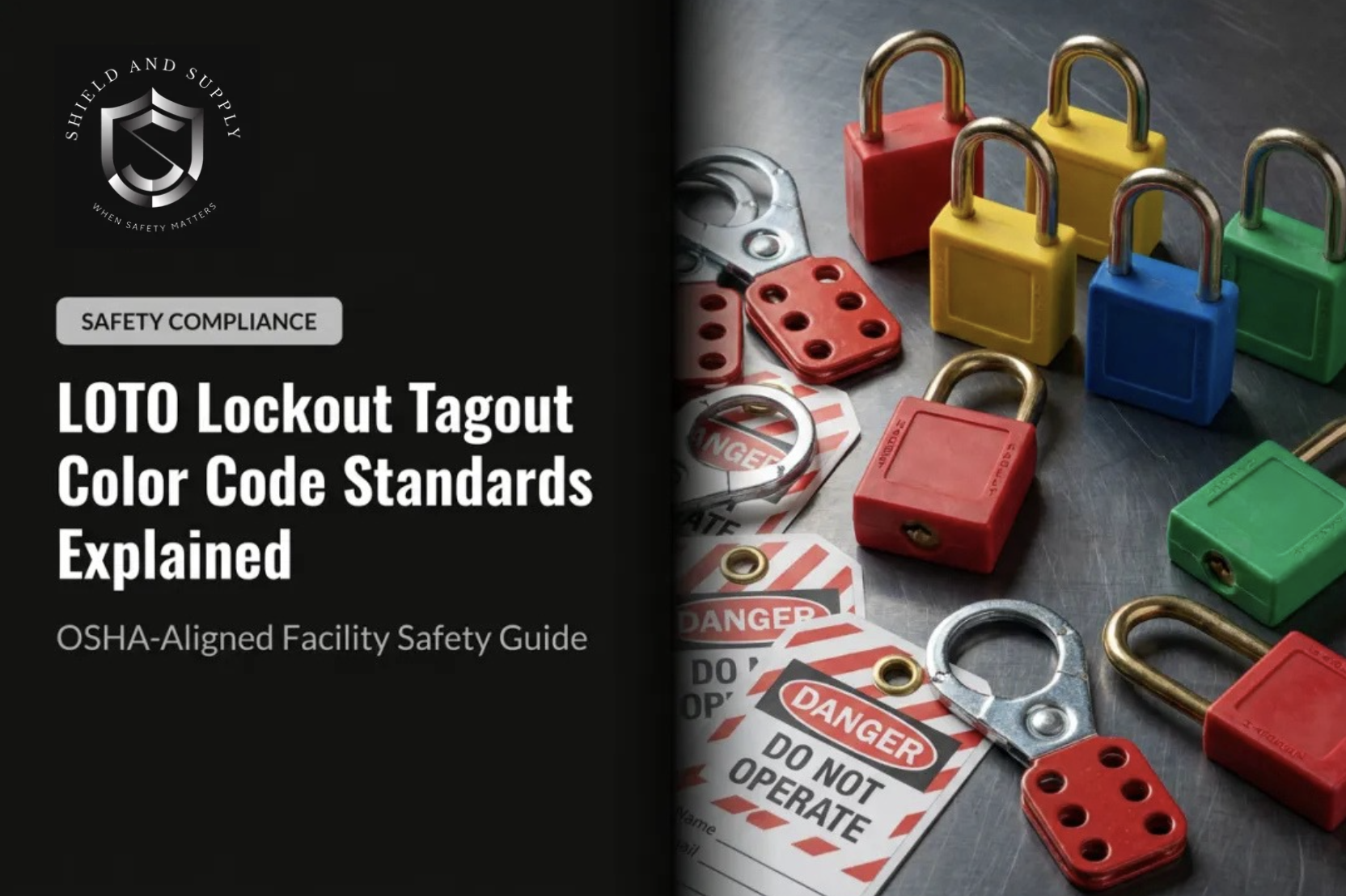
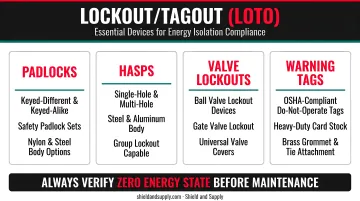
OSHA requires all LOTO devices to meet four specific criteria: durable, standardized, substantial, and identifiable. Devices must be used exclusively for energy control — not repurposed for other tasks.
Core Device Categories
| Device Type | Purpose | Key Requirement |
|---|---|---|
| Lockout padlock | Physically secures energy-isolating device | Individually keyed, employer-issued, one lock per authorized employee |
| Tagout tag | Warns others not to re-energize | Must identify the employee; print must remain legible in wet/harsh conditions |
| Circuit breaker lockout | Secures electrical disconnects | Must prevent re-energization without excessive force |
| Valve lockout | Secures ball valves, gate valves, etc. | Must fit the specific valve type and size |
| Hasp / group lockout box | Enables multiple locks on one isolation point | Used for group lockout — accepts one lock per worker |
| Plug lockout cover | Secures electrical cords from being plugged in | Common for portable equipment |
Tag attachments must be non-reusable, self-locking, non-releasable, and capable of withstanding a minimum unlocking strength of 50 pounds.
Group Lockout Boxes
When a machine has multiple energy isolation points — or when multiple workers are involved — a hasp or group lockout box allows every authorized employee to apply their own personal lock. The machine stays locked out until every single worker removes their lock. No one person can re-energize the equipment on behalf of the group.
Printing LOTO Tags On-Site
One compliance gap that surfaces in audits: outdated, illegible, or non-standardized tags in the field. Shield and Supply's LabelTac® industrial printers paired with LabelSuite™ software let facilities print durable, customized LOTO tags and energy control labels on demand. Vinyl supply rolls are rated for 5–10 years, and print ribbons produce scratch- and chemical-resistant output that holds up where paper tags deteriorate.
The Step-by-Step LOTO Procedure
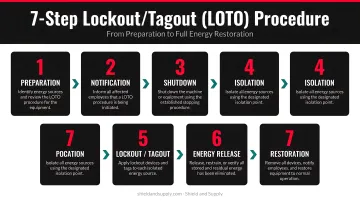
OSHA 29 CFR 1910.147(d)-(e) defines the application and removal sequence. Here's how each step works in practice.
Step 1: Preparation
Before touching anything, the authorized employee must:
- Identify all energy sources feeding the equipment (electrical, hydraulic, pneumatic, stored, thermal)
- Review the machine-specific energy control procedure
- Gather all required LOTO devices
Skipping preparation is one of the leading causes of incomplete lockouts — missing a single energy source means the equipment is never fully isolated.
Step 2: Notification
Notify all affected employees — anyone who operates or works near the equipment — that the machine will be shut down and locked out. Communicate:
- Which equipment is being locked out
- Why the shutdown is occurring
- How long it's expected to take
- Who the authorized employee is
Step 3: Shutdown and Isolation
Shut the machine down using its normal stopping procedure (stop button, closing valve, opening switch). Then physically operate each energy-isolating device to separate the equipment from its energy sources.
Critical distinction: Pushing a stop button is not isolation. The energy-isolating device must be physically moved to the safe position — a stop button only removes the command signal, not the energy supply.
Step 4: Lockout/Tagout Application
Apply the assigned personal lockout device to each energy-isolating device, then attach the tagout warning tag. Every authorized employee working on the equipment applies their own individual lock — never a shared lock, never a duplicate key.
Step 5: Stored Energy Dissipation
This step is skipped more often than any other, and workers have died because of it.
After locking out, all residual or stored energy must be released or restrained:
- Bleed down hydraulic pressure
- Discharge capacitors
- Block elevated machine members (ram blocks, safety pins)
- Release spring tension
- Allow thermal equipment to cool to a safe temperature
- Vent pressurized vessels
If energy can reaccumulate during the work, verification of isolation must continue throughout the task.
Step 6: Verification
Attempt to start the machine using its normal controls — after ensuring no personnel are in the danger zone. Non-activation confirms isolation.
If the machine responds, stop immediately and re-evaluate the lockout before any work proceeds.
Step 7: Restoration
Before re-energizing, complete each step in order:
- Remove all tools and materials from the machine
- Ensure all workers are clear of the equipment
- Replace all guards that were removed
- Have each authorized employee remove their own lock and tag
- Notify affected employees that the machine is returning to service
Lock removal rule: Only the employee who applied a lock may remove it. If that employee is unavailable, removal requires documented supervisor approval, confirmation the employee has left the facility, and direct notification to that employee before they return to work.
Building an OSHA-Compliant LOTO Program
A solid LOTO procedure on the floor is only as good as the program behind it. OSHA 1910.147 specifies four elements every employer must maintain.
Written Energy Control Procedures
OSHA requires employers to develop, document, and implement written energy control procedures for each machine or type of equipment. Each procedure must specify:
- Steps to shut down, isolate, block, and secure the machine
- How stored energy is released or restrained
- Device placement, removal, and transfer steps
- Testing and verification methods
There is a narrow exception: documentation isn't required when a single, readily identified energy source can be completely de-energized by one lockout device under exclusive control of the authorized employee — and no stored energy hazard exists. Most industrial equipment doesn't meet all these conditions.
Employee Roles and Authorization
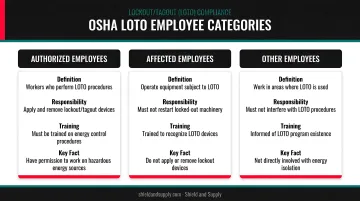
OSHA defines three employee categories under 1910.147:
| Category | Who They Are | Training Required |
|---|---|---|
| Authorized employee | Performs lockout/tagout; applies and removes devices | Full: energy sources, magnitude, isolation methods |
| Affected employee | Operates the equipment; must be notified | Purpose and use of LOTO program |
| Other employee | Works in the area but not on locked-out equipment | Prohibition on restarting locked-out equipment |
Training and Retraining Requirements
Initial training is required for all three categories. Retraining is required when:
- Job assignments change
- New equipment or processes are introduced
- Periodic inspection reveals gaps in knowledge or procedure compliance
Those gaps feed directly into the inspection cycle.
Annual Program Inspections
At minimum once per year, an authorized employee — someone other than the one using the procedure being reviewed — must inspect each energy control procedure.
The inspection must:
- Review the procedure with affected employees
- Identify and correct any deviations
- Be documented with the machine name, inspection date, employees involved, and inspector's identity
LOTO Documentation and Labeling at the Point of Use
Written procedures matter most when workers can reference them at the machine. Posted labels identifying energy sources, isolation points, and required steps reduce errors at the moment decisions get made.
Machine-level labels need to hold up in industrial environments, stay accurate as procedures change, and be replaceable without outside lead times. Shield and Supply's LabelTac® printers let facilities produce these labels in-house — customized per equipment, updated on demand. SafetyTac® floor marking tape can also demarcate lockout station areas, making them immediately visible to workers across the facility.
Common LOTO Mistakes to Avoid
Even well-documented LOTO programs break down in practice. These are the four failure points that show up most often — and the ones most likely to result in serious injury.
Skipping Stored Energy Release
The most dangerous assumption in LOTO: the primary power source is disconnected, so the machine is safe. A single pressurized hydraulic line or charged capacitor can cause the same injuries as a fully energized machine. This failure contributed to 77% of LOTO fatalities in NIOSH's review.
Shared or Master Keys
Any worker who has access to a master key can inadvertently remove another worker's lock and re-energize a machine while maintenance is still in progress. Each authorized employee must have their own uniquely keyed lock assigned exclusively to them — no exceptions.
Poor Shift-Change Communication
LOTO failures frequently occur at shift changes. If incoming workers start operating equipment without realizing a lockout is still active — or if an outgoing worker hasn't been formally relieved — the result can be fatal.
OSHA 1910.147(f)(4) requires a documented shift-change procedure. At minimum, that means:
- Outgoing and incoming authorized employees physically meet at the equipment
- Lockout responsibility is formally transferred before any lock is removed
- The incoming worker verifies the machine state independently
Treating LOTO as a Paperwork Exercise
Facilities with the highest incident rates often have procedures on file but no culture of enforcement. Effective enforcement requires:
- Regular audits that identify real deviations, not just check boxes
- Visible management accountability when procedures aren't followed
- Refresher training triggered by near-misses, not just formal retraining schedules
- Consistent enforcement regardless of production pressure
Frequently Asked Questions
What are the steps of lockout tagout procedures?
The seven LOTO steps in order: preparation, notification, shutdown, isolation, stored energy dissipation, lockout/tagout application (each worker applies their own lock), and verification. Always follow the machine-specific energy control procedure for the exact sequence.
What is the OSHA standard for lockout tagout and what does it require?
The primary standard is 29 CFR 1910.147 (Control of Hazardous Energy), covering general industry. It requires employers to develop written energy control procedures, provide LOTO devices, train all three categories of employees, and conduct at least annual inspections of each energy control procedure.
Who is authorized to remove a lockout/tagout device?
Only the authorized employee who applied the device may remove it. If that employee is unavailable, a supervisor must document approval, confirm the employee has left the facility, attempt to contact them, and notify them before they return to work.
What is required for a group lockout?
Each authorized employee must apply their own personal lock to a shared hasp or group lockout box. One authorized employee holds primary responsibility, and the equipment cannot be re-energized until every worker removes their lock — multi-crew situations require coordination across all groups.
What types of lockout/tagout devices are commonly used?
Common devices include individually keyed padlocks, circuit breaker lockouts, valve lockouts, plug covers, hasps, and warning tags. OSHA requires all devices to be employer-issued, standardized within the facility, durable, and used exclusively for energy control.
What is an energy-isolating device and what are some examples?
An energy-isolating device is a mechanical element that physically prevents the transmission or release of energy. Examples include manually operated circuit breakers, disconnect switches, line valves, and blocks. Push buttons, selector switches, and other control-circuit devices do not qualify as energy-isolating devices under OSHA's definition.