Introduction
Picture this: a maintenance technician approaches a piece of equipment mid-repair, spots a lock on the energy isolating device, and assumes it belongs to a colleague who has already cleared the machine. It doesn't. That assumption — made in seconds, in a noisy plant environment — is exactly how LOTO-related injuries happen.
Color coding exists to eliminate that ambiguity. When every lock and tag in your facility communicates status, hazard type, or ownership at a glance, workers don't have to guess.
OSHA estimates that compliance with 29 CFR 1910.147 — the federal standard governing control of hazardous energy — prevents 120 fatalities and 50,000 injuries each year. Despite that, lockout/tagout ranked No. 4 on OSHA's FY 2025 Top 10 most-cited violations, with a preliminary count of 2,177 violations reported by the National Safety Council.
This guide covers:
- What OSHA actually requires for LOTO color standardization
- What each color conventionally signals
- How to choose between hazard-based and responsibility-based systems
- How to build a documented program that holds up to inspection
Key Takeaways
- OSHA requires LOTO devices to be standardized by color, shape, or size, but does not mandate specific colors
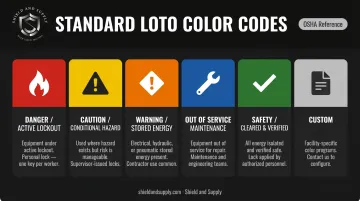
- Red = danger/active lockout, yellow = caution, orange = warning, blue = out-of-service/informational, green = cleared for use
- Facilities choose between hazard-based, responsibility-based, or hybrid color systems — each approach requires its own documentation
- Every color assignment must be documented, trained, and posted — not just assumed
- LabelTac® printers let facilities print custom LOTO tags on-site using color-matched vinyl rolls for any system they adopt
What Is LOTO Color Coding and Why Does It Matter?
Lockout/Tagout (LOTO) is a safety procedure used during equipment servicing and maintenance to prevent the unexpected release of hazardous energy — electrical, hydraulic, pneumatic, thermal, or mechanical. Color coding is the visual layer on top of that procedure. It lets workers identify the status, hazard type, or ownership of a lock or tag without needing to read fine print or track down the person who applied it.
Why Visual Identification Is Critical in Industrial Settings
In industrial environments, text-based communication routinely fails:
- Noise makes verbal confirmation unreliable
- Low visibility (poor lighting, PPE, distance) makes small text unreadable
- Language barriers exist in multilingual workforces
- Time pressure during shift changes encourages shortcuts
Color cuts through all of that. A red lock on an energy isolating device communicates "danger — do not touch" faster than any label.
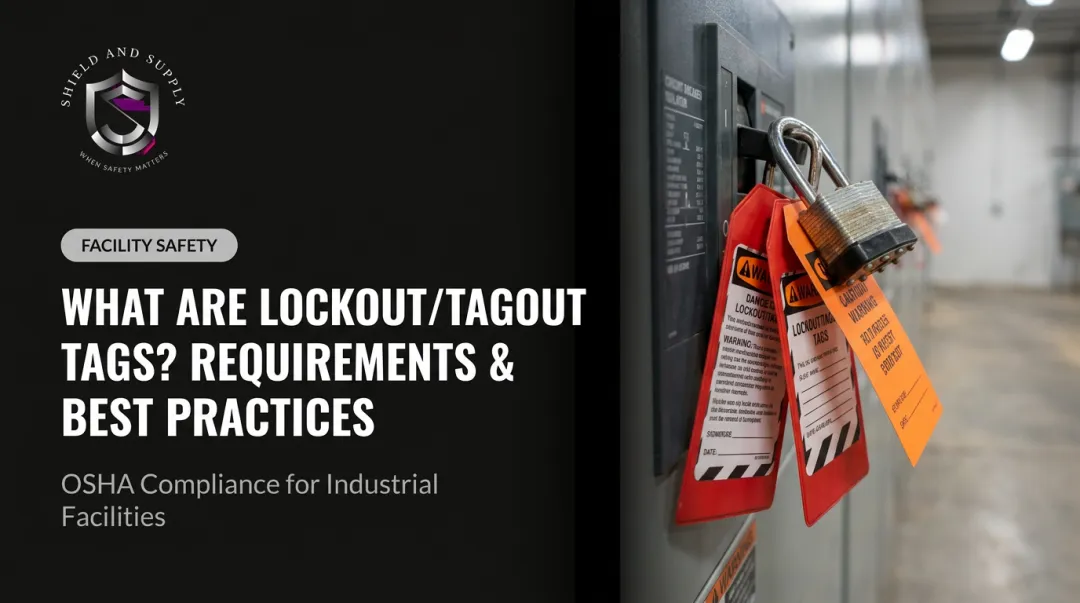
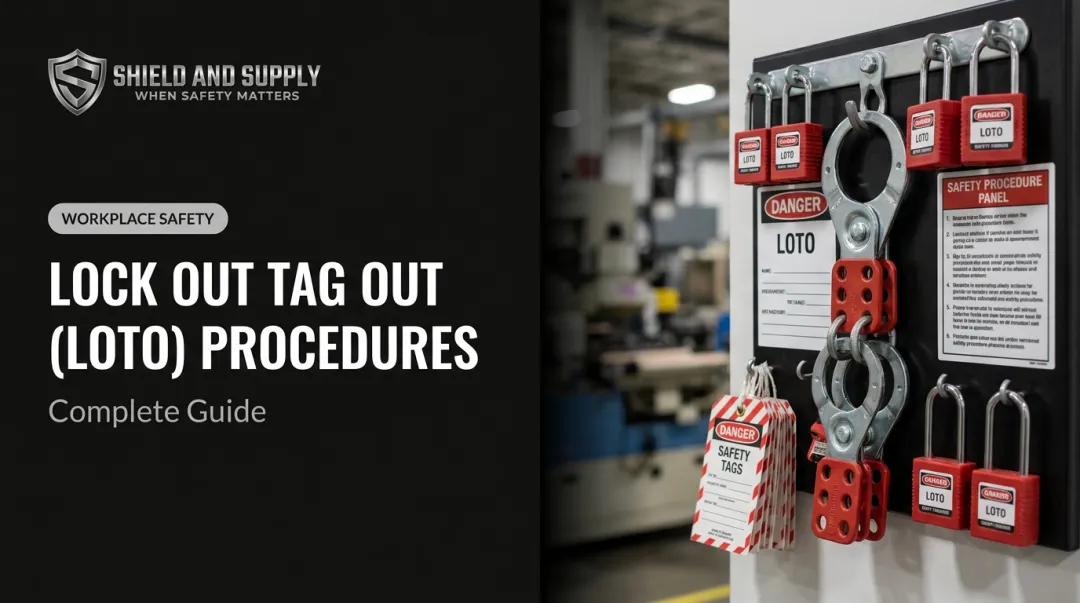
Color coding applies to both padlocks and LOTO tags, but they serve different purposes. Padlocks provide the physical barrier — the actual energy isolation. Tags communicate information: who applied the lock, what hazard is present, and what the equipment status is. Under OSHA 29 CFR 1910.147, both elements are required to work in tandem — and consistent color coding is what makes that system legible at a glance.
OSHA's Requirements for LOTO Color Standardization
What 29 CFR 1910.147 Actually Says
The primary regulatory framework for LOTO in general industry is 29 CFR 1910.147, the OSHA standard for control of hazardous energy.
The standardization requirement lives in 1910.147(c)(5)(ii)(B): LOTO devices must be standardized within the facility by at least one of three criteria — color, shape, or size. For tagout devices, print and format must also be standardized.
A common misread: OSHA does not require red locks. What matters is that your LOTO devices are visually distinguishable from every other lock in the workplace — security padlocks, equipment lockboxes, or anything else. As long as your LOTO locks are standardized and exclusive to energy isolation, the color is your call.
Full Device Requirements Beyond Color
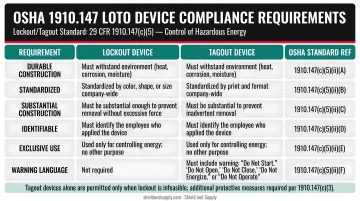
Color is just one piece of the device compliance picture. The full 1910.147(c)(5)(ii) requirements include:
| Requirement | What It Means |
|---|---|
| Exclusive use | LOTO devices are used only for energy control — never doubled as security locks |
| Singular identity | Each device must identify the authorized employee who applied it |
| Durable | Devices must withstand the environment for the full duration of exposure |
| Substantial (locks) | Cannot be removed without excessive force — bolt cutters, metal cutting tools |
| Substantial (tags) | Non-reusable, self-locking attachment with minimum 50 lb unlocking strength |
| Standardized | Consistent by color, shape, or size across the facility |
Where the Color Recommendations Come From
Those device requirements address what LOTO hardware must do — the question of which colors to use comes from a separate source entirely.
The color framework most facilities follow — red for danger, yellow for caution, orange for warning — actually originates in 29 CFR 1910.145 Appendix A, which covers accident-prevention signs and tags, not LOTO devices specifically. OSHA describes it as a recommended color scheme, not an enforceable LOTO mandate.
ANSI Z535.1-2022 and ISO 3864-1:2011 establish similar safety color conventions for signs and markings. These standards reinforce the conventions widely used in industrial facilities, but they don't override a facility's ability to define its own LOTO color system.
Any color system works — provided it is documented, consistent, and trained. Workers injured from hazardous energy exposure lose an average of 24 workdays for recuperation, which makes an informal or undocumented color system a genuine liability risk, not just a paperwork gap.
LOTO Color Codes Explained: What Each Color Signals
Most facilities follow conventions derived from OSHA's sign/tag color guidance and ANSI safety color standards. Here's what each color typically communicates:
Red — Active Lockout / Danger
Red is the most widely used LOTO color. "Danger / Do Not Operate" tags are almost universally red. Red locks signal an active lockout — the equipment is isolated and a worker is actively servicing it.
Every major standard points the same direction:
- OSHA 1910.145 Appendix A recommends red for DANGER-level accident-prevention signs
- ANSI Z535 uses red for DANGER signal panels
- ISO 3864-1:2011 assigns red to prohibition and stop conditions
This alignment is why red has become the go-to standard for LOTO padlocks even without an explicit regulatory mandate.
Yellow — Caution
Yellow indicates a potential hazard that requires attention but isn't immediately life-threatening. In LOTO programs, yellow tags or locks may signal equipment that is partially operational but restricted, or work areas requiring careful approach. OSHA recommends yellow for CAUTION-level signs; ANSI and ISO both use yellow for warning conditions.
Orange — Warning
Orange sits between yellow (caution) and red (danger) on the hazard scale. Some facilities use orange to distinguish a warning-level hazard — more serious than caution but not an imminent danger. Others assign orange specifically to external contractors or temporary workers to differentiate their locks from permanent in-house employees.
Blue — Out of Service / Informational
Blue typically signals equipment that is out of service but not under an active hazardous energy lockout — machinery awaiting scheduled maintenance or repair rather than active servicing. This distinction matters. A blue lock prevents a worker from confusing "scheduled for repair" with "actively locked out by a colleague." ANSI Z535 uses blue for NOTICE panels, which aligns with this informational function.
Green — Cleared for Use
Green indicates safety clearance — equipment that has been inspected and verified safe to operate. A green tag applied after all lockout steps are verified signals that energy has been restored and the machine is operational.
One important note: green should only be applied by authorized personnel who have confirmed that all locks and tags have been properly removed and all workers are clear.
Custom Colors
Some facilities add colors for specific hazard types (chemical, biological, electrical) or for distinct user categories. Custom colors are permissible, provided each one meets three conditions:
- Has a written definition in the facility's LOTO procedure manual
- Is communicated consistently across all signage and hardware
- Is covered during worker training before use
When those conditions are met, custom color schemes extend the system — rather than create confusion.
Hazard-Based vs. Responsibility-Based Color Coding
Facilities typically approach LOTO color coding in one of two ways.
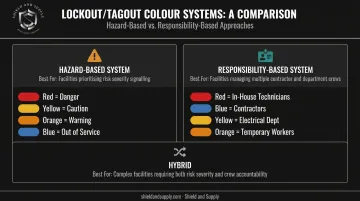
Hazard-based systems use color to communicate the type or severity of risk:
- Red = immediate danger
- Yellow = caution-level hazard
- Orange = warning-level hazard
- Blue = out of service
Responsibility-based systems use color to identify who applied the lock:
- Red = in-house maintenance technicians
- Blue = contractors
- Yellow = electrical department
- Orange = temporary or external specialists
Which Approach Fits Your Facility?
| Facility Type | Better Approach |
|---|---|
| Smaller facility, consistent workforce | Hazard-based — hazard type is the most useful communication |
| Complex site with multiple trades or contractors | Responsibility-based — ownership identification is more critical |
| Large facility with diverse hazard types and multiple crews | Hybrid system combining both |
Whichever direction the table points you, note that OSHA doesn't mandate either approach. The regulation requires standardization and documentation, not a specific philosophy. For multi-employer situations, 29 CFR 1910.147(f)(2) requires on-site and outside employers to inform each other of their respective LOTO procedures — color differentiation for contractors is a practical tool, not a regulatory mandate.
That said, a system no one understands is a system that fails. Document your chosen approach in your written LOTO program and verify that every worker who could encounter a locked-out machine knows what each color means.
How to Build Your Facility's LOTO Color Coding System
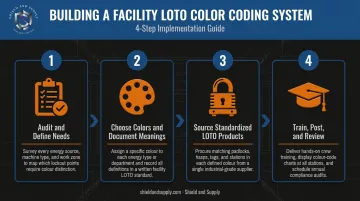
Step 1 — Audit and Define Your Needs
Start by mapping your maintenance activities, hazard types, worker categories, and departments involved in LOTO procedures. Identify:
- How many distinct trades or departments perform LOTO?
- Do contractors regularly work alongside in-house staff?
- What energy types are most common (electrical, hydraulic, pneumatic)?
- Are there specific hazards that warrant their own visual category?
This audit determines whether a hazard-based, responsibility-based, or hybrid system fits your operation.
Step 2 — Choose Colors and Document Meanings
Keep the system simple. Four to six colors is the practical ceiling — beyond that, workers struggle to remember distinctions, and sourcing enough consistent product variants becomes difficult.
Each color must have a clearly written definition in your LOTO procedure manual. For example:
- Red — Active lockout, authorized technician servicing equipment
- Blue — Equipment out of service, not under active hazardous energy control
- Orange — Contractor lock, outside servicing personnel
- Yellow — Caution, restricted operation only
Step 3 — Source Standardized LOTO Products
Consistency requires using the same color products across every location, shift, and crew. Facilities that need custom color-coded tags on short notice — or that update procedures frequently — can print them on-site using Shield and Supply's LabelTac® industrial label printers paired with LabelSuite™ software.
LabelTac® vinyl supply rolls come in red, yellow, orange, blue, green, and other colors, with matching print ribbons. Tags can be updated whenever procedures change, cutting the lag and cost of reordering pre-printed stock. The printers are built for industrial environments, with scratch- and chemical-resistant output that meets OSHA's durability requirements for LOTO tags.
Step 4 — Train, Post, and Review
Under 29 CFR 1910.147(c)(7), authorized employees must understand hazardous energy recognition and energy control methods. Affected employees must understand the purpose and use of the energy control procedure. Other employees in the work area must know not to restart locked-out equipment.
Beyond the regulatory floor:
- Post color code reference charts at LOTO stations, tool boards, and work area entry points
- Include color system explanation in new employee and contractor onboarding
- Review the system at least annually, per 29 CFR 1910.147(c)(6)(i), or whenever new hazard types, equipment, or worker categories are introduced
- Document all reviews with dates, employees covered, and the inspector's identity
Frequently Asked Questions
What does OSHA require for lockout/tagout?
OSHA's 29 CFR 1910.147 requires employers to establish a written energy-control program, use standardized LOTO devices (by color, shape, or size), train authorized and affected employees, and conduct annual inspections — all to prevent unexpected energization or release of hazardous energy during servicing.
What are the OSHA colors for lockout/tagout?
OSHA recommends — but does not mandate — a color framework from 29 CFR 1910.145 Appendix A: Red = Danger, Yellow = Caution, Orange = Warning, and fluorescent orange or orange-red = Biological Hazard. These are sign and tag color recommendations, not enforceable LOTO device color requirements.
What are the color codes for lockout/tagout?
The most common LOTO color conventions are: red for active lockout/danger, yellow for caution, orange for warning or contractor use, blue for out-of-service, and green for cleared/safe-to-operate. Specific meanings vary by facility — what counts is a documented, consistently applied program.
Do LOTO locks need to be red?
No. OSHA does not require LOTO locks to be red. The requirement is standardization by at least one of color, shape, or size. Red is the most widely adopted convention because it aligns with danger signaling across OSHA, ANSI, and ISO standards — but any color works if it's documented and exclusive to LOTO use.
What color is a personal lock in LOTO?
OSHA does not specify a color for personal locks. Many facilities assign each worker or department a specific color that corresponds to their role or status — for example, in-house technicians use red while contractors use orange. That color is then used exclusively for their personal lockout padlock.
What is the ISO standard for LOTO color coding?
ISO 3864-1:2011 establishes workplace safety identification colors — red = prohibition/danger, yellow = warning, blue = mandatory action, green = safe condition — that align closely with OSHA's recommended LOTO color framework. Note that ISO 3864-1 governs safety signs and markings, not LOTO device colors specifically.