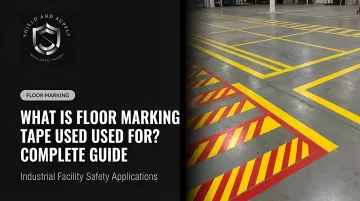
This guide is written for safety managers, warehouse supervisors, and operations leads who need a clear, practical reference. You'll find the primary uses of floor marking tape, color standards, tape types, OSHA compliance requirements, and a straightforward framework for choosing the right product.
The stakes are real: according to NIOSH, nearly 100 workers are killed and 20,000 seriously injured each year in forklift-related incidents alone. Floor marking is one of the most direct visual controls a facility can deploy to reduce that risk.
Key Takeaways
- Floor marking tape defines pedestrian walkways, forklift lanes, hazard zones, storage areas, and emergency egress routes
- OSHA 29 CFR 1910.176(a) requires permanent aisles and passageways to be appropriately marked where mechanical handling equipment is used
- Color coding follows OSHA 1910.144 and ANSI Z535.1 — yellow for aisles, red for danger, green for safety, and striped patterns for physical hazards
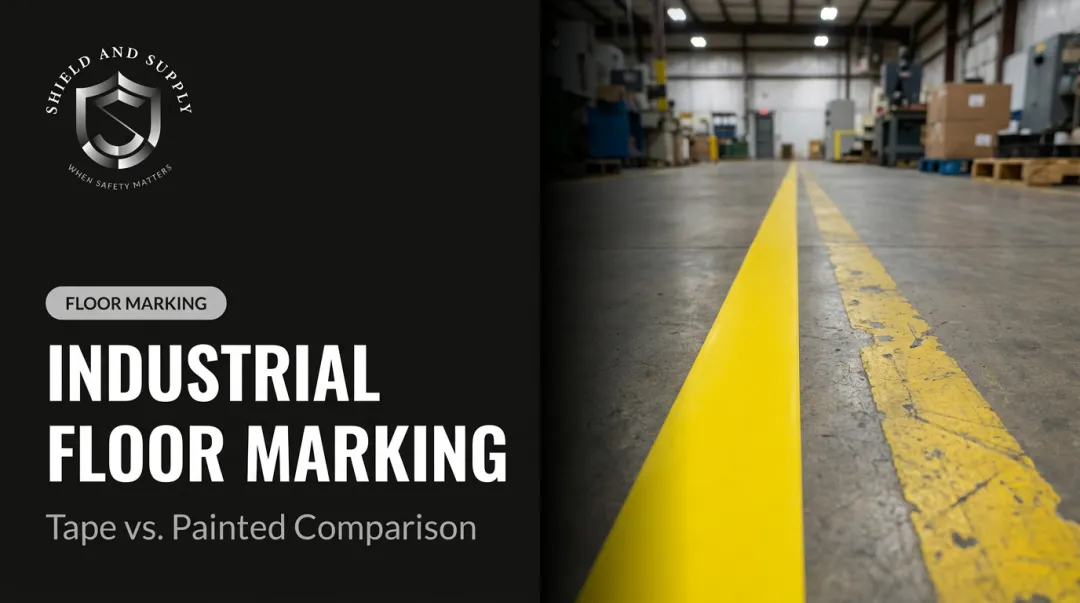
- Industrial vinyl floor tape outlasts paint with no downtime, no fumes, and easy repositioning when layouts change
- Tape selection depends on traffic type, environment, surface material, and required visibility
What Is Floor Marking Tape Used For?
Floor marking tape is a pressure-sensitive adhesive tape applied directly to facility floors to communicate visual information — zones, boundaries, hazards, directions, and compliance markers — without requiring paint, stencils, or permanent infrastructure.
It's used daily in warehouses, manufacturing plants, distribution centers, and food production facilities — and the applications span more ground than most people expect.
Pedestrian and Traffic Lane Marking
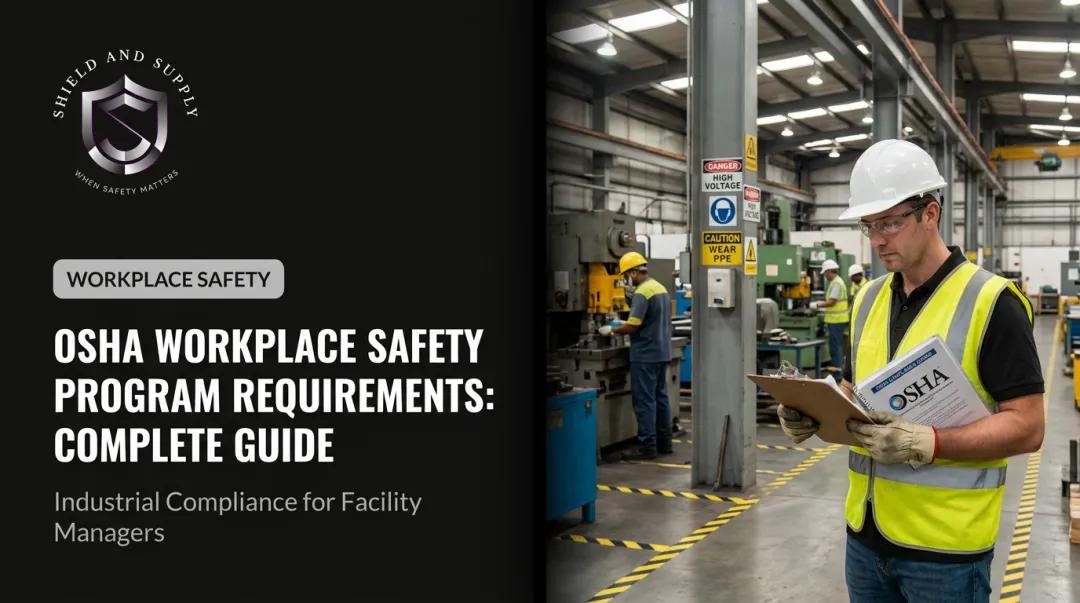
Keeping foot traffic separated from forklift routes is one of the most critical uses in any industrial facility. OSHA's Powered Industrial Trucks eTool explicitly recommends separating pedestrian and forklift traffic wherever possible, using protected walkways or designated pedestrian aisles where physical barriers aren't feasible.
Floor tape handles this visually and immediately:
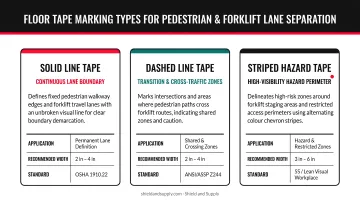
- Solid lane lines define aisle boundaries and keep workers out of forklift travel paths
- Directional arrows manage traffic flow through high-congestion corridors
- Footprint shapes guide workers along designated walking routes near machinery
Hazard and Danger Zone Identification
Striped or color-coded tape alerts workers before they enter a hazardous area — not after. Common applications include:
- Dangerous machinery perimeters
- Electrical panel clearance zones
- Chemical storage boundaries
- Slip-risk and wet floor areas
Around confined spaces, high-voltage areas, and forklift intersections, floor tape is typically paired with floor signs and wall signage to create overlapping visual cues. No single marker is sufficient on its own.
5S Workplace Organization and Storage Zone Marking
Floor marking tape is a core tool in 5S lean methodology (Sort, Set in Order, Shine, Standardize, Sustain). The Lean Enterprise Institute defines 5S as workplace practices conducive to visual control and lean production — and floor tape is the most practical way to implement the visual component.
Color-coded zones tell workers instantly:
- Where raw materials belong
- Where finished goods are staged
- Where defects and scrap are held
- Where carts, pallets, and equipment park when not in use
When something is out of place, it's immediately obvious without any instruction needed.
Emergency Egress and Safety Equipment Marking
OSHA 1910.37 requires exit routes to be adequately lit and exits clearly visible and marked. Floor tape supports this requirement by marking:
- Emergency exit routes and directional paths
- Fire extinguisher access zones
- First aid station approach paths
- AED equipment locations
Photo-luminescent (glow-in-the-dark) tape is particularly valuable here — it absorbs ambient light and remains visible during power outages, supporting egress visibility when overhead lighting fails.
Floor Marking Tape Color Code Standards
Color coding in industrial facilities is guided by OSHA 1910.144 (which mandates specific uses for red and yellow) and ANSI Z535.1 (a voluntary consensus standard that provides a broader color system). Consistency is the goal: workers need to read a color and understand its meaning instantly.
Here's how the standard colors break down:
Yellow
The most common color in industrial marking. OSHA 1910.144 defines yellow as the standard for caution and physical hazards — striking against, stumbling, falling, tripping, and caught-between hazards.
Use for: pedestrian aisles, traffic lanes, walkway edges, trip hazard boundaries. Yellow/black striped patterns intensify the warning for higher-risk zones.
Red
OSHA 1910.144 mandates red for fire protection equipment, danger, and stop functions.
Use for: fire extinguisher locations, emergency stop buttons, flammable material storage, emergency egress lines, and any area requiring an immediate stop action.
Green
OSHA 1910.145 Appendix A identifies green with safety instruction and first-aid equipment locations.
Use for: first aid stations, AED locations, safety equipment storage, general safe areas, and finished goods zones in 5S systems.
Orange and Blue
Both colors are supported by OSHA 1910.145 Appendix A as recommended color coding:
- Orange — dangerous parts of machines or energized equipment that can cut, crush, shock, or injure; relevant when machine guards are open
- Blue — out-of-service equipment or machinery under repair; also used in 5S for raw material storage areas
Striped Patterns
Stripes communicate elevated urgency. Common industry patterns:
| Pattern | Meaning |
|---|---|
| Black/Yellow | Extra caution near physical hazards or heavy machinery |
| Red/White | Clearance zones — fire equipment, electrical panels, emergency access that must stay unobstructed |
| Black/White | Housekeeping and operational keep-clear zones not tied to safety compliance |
| Green/White | Safety or 5S zone designations in some facilities |
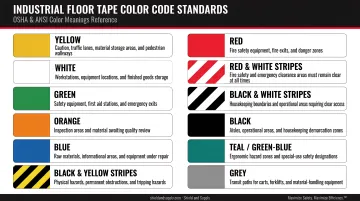
Note: OSHA mandates specific color meanings for red and yellow. Stripe patterns and broader color systems (orange, blue, green, black/white) are recommended industry practice, not federal mandates. Still, facilities that apply them consistently reduce confusion and make compliance audits faster.
Types of Floor Marking Tape
Not all floor tape performs the same way. Matching tape construction to your specific application — traffic level, environment, surface type — is what determines whether a marking lasts six months or six years.
Vinyl Floor Tape
Vinyl (PVC) tape is the most common industrial floor marking material. It resists abrasion, moisture, and chemicals, and it's available in solid colors, stripes, and diagonal patterns.
Shield and Supply carries the SafetyTac® line for vinyl floor marking applications:
- SafetyTac® (Original) — best-selling, durable and snag-resistant; available in 2", 3", 4", and 6" widths in 11 solid colors; from $120.00
- SafetyTac® Hazard — forklift and solvent resistant; Black/Yellow, Red/White, Black/White, and Green/White stripe patterns; from $159.00
- SafetyTac® Lean — lowest profile option, same tough construction, cost-effective; from $89.00
- SafetyTac® 2.0 — denser material, more aggressive adhesive, improved forklift-resistant profile; engineered to pass a forklift pivot test; from $110.00
All SafetyTac® products are rated for heavy forklift traffic and tested across a range of industrial temperatures and chemical exposures.
Anti-Slip Floor Tape
Anti-slip tape has a grit-coated surface that provides traction in areas prone to slips and falls — near loading docks, wet areas, ramps, and machine access points. It's available in solid and black/yellow striped patterns.
Glow-in-the-Dark and Reflective Tape
Photo-luminescent tape absorbs ambient light and glows in the dark — critical for emergency egress routes when power fails. Reflective tape uses retroreflective material to bounce light from forklifts or flashlights, improving visibility in areas with active vehicle traffic.
OSHA 1910.37 requires exit routes to be adequately lit and marked — photo-luminescent and reflective tape are among the most practical ways to meet that requirement in low-light or power-loss scenarios.
Specialty Formats: Shapes and Message Tape
Beyond roll tape, floor marking products include:
- Pre-cut arrows — directional flow markers at intersections and corridor entries
- Corner angles — define storage cell boundaries precisely (standard in 5S implementations)
- Dots — position markers for equipment, carts, or social distancing intervals
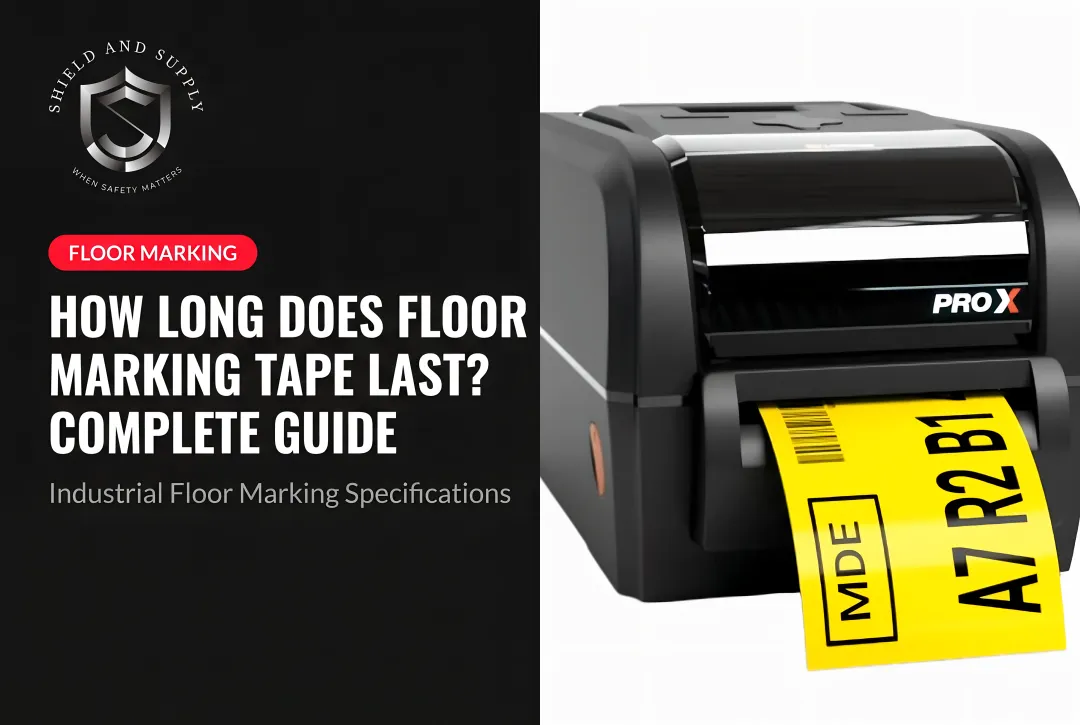
- Repeating message tape — prints "CAUTION," "DO NOT ENTER," or custom messages at regular intervals along the tape length
OSHA Requirements for Floor Marking
Three OSHA standards are directly relevant to floor marking:
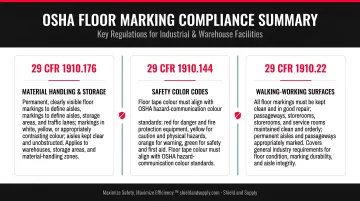
- 29 CFR 1910.176(a) — The primary aisle-marking requirement. Where mechanical handling equipment is used, permanent aisles and passageways must be marked. OSHA doesn't mandate tape specifically (paint, strips, and dots all qualify), but markings must clearly define the aisle and be maintained.
- 29 CFR 1910.144 — Mandates specific color uses for red and yellow safety markings.
- 29 CFR 1910.22 — Requires walking-working surfaces to be kept free of hazards.
A 1972 OSHA interpretation adds further specificity: marking lines should be 2 inches or wider (2–6 inches is the recommended range), and aisles must be at least 3 feet wider than the largest equipment used — or at least 4 feet where no mechanical equipment operates.
The penalty exposure is real: current OSHA maximums (2026 Federal Register) run $16,864 per serious violation and up to $168,641 per willful or repeated violation. A facility without clearly marked permanent aisles in a forklift environment is a citation waiting to happen.
One practical advantage of tape over paint: when your facility layout changes, tape comes up and goes back down in minutes. Staying in compliance as operations evolve is easier with a tape-based system. Shield and Supply's SafetyTac® floor marking tape is built for this kind of operational flexibility, and the company offers a free Floor Marking Guide for facilities working through their compliance setup.
Floor Marking Tape vs. Floor Paint
The comparison comes up often. Here's the honest breakdown:
Where tape wins:
- Installs immediately with zero drying time or ventilation requirements
- Safe for enclosed facilities and food production areas — no fumes
- Peels off and repositions in minutes; paint requires grinding or chemical removal
- Ships with stripes and hazard patterns built in, eliminating masking and multiple coats
- Industrial vinyl resists chipping, peeling, and forklift abrasion longer than standard floor paint
When paint is still a reasonable choice:
- Very large permanent floor areas in low-traffic zones where precise edges aren't critical
- Some outdoor environments where tape adhesion is less reliable due to UV exposure and moisture intrusion
- Facilities that already have a painted floor system and use tape only for precise hazard callouts
Most industrial facilities use tape as the primary system for aisle lines, hazard markings, and 5S zones — and some add paint for broad background zones. Where precision matters — edges, corners, color-coded zones — tape consistently outperforms paint.
How to Choose the Right Floor Marking Tape
Match Tape to Traffic Level
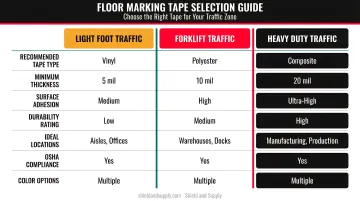
Traffic type determines the durability you need:
- Light foot traffic only — standard vinyl tape in 2" width is sufficient
- Mixed foot and forklift traffic — look for tapes with forklift-resistant profiles and aggressive adhesives; SafetyTac® 2.0 is designed for this
- Heavy forklift-only zones — thicker, denser tape with beveled edges that resist peeling from repeated wheel contact
Factor in Your Environment
| Condition | What to Look For |
|---|---|
| Wet or washed-down floors | Water-resistant adhesive, solvent-resistant backing |
| Chemical or solvent exposure | Chemical-resistant formulation |
| Cold storage / freezer | Specialty cold-rated tape; some formulations apply down to -13°F |
| High-temperature areas | Temperature-rated adhesive |
| Outdoor application | Tape typically not recommended; paint or specialty outdoor products |
Width and Visibility
OSHA's 1972 interpretation accepts 2 inches as the minimum. For high-traffic forklift zones, wider tape (3–4") improves visibility, especially from a forklift cab.
Also consider color contrast against your floor. Yellow tape on a yellow epoxy floor defeats the purpose — white or black-outlined markings may be more visible in that situation.
Surface Preparation
Once you've selected the right tape, proper surface prep determines how long it lasts. The floor must be clean, dry, smooth, and free of contaminants before any tape goes down — this directly affects adhesion life. Oily or heavily textured concrete may require degreasing or a primer coat first.
Frequently Asked Questions
Are floor markings required by OSHA?
Yes, for facilities using mechanical handling equipment. OSHA 29 CFR 1910.176(a) requires permanent aisles and passageways to be appropriately marked, and 1910.144 provides color guidance for red and yellow hazard markings. Floor tape is a widely accepted, inspection-ready method — OSHA's own interpretations confirm that paint is not the only compliant option.
What is the best floor tape for forklift traffic?
Heavy-duty industrial vinyl tape with a durable construction, adhesive, and a beveled or forklift-resistant edge profile. SafetyTac® 2.0 is specifically engineered to pass a forklift pivot test. Select tape by manufacturer traffic rating and product data sheet rather than by a generic mil number alone.
What materials can marking tape stick to?
Floor marking tape adheres best to smooth, clean, dry surfaces — sealed concrete, epoxy-coated floors, tile, and wood. Surface prep (degreasing and thorough drying) is essential; oily, heavily textured, or unsealed concrete may require a primer or specialty adhesive for lasting adhesion.
Does floor marking tape leave residue?
High-quality industrial floor marking tape is designed for clean removal without residue, especially when replaced within its recommended service life. Low-cost or general-purpose tapes (duct tape, packaging tape) are significantly more likely to leave adhesive residue and shouldn't be used for floor marking applications.
What tape color should I use for forklift traffic lanes?
Yellow is the standard OSHA/ANSI color for traffic lanes and aisles, including forklift routes. Yellow/black striped tape — like SafetyTac® Hazard in Black/Yellow — is appropriate for higher-risk forklift zones where extra visibility is needed.
What type of floor marking tape is strongest?
Industrial-grade vinyl floor tape with forklift-resistant construction is the most durable option. Look for products explicitly rated for forklift traffic, with a beveled edge profile and a strong adhesive system — and always verify against the manufacturer's product data sheet before purchasing.