This guide breaks down the practical differences between the two methods across installation time, durability, flexibility, cost, and compliance support — so you can make the right call for your facility the first time.
Key Takeaways
- Floor marking tape installs immediately with zero cure time; industrial paint requires 48–72 hours before vehicle traffic
- Heavy-duty PVC tape withstands forklift pivot turns that would visibly degrade paint within weeks
- Tape supports evolving 5S/Lean layouts — peel it up, reposition it, done; paint removal requires grinding or caustic chemicals
- Paint costs less upfront, but reapplication labor and downtime drive the total cost well above tape
- For most indoor industrial facilities, tape is the more practical, durable, and OSHA-compliant choice
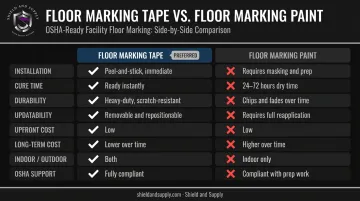
Tape vs. Paint: Quick Comparison
| Factor | Floor Marking Tape | Floor Marking Paint |
|---|---|---|
| Installation | Apply and use immediately | 48–72 hrs for vehicle traffic (epoxy) |
| Cure time | None | Up to 72 hours per manufacturer TDS |
| Durability | Withstands forklift pivots; colors intact | Chips and fades under heavy traffic |
| Updatability | Peel and reposition with minimal tools | Grinding, sanding, or caustic chemicals required |
| Upfront cost | Higher per linear foot | Lower per linear foot |
| Long-term cost | Lower (less reapplication) | Higher (labor + downtime for recoating) |
| Indoor/Outdoor | Primarily indoor | Indoor and outdoor |
| OSHA support | Color-coded, pre-printed formats available | Basic color coding; no pre-printed options |
Installation Time
This is where tape wins decisively. Press it down and you're done. No cordoning off sections, no ventilation requirements, no waiting for cure windows.
Paint requires the opposite approach. Rust-Oleum's industrial 100% solids epoxy floor coating (6600 System) specifies 48–72 hours before vehicle traffic at 70–80°F. Sherwin-Williams ArmorSeal 8100 lists 48 hours for heavy traffic. In a facility running two or three shifts, that downtime has a real operational cost.
Flexibility and Updatability
5S and Lean programs require layouts to evolve. Tape accommodates that — pull it up, reposition, apply new tape. A layout change takes hours, not days.
Repainting is a multi-day project. Surface prep alone adds significant time before a single line is applied:
- Degreasing and etching the existing floor surface
- Waiting up to 30 days for new concrete to cure (per Rust-Oleum's guidelines)
- Removing old paint with belt sanders or chemical strippers
Each of those steps adds hours of labor and operational cost before the new layout even begins.
What Is Industrial Floor Marking Tape?
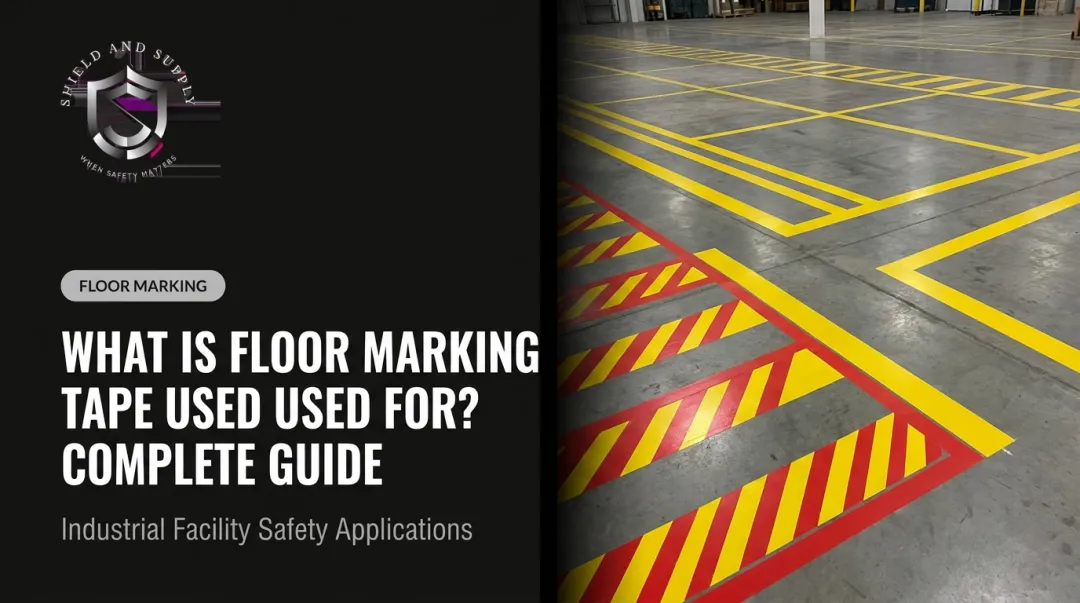
Industrial floor marking tape is a pressure-sensitive adhesive product (typically PVC or vinyl) engineered to bond to concrete, epoxy-coated, and tile floors in heavy-traffic industrial environments. It's the practical marking choice for warehouses, manufacturing plants, and distribution centers where safety zones need to stay visible and layouts need to stay flexible.
Core Operational Benefits
- Applies and opens to traffic immediately — no cure time, no production shutdowns
- Any team member can install it cleanly, with no specialized labor required
- Protective construction resists fading under cleaning chemicals and forklift traffic
Tape Formats to Know
Different applications need different tape grades:
- Standard vinyl — low-to-moderate foot traffic, workstation demarcation
- Heavy-duty PVC — forklift lanes, pallet zones, high-pivot areas
- Hazard stripe — OSHA color-coded boundary marking (black/yellow, red/white, etc.)
- Low-profile tape — minimizes snag risk in high-pallet-drag environments
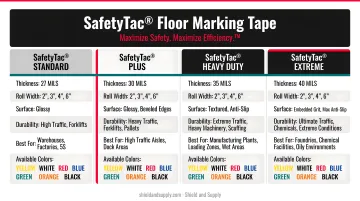
Shield and Supply's SafetyTac® line maps directly to these grades. Here's what each product is built for:
- SafetyTac® (standard) — best-seller; 2", 3", 4", 6" widths × 100' rolls; 11 color options; from $120
- SafetyTac® 2.0 — denser material, more aggressive adhesive, forklift pivot-tested; from $110
- SafetyTac® Lean — lowest profile; same tough construction for cost-effective durability; from $89
- SafetyTac® Hazard — hazard stripe patterns (black/yellow, red/white, black/white, green/white); from $159
Where Tape Fits in Daily Operations
Tape is the practical choice for:
- Separating pedestrian walkways from forklift corridors
- Outlining equipment staging and storage zones
- Marking emergency egress paths
- Color-coding workstations in 5S environments
Industries where tape dominates include warehousing and distribution, automotive manufacturing, food processing, and any facility where layout changes make multi-day paint shutdowns impractical.
What Is Industrial Floor Marking Paint?
Industrial floor marking paint is a liquid coating — available in epoxy-based, polyurethane, or water-based acrylic formulations — applied by roller or brush to create boundary lines and zone markings on concrete or sealed floors. For large-scale industrial and outdoor applications, it's been the default marking method for decades.
How It Works
Once cured, paint bonds directly to the floor surface. Two-component epoxy systems (like Rust-Oleum 6600 or Sherwin-Williams ArmorSeal 8100) offer solid chemical and abrasion resistance for indoor industrial concrete. Polyurethane formulations handle temperature fluctuations and abrasion well.
Water-based acrylics (like Valspar Zone Marking Paint) dry faster but are better suited to lighter-traffic applications — parking lots and warehouse floors with limited forklift exposure.
Critical Limitations
- Cure time — epoxy requires 48–72 hours before full vehicle use; operations must stop or route around marked areas
- Surface prep — new concrete must cure 30 days before coating (per Rust-Oleum 6600 TDS); degreasing and etching required
- VOC exposure — the EPA notes indoor VOC concentrations can run up to 10 times higher than outdoors; solvent-based paints require ventilation and can halt nearby operations
- Reapplication — paint wears, fades, and chips under forklift traffic; high-traffic facilities typically reapply every 1–3 years, even with properly prepped surfaces
Where Paint Still Makes Sense
Paint remains the practical choice for:
- Outdoor applications — parking lots, loading aprons, curbs (Rust-Oleum 2300 System and Valspar Zone Marking Paint are formulated for asphalt and concrete)
- Airfield and roadway markings — governed by FAA Advisory Circular 150/5340-1M and FHWA MUTCD standards; tape is not a viable substitute at scale
- Permanent, rarely changing layouts — when budget constraints favor lower upfront material cost and the layout won't need updates for years
- Existing painted systems — older facilities already operating on painted floor systems that aren't due for a full redesign
Which Is the Right Choice for Your Facility?
The honest answer depends on your facility's specific conditions. Here's how to think through it:
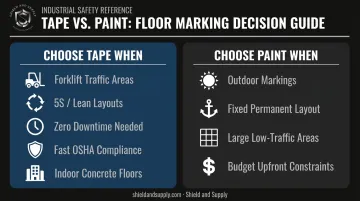
Choose Floor Marking Tape When:
- Forklifts and heavy equipment run over marked areas regularly
- Your facility uses 5S or Lean methodologies that require adaptable layouts
- Any marking downtime is operationally unacceptable
- You need OSHA-compliant markings installed quickly (new facility setup, compliance audit prep)
- Indoor concrete, epoxy-coated, or tile floors are the primary surface
Choose Floor Marking Paint When:
- Permanent outdoor markings are needed — parking lots, loading docks, airfield aprons
- Your layout is fixed and unlikely to change for several years
- Budget constraints limit upfront spend on a large, low-traffic area
- You're marking very large outdoor areas where tape coverage is impractical
OSHA Compliance — What the Standard Actually Says
OSHA 29 CFR 1910.22 requires that permanent aisles and passageways be appropriately marked. OSHA Directive STD 01-01-004 clarifies that the standard does not require painted floor lines specifically — alternatives including tape, traffic cones, and powder striping are acceptable if they clearly mark aisles and passageways.
Tape has a practical compliance advantage for two reasons:
- Consistent line width and visibility: Tape doesn't fade the way paint does under foot and forklift traffic, keeping markings audit-ready longer.
- Pre-printed hazard stripe formats: Available in patterns that match OSHA 1910.144 color codes (red for danger/fire equipment, yellow for caution and physical hazard zones).
The Real-World Case for Switching to Tape
Facilities that rely on paint for forklift-heavy zones often find themselves repainting on a cycle driven by traffic degradation, not scheduled maintenance. Every repainting event means production downtime, surface prep, cure time, and labor costs that aren't recoverable.
Heavy-duty PVC tape like SafetyTac® 2.0 is engineered to pass forklift pivot tests, the type of load that shears paint markings in high-traffic corners and staging areas within weeks. The upfront cost per linear foot is higher than paint, but the total cost of ownership favors tape when you account for reapplication frequency, labor, and lost production time.
For facilities exploring the switch, Shield and Supply's floor marking experts can help identify the right tape grade for specific traffic levels and compliance needs — call 1-877-514-0727 or explore the SafetyTac® floor marking tape line directly.
Conclusion
For most indoor industrial facilities — warehouses, manufacturing plants, distribution centers with active forklift traffic — floor marking tape is the more practical long-term solution. It installs without downtime, holds up under the traffic conditions that degrade paint quickly, and adapts when layouts change.
Paint still has a place: permanent outdoor markings, large-scale pavement applications, and situations where upfront material cost is the overriding constraint. But for facilities where OSHA compliance, operational continuity, and layout flexibility matter, the case for tape is straightforward.
Choose the wrong system and you're repainting or re-taping every few months — adding cost and pulling crews off productive work. Shield and Supply's industrial floor marking tape is built for the environments where paint falls short: high-traffic aisles, forklift zones, and facilities that need to reconfigure without downtime.
Frequently Asked Questions
Are floor markings required by OSHA?
Yes. OSHA 29 CFR 1910.22 requires that permanent aisles and passageways in general industry be appropriately marked. OSHA does not mandate a specific method — tape, paint, and other alternatives are all acceptable as long as they clearly delineate walkways and hazard zones.
What is the best floor tape for forklift traffic?
Heavy-duty PVC floor tape rated for forklift and industrial vehicle traffic is the right choice. Look for products specifically tested for forklift pivot loads — SafetyTac® 2.0, for example, is built with denser material and a forklift-resistant profile designed to pass pivot testing. Brady ToughStripe Max (0.022 in. thick) is another commonly referenced option.
What is the purpose of floor marking tape?
Floor marking tape visually delineates pedestrian walkways, forklift corridors, equipment staging zones, hazard areas, and emergency egress paths in industrial facilities. It supports both OSHA compliance and operational efficiency through clear, durable visual cues.
What kind of paint is used for floor markings?
Industrial floor marking paint is typically epoxy-based, polyurethane, or water-based acrylic. Epoxy (like Rust-Oleum 6600 or Sherwin-Williams ArmorSeal 8100) offers the best chemical and abrasion resistance for indoor concrete. Polyurethane suits outdoor or temperature-variable environments, while water-based acrylics are preferred indoors to reduce VOC hazards.
How long will marking paint last?
Lifespan depends on coating type, surface preparation, and traffic volume. In well-maintained, light-traffic areas, quality epoxy markings can last 3–5 years. High-forklift zones with inadequate surface prep or light-duty coatings can show visible degradation within months.
What tape can I use for a concrete floor?
PVC-backed or vinyl industrial floor marking tape with a pressure-sensitive adhesive is designed specifically for concrete. Clean the surface thoroughly before application — remove dust, oils, and debris. For concrete in forklift-traffic areas, heavier-grade tape is recommended; contact Shield and Supply at 1-877-514-0727 for guidance on the right grade for your specific application.