This guide is written for safety managers, operations leads, and HR teams at California manufacturing plants, warehouses, and industrial facilities. What follows is a practical, actionable compliance checklist — covering the IIPP requirement, hazard communication, recordkeeping rules, training mandates, and the violations inspectors cite most often.
Key Takeaways
- Cal/OSHA operates under Title 8 CCR and is stricter than federal OSHA in several key areas
- Every California employer must maintain a written, site-specific Injury and Illness Prevention Program (IIPP)
- Missing labels and incomplete SDS files are among the most frequently cited hazard communication violations in industrial settings
- Fatalities and serious injuries must be reported to Cal/OSHA within 8 hours
- Serious violation fines reach $25,000; willful or repeat violations go up to $162,851
Cal/OSHA vs. Federal OSHA: What California Employers Must Know
California operates an OSHA-approved State Plan administered through the California Department of Industrial Relations. The plan received initial federal approval in 1973, and in many respects it exceeds federal standards rather than simply mirroring them.
Three areas where Cal/OSHA goes further than federal OSHA:
- Mandatory IIPP — Every California employer with at least one employee must maintain a written Injury and Illness Prevention Program under Title 8 CCR §3203. Federal OSHA has no equivalent universal requirement.
- Heat illness prevention (indoor and outdoor) — Cal/OSHA covers outdoor workplaces under Title 8 §3395 and indoor workplaces under Title 8 §3396 (triggered at 82°F). Federal OSHA has not finalized a comparable indoor heat standard.
- Workplace Violence Prevention Plan (WVPP) — Under SB 553 (Labor Code §6401.9, effective July 1, 2024), most California employers must maintain a written WVPP and conduct annual employee training — a requirement with no federal general-industry equivalent.
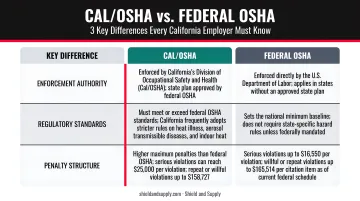
All three of these requirements apply broadly — because Cal/OSHA's jurisdiction covers virtually all California private-sector employers and most public employers. Narrow exclusions apply to federal employees, certain maritime operations, railroad safety, and other narrow categories. If you're operating a manufacturing plant, warehouse, or distribution facility in California, assume Cal/OSHA applies to you.
The Injury and Illness Prevention Program (IIPP): Your Compliance Foundation
Under Title 8 CCR §3203, every California employer must "establish, implement, and maintain an effective Injury and Illness Prevention Program." Cal/OSHA uses the word effective deliberately — a document filed in a drawer and never used won't pass inspection.
The IIPP must address eight required elements:
- Responsibility
- Compliance
- Communication
- Hazard assessment
- Accident and exposure investigation
- Hazard correction
- Training and instruction
- Recordkeeping
What a Compliant IIPP Must Include
The program must name a specific person responsible for safety — not just a job title — and establish a communication system that reaches all employees, including non-English speakers. It must also document a process for identifying, correcting, and tracking workplace hazards.
Generic templates downloaded from the internet rarely meet this standard. Cal/OSHA inspectors look for signs that the program reflects your actual operations. Outdated location names, references to employees who left years ago, or hazard lists copied from another site are common citation triggers.
Beyond the basics, a compliant IIPP must include:
- A procedure for ensuring employee compliance with safe practices
- A documented process for investigating incidents and near-misses
- A corrective action system that closes the loop after hazards are identified
IIPP Checklist Items for Industrial and Warehouse Employers
Run through these self-audit questions before your next inspection:
- Is the IIPP signed, dated, and updated within the last 12 months?
- Does it identify all current work areas and operations (forklifts, chemicals, machinery, confined spaces)?
- Does the named responsible person still hold that role?
- Are safety committee meeting minutes documented and on file?
- Are hazard assessments current and site-specific — not copied from a prior location?
- Is there a documented incident investigation process, and has it been used?
Hazard Communication and Safety Labeling Requirements
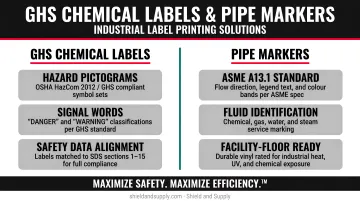
Cal/OSHA's Hazard Communication Standard, Title 8 CCR §5194, aligns with both the federal HazCom standard and the UN Globally Harmonized System (GHS). Every hazardous chemical in your facility must be identified, labeled, and accompanied by a Safety Data Sheet accessible to employees at all times.
HazCom violations consistently appear on Cal/OSHA's Top 10 Most Frequently Cited Standards list — making this one of the highest-risk compliance areas for industrial employers.
GHS Label Requirements
Every shipped container of hazardous chemicals must carry six required elements:
- Product identifier
- Signal word (Danger or Warning)
- Hazard statement(s)
- Precautionary statement(s)
- Pictogram(s)
- Supplier name, address, and phone number
Secondary containers and workplace containers must also be labeled with a product identifier and enough hazard information to protect employees. The one exception: portable containers filled for immediate use by the employee who transferred the chemical during a single shift.
SDS binders — or digital equivalents — must be current and complete. When a new chemical enters the facility (including common cleaning products), the corresponding SDS must be added immediately.
Visual Workplace Communication and Compliance Labels
Beyond chemical labeling, Cal/OSHA requires clear visual communication throughout the facility. Under Title 8 §3321, above-ground piping carrying hazardous substances must be identified at points where confusion could create hazards — using color bands, painted sections, or labeled abbreviations near valves and outlets.
Additional visual requirements include:
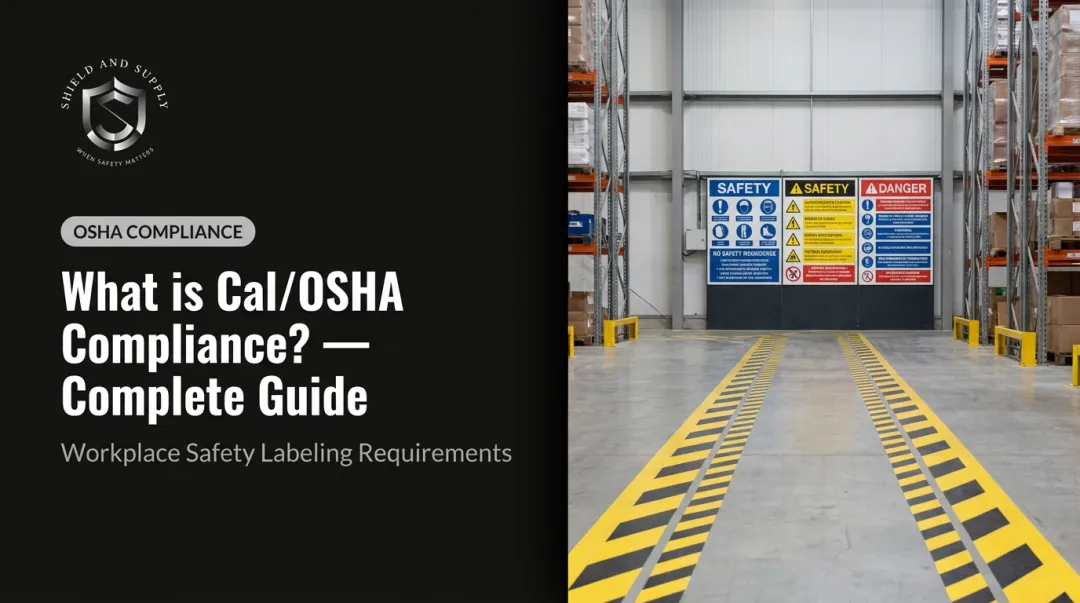
- Floor markings delineating walkways, work zones, and hazard areas
- Equipment safety labels and lockout/tagout tags on all energy isolation points
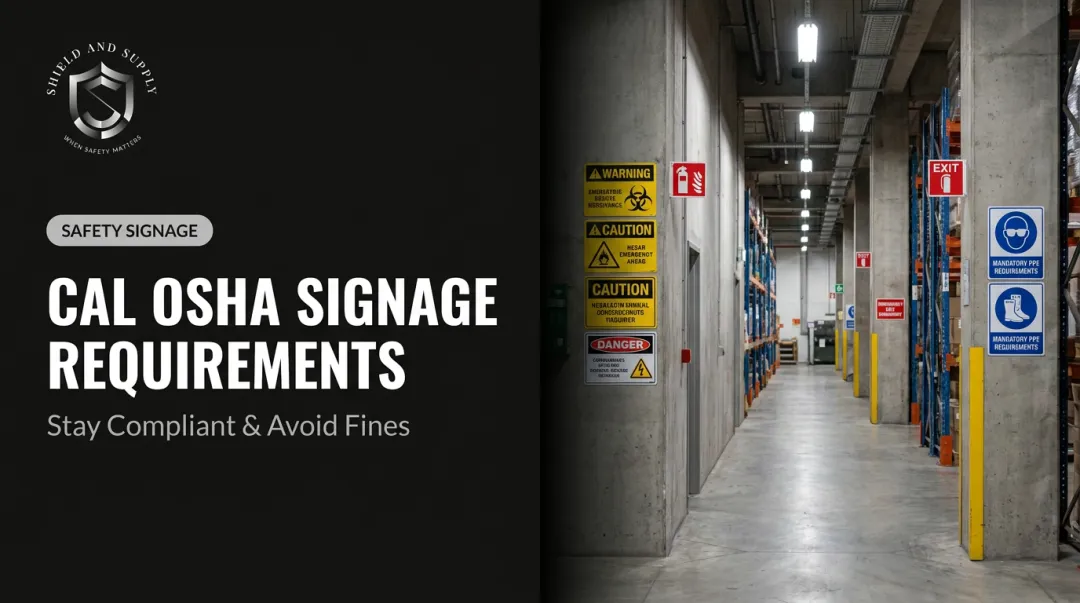
- Prominently posted safety signs at entry points and hazard areas
- Emergency information posted conspicuously near exits and workstations
Keeping up with labeling as new chemicals and hazards enter the facility is a persistent challenge. On-demand industrial label printers — such as Shield and Supply's LabelTac® line, paired with LabelSuite™ labeling software — let safety managers print GHS chemical labels, pipe markers, floor signs, and lockout/tagout tags without waiting on pre-printed orders. Built-in templates for OSHA compliance applications cover most common use cases out of the box.
Quick HazCom checklist:
- All hazardous containers labeled per GHS requirements?
- SDS accessible within the work area for every chemical on-site?
- Floor markings intact, legible, and reflective of current traffic patterns?
- Pipe markers installed on all applicable lines?
- Lockout/tagout labels present at all energy isolation points?
Recordkeeping, Posting, and Reporting Requirements
OSHA 300 Log and Annual Summary
Most employers with more than 10 employees must record all work-related injuries and illnesses that result in:
- Days away from work
- Restricted duty or job transfer
- Medical treatment beyond first aid
- Loss of consciousness
- Diagnosis by a licensed healthcare professional
Employers with 10 or fewer employees at all times during the prior calendar year are partially exempt under Title 8 §14300.1. Certain low-hazard industries carry an additional exemption under §14300.2.
Annual Posting and Electronic Submission
The OSHA Form 300A annual summary must be physically posted in a visible common area from February 1 through April 30 each year. Even if no recordable incidents occurred, the form must be completed with zeros, signed, and posted.
Electronic submission requirements:
- 250+ employees: Must submit Form 300A data electronically by March 2
- 20–249 employees in designated industries: Must submit Form 300A by March 2
- 100+ employees in high-hazard industries: Must also submit Form 300 and Form 301 data
Required workplace postings beyond the 300A:
- Cal/OSHA Safety and Health Protection on the Job poster (required under Labor Code §6328)
- Emergency telephone numbers posted conspicuously
- Evacuation routes and emergency procedures near exits and workstations
Incident Reporting Timelines
Under Title 8 §342, employers must report work-connected fatalities and serious injuries or illnesses to Cal/OSHA as soon as possible, but no longer than 8 hours after the employer knows or reasonably should have known. Serious injuries include inpatient hospitalization, amputation, or loss of an eye.
Failing to report on time is a separate citable violation, in addition to any underlying safety citation. Keep a documented notification process — who calls Cal/OSHA, what information is ready — so the 8-hour window doesn't slip during an already stressful incident response.
Training and Emergency Preparedness Requirements
Cal/OSHA mandates training as a core element of the IIPP. Training must occur:
- At time of hire
- When a new hazard is introduced
- When the IIPP is updated
All training must be conducted in a language and format the employee can understand. Attendance must be documented with sign-in sheets and training logs.
These documentation requirements apply to all training events — including the situation-specific triggers California imposes on industrial and warehouse environments.
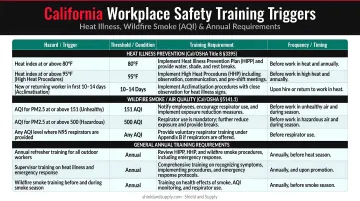
California-specific training triggers:
| Trigger | Requirement |
|---|---|
| Indoor temperature reaches 82°F | Heat illness prevention training and controls (Title 8 §3396) |
| Outdoor heat conditions | Heat illness prevention training before working in high heat (Title 8 §3395) |
| PM2.5 AQI hits 151 or above | Wildfire smoke training; N95 respirators available for voluntary use (Title 8 §5141.1) |
| PM2.5 AQI exceeds 500 | Respirator use becomes mandatory |
| Annual cycle | Workplace Violence Prevention Plan training required under Labor Code §6401.9 |
The Emergency Action Plan (EAP) must be written, site-specific, and actively communicated — not just filed away. A compliant EAP covers:
- Site-specific hazards and evacuation routes
- Employee roles and responsibilities during emergencies
- Procedures for reporting fires or other emergencies
- Communication with employees at hire and after every update
An EAP that lives only on a shared drive and has never been reviewed with staff does not satisfy the requirement. Employees must be able to demonstrate awareness of its contents.
Cal/OSHA's Most Commonly Cited Violations
Cal/OSHA publishes annual citation data through the DIR's Top 10 Most Frequently Cited Standards report. For industrial, manufacturing, and warehouse employers, citations cluster around a predictable set of areas:
| Violation Category | Why It Gets Cited |
|---|---|
| IIPP deficiencies | Generic, outdated, or unenforced programs — most common overall violation |
| HazCom/labeling failures | Unlabeled containers, missing SDS, inadequate employee training |
| Forklift/powered industrial truck safety | Operator certification gaps, missing pre-shift inspections |
| Machine guarding | Missing or bypassed guards on presses, conveyors, and cutting equipment |
| Lockout/tagout non-compliance | Absent procedures, unlabeled energy points, incomplete employee training |
| Recordkeeping errors | Inaccurate 300 logs, missing 300A signatures, late or absent electronic submissions |
A pattern worth noting: many citations in industrial settings stem from documentation gaps, not absent safety equipment. The guard may be present; the written procedure may not exist. Those documentation gaps carry real financial weight — and the penalty structure makes that clear.
Penalty Structure (Effective January 1, 2025)
Per the 2025 DIR penalty update:
- Serious violation: up to $25,000 per violation
- Willful or repeat violation: up to $162,851 per violation; minimum $11,632
These figures apply to citations issued on or after January 1, 2025. Cal/OSHA adjusts them periodically. For facilities with multiple violations across multiple pieces of equipment or employee exposures, the total can escalate quickly.
Frequently Asked Questions
What are Cal/OSHA compliance requirements?
Cal/OSHA requires California employers to maintain a written IIPP and follow Title 8 safety standards covering hazard communication, recordkeeping, training, PPE, and emergency planning — often exceeding federal OSHA minimums. The IIPP's eight mandatory elements must be implemented and enforced on-site, not merely documented.
What are Cal/OSHA's most commonly cited violations?
The most frequently cited categories are IIPP deficiencies, HazCom and labeling failures, forklift safety, machine guarding, lockout/tagout non-compliance, and recordkeeping errors. In industrial settings, citations often result from missing or outdated documentation rather than absent safety equipment.
What is the difference between Cal/OSHA and federal OSHA?
California operates an approved state plan under Title 8 CCR that must be at least as effective as federal OSHA — and in many cases is stricter. Cal/OSHA-specific requirements include the mandatory written IIPP, indoor heat illness prevention rules, and the SB 553 Workplace Violence Prevention Plan, none of which have direct federal equivalents.
Does Cal/OSHA apply to all California employers?
Cal/OSHA covers virtually all California private-sector and most public-sector employers, with narrow exceptions for federal employees and certain maritime and transportation categories. The IIPP requirement applies to essentially every employer with at least one employee.
What are the penalties for Cal/OSHA violations?
For citations issued on or after January 1, 2025: serious violations carry a maximum penalty of $25,000 per violation; willful or repeat violations carry a maximum of $162,851, with a minimum of $11,632. Facilities with multiple deficiencies can face penalties that compound across violations.
How often do Cal/OSHA inspections occur, and what triggers them?
There is no fixed schedule — high-hazard industries like manufacturing and warehousing face programmed inspections on multi-year cycles, while complaint-driven, referral, and post-incident inspections can occur at any time. Proactive self-auditing before an inspector arrives is the most reliable way to reduce exposure.