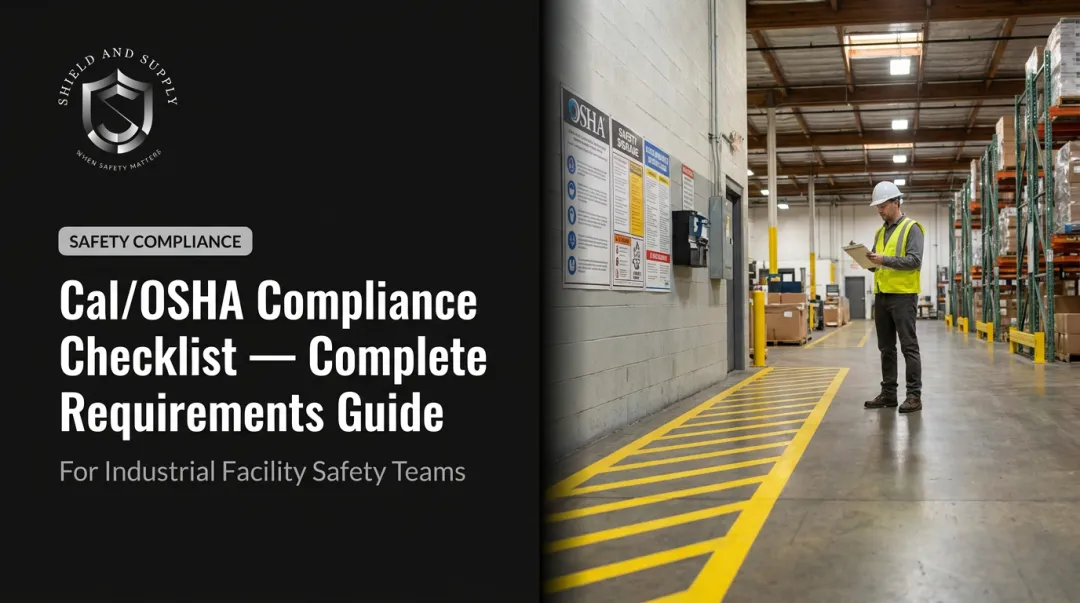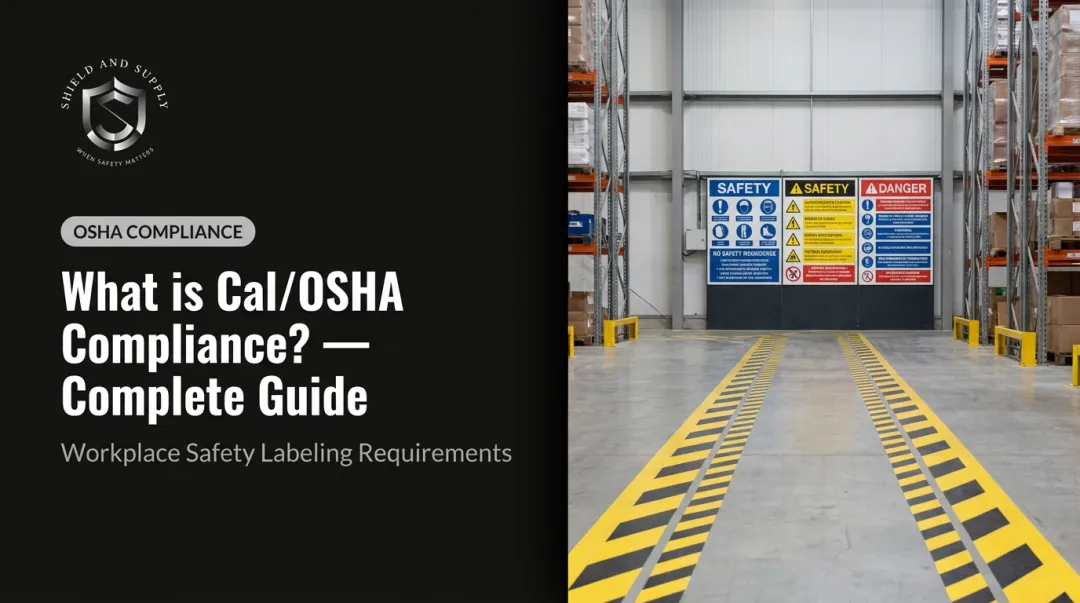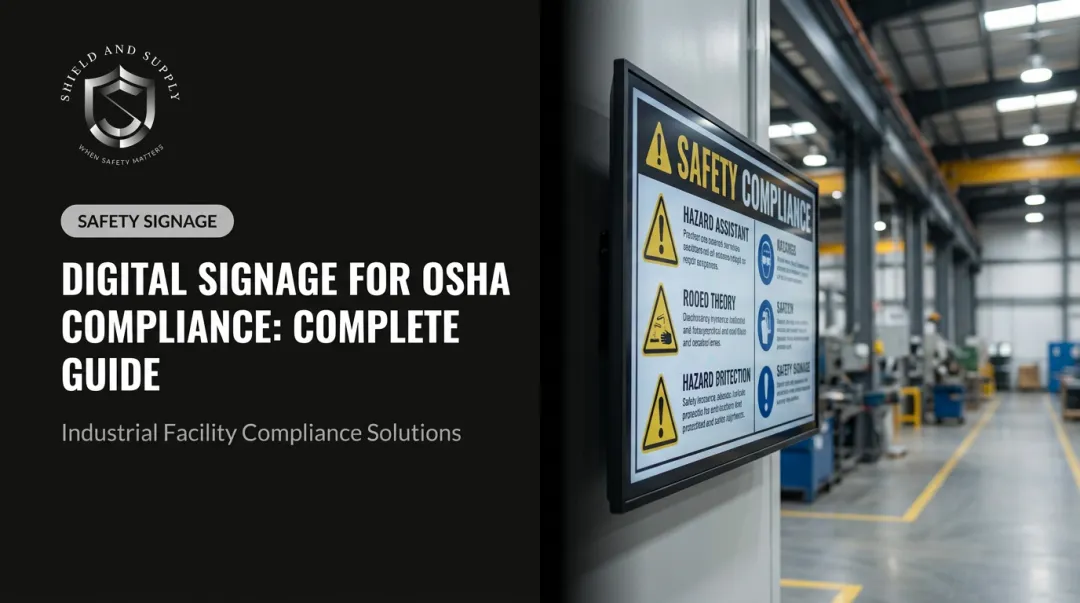
Missing required signage might seem like a minor paperwork issue, but inspectors treat it as a compliance failure. Failure to post the Cal/OSHA Notice alone can result in a fine up to $1,000 per violation — and if an injury follows an unmarked hazard, liability exposure compounds quickly.
This guide covers everything California employers need to stay current: the five Cal OSHA accident prevention sign types, required workplace poster obligations, design and posting standards, and the compliance mistakes that routinely generate citations.
Key Takeaways
- Cal OSHA (Title 8, CCR §3340) defines 5 accident prevention sign types: Danger, Warning, Caution, General Safety, and Biological Hazard — each with specific color requirements
- The "Safety and Health Protection on the Job" notice must be posted immediately upon receipt at every establishment; violations carry fines up to $1,000
- Required postings extend beyond safety signs: Form 300A (February–April), Minimum Wage Order, Workers' Comp notice, Paid Sick Leave, and Whistleblower Protections are all mandatory
- Cal OSHA adds a "Warning" sign category that federal OSHA does not include — relying on federal standards alone creates a compliance gap in California
- Compliance is ongoing — posted notices must remain current, legible, and in place at every location where employees work
Cal OSHA Signage Requirements: The Basics
Cal OSHA is administered by the Division of Occupational Safety and Health (DOSH) under the California Department of Industrial Relations. Its signage rules are codified in Title 8 of the California Code of Regulations.
California employers face two distinct compliance layers:
- Accident prevention signs — governed by §3340, these regulate hazard communication on the facility floor
- Required workplace notices and posters — governed by §340 and DIR mandates, these address worker rights and employer obligations
Both layers apply to all California employers regardless of size. For multi-location or physically dispersed operations — construction sites, transportation companies, warehouses with multiple buildings — required notices must be posted at each location where employees report daily or from which they operate.
That multi-location rule matters because Cal OSHA operates as a federally approved State Plan, meaning it must be at least as effective as federal OSHA standards — and in several areas it exceeds them. Assuming federal compliance covers your California obligations is a common and costly mistake.
Key Regulations to Know
| Regulation | What It Governs |
|---|---|
| Title 8 CCR §3340 | Accident prevention sign types, color specs, design requirements |
| Title 8 CCR §340 | Cal/OSHA Notice posting requirements, content, and fine structure |
| Title 8 CCR §336 | Civil penalty assessment ranges for violations |
| DIR Required Posters List | Wage orders, leave notices, anti-discrimination postings |
The 5 Types of Cal OSHA Safety Signs and When to Use Them
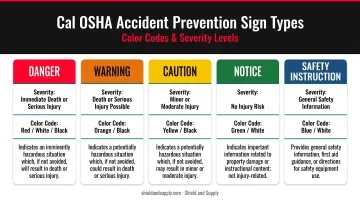
Federal OSHA's 29 CFR 1910.145 classifies accident prevention signs into three categories (Danger, Caution, Safety Instruction) plus biological hazard. California's Title 8 §3340 uses five. Each category carries specific color requirements and hazard thresholds — and using the wrong one can put you out of compliance.
Danger Signs (Highest Severity)
Color: Red, black, and white only
Reserved for situations where an immediate hazard exists. Employees must understand that a Danger sign signals imminent risk requiring special precautions before proceeding. This is the highest-severity classification — don't apply it to situations that are hazardous but not immediately life-threatening.
Warning Signs (Cal OSHA-Specific Category)
Color: Signal word WARNING in black letters on a rectangular orange background, or within a safety orange truncated diamond on a black background
This category sits between Danger and Caution and indicates a potentially hazardous situation that could result in death or serious injury if not avoided. Federal OSHA's sign classification has no equivalent Warning category. This is a California-specific requirement that employers familiar with federal standards routinely miss.
Caution Signs
Color: Yellow background, black panel, yellow letters
Used for potential hazards or unsafe practices where the risk is serious but lower-severity than a Warning or Danger situation. The distinction matters: using a Caution sign on a hazard that rises to Warning level means the sign doesn't meet California's legal standard.
General Safety Signs
Color: White background, green panel, white letters
These communicate general instructions and safety suggestions — not active hazard warnings. Common uses include:
- First aid station locations
- Safe exit route information
- Hygiene and sanitation reminders
- Emergency equipment locations
Biological Hazard Signs
Required wherever there is an actual or potential presence of infectious agents — on equipment, containers, rooms, or materials. The fluorescent orange or orange-red biohazard symbol must appear unobstructed:
- No other markings superimposed on the symbol
- Accompanying text goes around the symbol, not over it
Required Workplace Posters and Notices Under Cal OSHA
Safety signs handle hazard communication on the floor. Workplace posters cover worker rights and employer obligations. Inspectors check both — and citations follow when either is missing or non-compliant.
The Cal/OSHA "Safety and Health Protection on the Job" Notice
Under Title 8 CCR §340, every employer must post this notice immediately upon receipt, in a conspicuous place where notices are customarily displayed. Required content includes:
- Address and phone number of the nearest DOSH office
- Employee rights to report unsafe conditions or request inspections
- Anti-retaliation protections
- Citation posting information
- Access rights for safety records (MSDS/exposure records)
Employers must not allow this notice to be altered, defaced, or covered by other material. Inspectors check posting condition and placement, not just whether a notice is somewhere on the premises. Violation: up to $1,000 per occurrence.
Cal/OSHA Form 300A (Annual Injury and Illness Summary)
This form documents annual work-related injuries and illnesses and must be posted February 1 through April 30 each year, even if no injuries occurred during the prior year. It must be visible and easily accessible at each worksite.
Additional DIR-Required Posters
Beyond Cal/OSHA-specific notices, all California employers must display:
- Minimum Wage Order — current year's figures required
- Applicable IWC Wage Order — industry/occupation specific
- Workers' Compensation Insurance notice — obtained from your workers' comp carrier
- Paid Sick Leave notice — posted where employees can read it during the workday
- Whistleblower Protections notice — must be printed on 8.5" x 14" paper in lettering larger than 14-point type (effective Jan. 1, 2025)
Posters Required by Other California Agencies
Several mandatory posters originate outside Cal OSHA but still apply to California employers and are subject to inspection:
- CRD "California Law Prohibits Workplace Discrimination and Harassment" — required for all California employers
- EDD Notice to Employees (DE 1857A) — covers Unemployment Insurance, Disability Benefits, and Paid Family Leave; posted where employees can easily see it
- Employer Voting Notice — required at least 10 days before any statewide election, advising employees of paid leave provisions for voting
Cal OSHA Sign Design Standards: Color, Format & Wording Rules
A correctly categorized sign that's poorly constructed or worded still fails compliance. Title 8 §3340 specifies physical and content requirements for all accident prevention signs.
Physical Construction Requirements
- Signs must have rounded or blunt corners
- Free from sharp edges, burrs, splinters, or other projections
- Fastening hardware (bolts, brackets) must be positioned so they don't create a secondary hazard
For temporary construction signs: they must remain visible whenever work is in progress and be removed or covered promptly once the hazard no longer exists. Leaving temporary signs up after a hazard is resolved creates its own compliance problem.
Wording Standards
Sign text must be:
- Concise and easily read
- Sufficient to be understood without additional context
- Positive (instructional) rather than negative — "Use Hand Rail" rather than "Don't Fall"
- Factually accurate
Producing Signs In-House
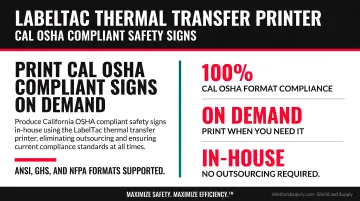
Meeting these color, format, and wording requirements consistently across a facility is the practical challenge for in-house sign production. Shield and Supply's LabelTac® printers are built for exactly this — supporting thermal transfer printing across all five Cal OSHA sign categories.
Key capabilities include:
- Prints in all required Cal OSHA colors — orange, yellow, red, green, black, and white
- LabelTac® 9 prints up to 9" wide, suited for signs that need to be visible across a facility floor
- Compatible vinyl supply rolls are rated for 5–10 years indoors or outdoors, directly supporting §3340's requirement that posted notices remain undamaged and intact
- LabelSuite™ software is included at no additional cost and supports OSHA compliance labeling applications
Common Cal OSHA Signage Compliance Mistakes to Avoid
These three mistakes show up repeatedly in California facility audits — and each one carries real citation risk.
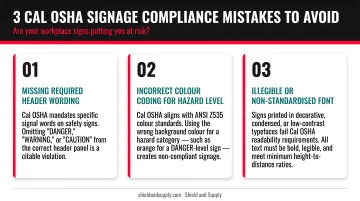
1. Using federal OSHA's 4-category system instead of Cal OSHA's 5-category system
Employers familiar with federal standards often apply Danger, Caution, Safety Instruction, and Biological Hazard — then miss Warning entirely. A hazardous situation that warrants a Warning sign but receives a Caution sign does not meet California's legal standard. Federal compliance doesn't carry over.
2. Posting in low-visibility locations or allowing notices to become covered or defaced
Section 340 prohibits the Cal/OSHA Notice from being altered, defaced, or covered. A notice buried behind a bulletin board update, hidden by a safety poster, or faded past readability is treated the same as no notice at all. Inspectors check condition and placement, not just presence.
3. Missing time-sensitive posting windows or using outdated poster versions
- Form 300A must be posted during the February 1–April 30 window specifically — not whenever it's convenient
- Minimum wage and other annually updated posters must reflect current-year figures
- The Whistleblower Protections notice has an effective date of Jan. 1, 2025 — older versions are non-compliant even if physically present
Frequently Asked Questions
What does Cal OSHA require?
Cal OSHA requires California employers to maintain safe workplaces by complying with Title 8 safety standards, posting the "Safety and Health Protection on the Job" notice, displaying all DIR-mandated workplace posters, and using properly designed accident prevention signs to communicate hazards. Requirements apply to all employers regardless of size.
What posters are required in the workplace in California?
Core required postings include:
- Cal/OSHA "Safety and Health Protection on the Job" notice
- Form 300A (February–April)
- Minimum Wage Order and applicable IWC Wage Order
- Workers' Compensation Insurance notice
- Paid Sick Leave and Whistleblower Protections notices
- CRD discrimination and harassment notice
- EDD Notice to Employees (DE 1857A)
What are the 4 types of safety signs?
Federal OSHA originally identified three sign categories plus biological hazard. Under Cal OSHA §3340, California requires five: Danger, Warning, Caution, General Safety, and Biological Hazard. "Warning" is the California-specific addition, sitting between Caution and Danger on the severity scale.
How much can Cal OSHA fine you for missing required signage?
Failure to post the Cal/OSHA Notice under §3340 carries fines up to $1,000 per violation. Broader serious violations carry penalties up to $25,000, and willful or repeat violations can reach $162,851 per violation under 2025 penalty schedules.
How is Cal OSHA different from federal OSHA for safety signs?
Cal OSHA is a federally approved State Plan that must meet or exceed federal standards. Key differences include the addition of the "Warning" sign category in §3340, stricter civil penalty ranges, and broader required posting obligations tied to California labor law that have no direct federal equivalent.
Do Cal OSHA safety signs need to be in languages other than English?
Section 3340 doesn't specify a language requirement for accident prevention signs. Under §3203, however, employers must communicate hazard information "in a form readily understandable by all affected employees" — meaning bilingual signage or supplemental training may be required for non-English-speaking workers.