This guide covers what Cal/OSHA is, how it differs from federal OSHA, the core compliance requirements, what inspectors look for, and the penalties for getting it wrong.
TL;DR: Cal/OSHA Compliance at a Glance
- Cal/OSHA is California's state-run workplace safety program, enforced under Title 8 of the California Code of Regulations (CCR)
- It applies to most private-sector employers and all state/local government workers in California
- Core compliance pillars: IIPP, hazard communication, employee training, and recordkeeping
- Penalties range from $1,000 to $162,851 per violation, with repeat or willful violations carrying the highest fines
- Staying compliant means continuous audits, updated training, and active hazard management
What Is Cal/OSHA and Who Does It Apply To?
Cal/OSHA is the shorthand name for California's Division of Occupational Safety and Health (DOSH), which operates under the California Department of Industrial Relations (DIR). The name distinguishes the state program from the federal OSHA agency.
California's program was established under the California Occupational Safety and Health Act of 1973, with the State Plan receiving initial federal approval on May 1 of that year.
All workplace safety standards are codified in Title 8 of the California Code of Regulations (CCR). They can only be adopted, amended, or repealed by the Occupational Safety and Health Standards Board, the sole California agency with that authority.
Who Must Comply
Cal/OSHA has jurisdiction over nearly every workplace in California. That includes most private-sector employers and all state and local government workers.
Federal OSHA retains a narrow slice of jurisdiction in California, covering:
- U.S. Government employees
- USPS contractors and contractor-operated mail facilities
- Private-sector employers within military installations, national parks, and national monuments
- Maritime employment on navigable waters
- Private-sector and tribal employers on federally recognized Native American reservations and trust lands
If your operation isn't on that federal exceptions list, Cal/OSHA governs your workplace. For industrial facilities — manufacturing plants, warehouses, distribution centers, agriculture operations, oil refineries, and healthcare facilities — that oversight is comprehensive and continuous.
Cal/OSHA vs. Federal OSHA: Key Differences
California operates under one of 22 OSHA-approved State Plans, covering both private-sector and state/local government workers. Under Section 18 of the federal OSH Act, State Plans must be "at least as effective" as the federal program — and California routinely exceeds that floor.
Where Cal/OSHA Goes Beyond Federal Standards
Several Cal/OSHA standards have no federal equivalent:
- Injury and Illness Prevention Program (IIPP) — mandatory for all California employers since 1991
- Heat Illness Prevention — both outdoor (Title 8 §3395) and indoor (Title 8 §3396, triggered at 82°F)
- Repetitive Motion/Ergonomics Standard — Title 8 §5110
- Aerosol Transmissible Diseases (ATD) — Title 8 §5199
Cal/OSHA also sets stricter Permissible Exposure Limits (PELs) for certain chemicals. Acetone is a documented example: Cal/OSHA's 8-hour TWA PEL is 500 ppm, compared to 1,000 ppm under federal OSHA — half the allowable exposure.
Side-by-Side Comparison
| Category | Federal OSHA | Cal/OSHA |
|---|---|---|
| Governing Authority | U.S. Department of Labor | California DIR / DOSH |
| Geographic Scope | Nationwide (baseline) | California only |
| Public-Sector Coverage | Generally no | Yes — state and local gov't |
| Standard Strictness | Baseline national standard | Frequently stricter |
| Key Unique Regulations | 29 CFR 1910/1926 | Title 8 CCR |
| California-Only Standards | None | IIPP, Heat Illness, ATD, Ergonomics |
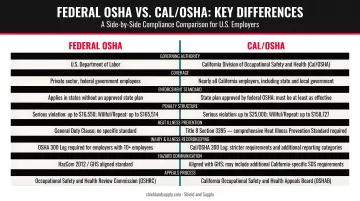
There is also a structural coverage gap: federal OSHA generally does not cover state and local government employees, but Cal/OSHA does. That means millions of California public workers fall under the state program rather than federal jurisdiction.
Key Cal/OSHA Compliance Requirements
Cal/OSHA compliance operates as a framework of interlocking standards, not a single checklist item. Employers must identify which standards apply to their specific operations, then implement the corresponding policies, procedures, training, and documentation.
Injury and Illness Prevention Program (IIPP)
Every California employer has been required to maintain a written IIPP since July 1, 1991, under Title 8 §3203. It's also the most frequently cited Cal/OSHA violation — ranked #1 for every calendar year from 2015 through 2025.
A compliant IIPP must include:
- A system for identifying and evaluating workplace hazards
- Procedures for correcting unsafe conditions
- A hazard communication system
- A mechanism for employees to report hazards without fear of reprisal
- Documentation of all hazard assessments, corrective actions, and training activities
DIR's publication Developing Your Workplace Injury & Illness Prevention Program is the official guide and a practical starting point for any employer building or updating their IIPP.
Hazard Communication and Workplace Safety Labeling
Cal/OSHA's Hazard Communication Standard (Title 8 §5194) aligns with the Globally Harmonized System (GHS) and requires:
- All hazardous chemicals properly labeled with product identifier, signal word, hazard statement, pictogram, precautionary statement, and responsible-party information
- Safety Data Sheets (SDS) readily accessible to employees during every work shift
- Employee training on chemical hazards at initial assignment and whenever new hazards are introduced
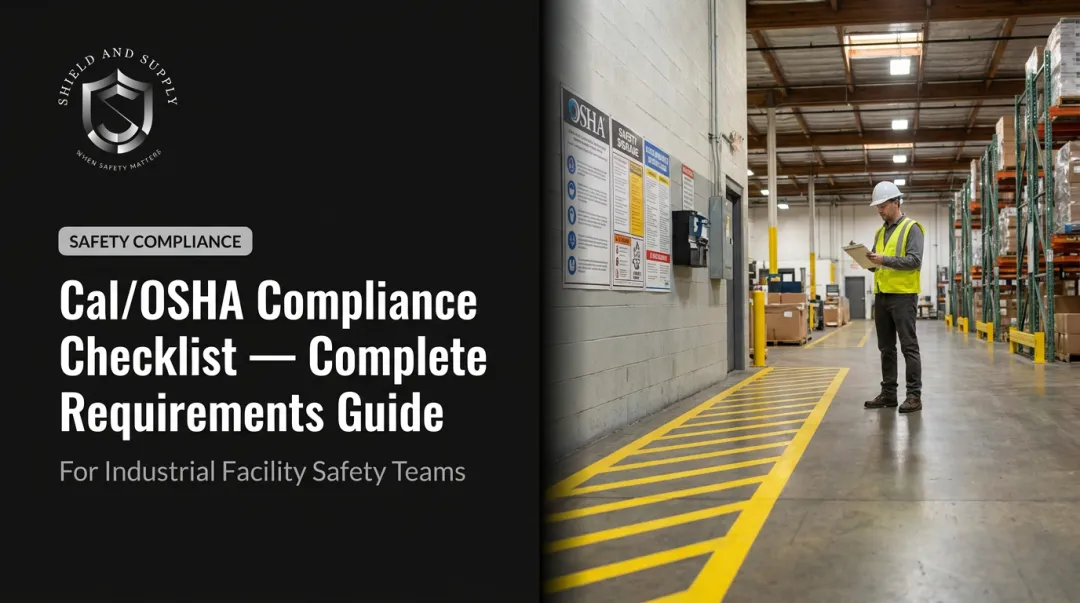
For manufacturing and warehousing facilities, visual compliance is one of the most auditable elements of any inspection — inspectors specifically check chemical labeling, pipe markers, floor markings, and safety signage. Missing or faded labels are citation triggers.
Facilities that produce labels in-house can close compliance gaps faster than those relying on external vendors. Shield and Supply's LabelTac® printers with LabelSuite™ software let facilities print GHS chemical labels, pipe markers, LOTO labels, and OSHA-compliant safety signs on demand — without waiting on a vendor or stocking pre-printed inventory.
Employee Training Requirements
Cal/OSHA mandates training for specific hazards — and even where no specific standard exists, California's General Duty Clause can still trigger a training obligation.
Key mandated training areas:
| Standard | Training Timing |
|---|---|
| Heat Illness Prevention (§3395/§3396) | Before beginning covered work |
| Lockout/Tagout (§3314) | Before working on or near energy-control tasks |
| Aerosol Transmissible Diseases (§5199) | At initial assignment, then annually |
| Hazard Communication (§5194) | At initial assignment, when new hazards introduced |
| Bloodborne Pathogens (§5193) | At initial assignment, then annually |
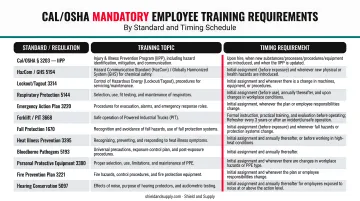
All training must be documented with dates, content covered, and employee sign-in records.
Recordkeeping and Injury Reporting
California employers with 11 or more employees must record work-related injuries and illnesses on Cal/OSHA Forms 300, 300A, and 301 (or equivalent). Employers with 10 or fewer are partially exempt from routine recordkeeping under Title 8 §14300.1, though they remain subject to other requirements.
For serious injuries or fatalities, Title 8 §342 requires employers to notify Cal/OSHA within 8 hours of when the employer knew — or with diligent inquiry would have known — of the death or serious injury. This is an immediate operational obligation, not a paperwork formality.
What to Expect During a Cal/OSHA Inspection
Inspections can happen without advance notice. Unauthorized advance notice to an employer is a misdemeanor under California law.
What Triggers an Inspection
- Employee complaints (the most common trigger)
- Reports of serious injury or fatality
- Referrals from other agencies
- Programmed inspections targeting high-hazard industries
- Follow-up visits after prior citations
What Inspectors Examine
During a typical inspection, a Cal/OSHA compliance officer will review:
- IIPP documentation and injury/illness logs
- Training records (dates, content, signatures)
- Chemical labeling and SDS availability
- Equipment safety and energy control procedures
- Emergency procedures and posting requirements
- Physical work conditions via walkaround assessment
- Private employee interviews (you cannot be present)
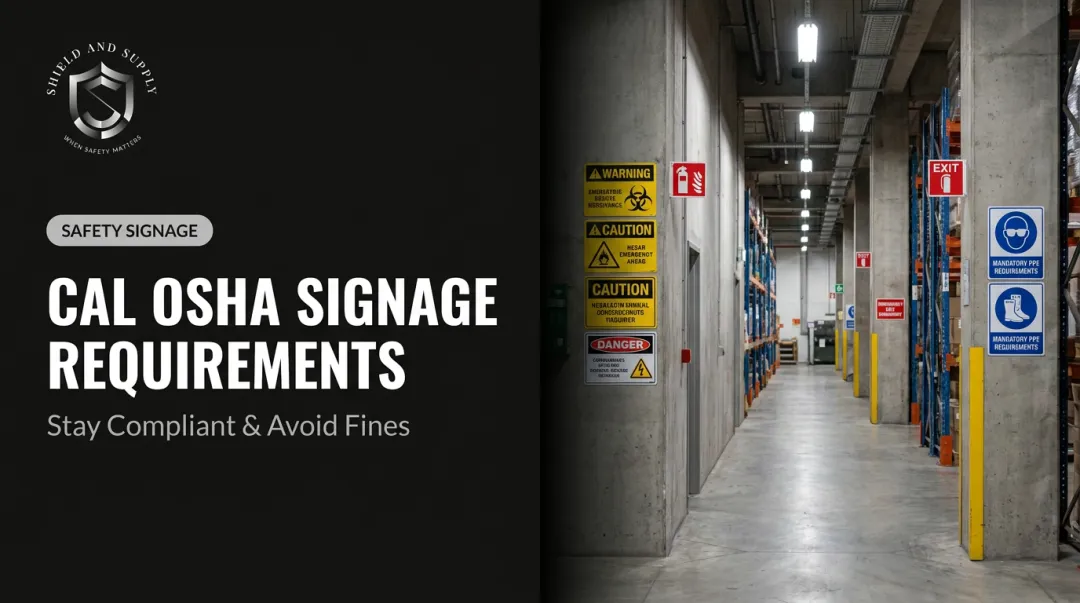
Safety labels and signage are a specific inspection checkpoint. Non-compliant, missing, or illegible labels are cited regularly.
Employer Rights and Obligations
Knowing your rights before an inspector arrives helps you respond confidently and avoid unnecessary missteps.
- You have the right to accompany the inspector during the walkaround
- You must provide requested records and documentation
- You can participate in a closing conference where potential violations are discussed
- Citations can be contested — appeals must be filed within 15 working days of receipt
Penalties for Cal/OSHA Violations
The DIR updated civil penalty amounts effective January 1, 2025. Current maximums:
| Violation Type | Maximum Penalty |
|---|---|
| General / Regulatory | $16,285 per violation |
| Serious | $25,000 per violation |
| Willful / Repeat | $162,851 (minimum $11,632) |
Penalty amounts are adjusted based on four factors under Title 8 §336:
- Gravity of the violation
- Employer size
- Good faith effort
- Compliance history
Smaller employers with clean records and documented corrective actions typically receive reduced penalties.
Knowing where inspectors focus most often helps prioritize your compliance efforts. The most frequently cited violations across 2025 inspections, per DIR data:
- §3203 — Injury and Illness Prevention Program
- §3395 — Heat Illness Prevention (Outdoor)
- §1509 — IIPP, Construction
- §342 — Reporting Fatalities and Serious Injuries
- §3314 — Lockout/Tagout
- §5144 — Respiratory Protection
- §5194 — Hazard Communication
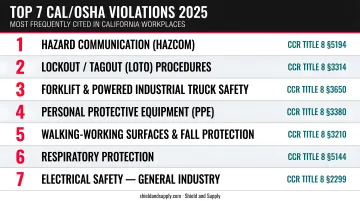
The IIPP has held the #1 position for at least 11 consecutive years. Many employers have an IIPP on file but haven't built it into daily operations — and that gap is exactly what inspectors find.
How to Build a Cal/OSHA Compliance Program
Step-by-Step Implementation
- Identify applicable standards — Use DIR's Title 8 table of contents and the Cal/OSHA User Guide to map which regulations apply to your industry, chemicals, job tasks, and facility conditions
- Develop a written IIPP — Tailor it to your actual workplace; a generic template won't survive an inspection
- Conduct a hazard assessment — Walk the facility, document findings, and correct conditions before an inspector does
- Deliver required training — Cover every mandated topic, and document it with dates, content, and signatures
- Establish recordkeeping systems — Set up Forms 300/300A/301, injury reporting procedures, and a documentation filing system
Ongoing Compliance Activities
Compliance doesn't end at setup. Ongoing activities include:
- Review and update your IIPP when regulations change or new hazards appear
- Refresh training after incidents or standard updates
- Conduct internal audits at scheduled intervals
Visual workplace safety is one of the most practical and auditable elements of any compliance program. Proper labeling, floor markings, pipe markers, and current hazard signage are visible proof of an active safety culture — and they're the first things inspectors notice.
Shield and Supply offers SafetyTac® floor marking tapes and LabelTac® printers for on-demand label production, so facilities can maintain visual compliance without relying on outside vendors for every update.
Free Cal/OSHA Resources
- DIR's Cal/OSHA User Guide — comprehensive overview of compliance obligations
- Consultation Services Branch — free, confidential on-site consultations for small and medium employers (separate from enforcement)
- DIR's IIPP publication — Developing Your Workplace Injury & Illness Prevention Program
The Consultation Services Branch is particularly underused. Inspectors from that branch cannot issue citations, making it a genuine no-risk resource for identifying and correcting problems before a formal inspection.
Frequently Asked Questions
What does Cal/OSHA stand for?
Cal/OSHA is shorthand for California's Division of Occupational Safety and Health (DOSH), which operates under the California Department of Industrial Relations (DIR). The name distinguishes the state program from federal OSHA.
What is the purpose of Cal/OSHA?
Cal/OSHA establishes, implements, and enforces workplace safety and health standards across California, protecting workers from injury, illness, and fatality. It sets regulations, conducts inspections, and issues citations and penalties for violations.
What is the difference between OSHA and Cal/OSHA?
Federal OSHA sets the baseline national workplace safety standards. Cal/OSHA is California's state-approved program and frequently adopts stricter rules — plus California-only standards like the IIPP, Heat Illness Prevention, and the Ergonomics Standard that have no federal equivalent.
Does Cal/OSHA supersede federal OSHA?
In California, Cal/OSHA is the primary enforcement authority for most employers and effectively supersedes federal OSHA for covered workplaces. Federal OSHA retains jurisdiction only over specific categories: federal employees, maritime workers on navigable waters, military installations, and workers on tribal lands.
What are the Cal/OSHA standards?
Cal/OSHA standards are codified in Title 8 of the California Code of Regulations. Key standards include the IIPP, Heat Illness Prevention, Hazard Communication, Lockout/Tagout, Ergonomics, and Workplace Violence Prevention, among many others.
What is a Cal/OSHA inspection?
A Cal/OSHA inspection is an unannounced or scheduled visit by a compliance officer to evaluate whether a workplace meets safety regulations. Inspectors review documentation, observe conditions, check equipment and labeling, and interview employees. Citations and penalties may be issued for any violations found.