Part of the problem is the regulatory landscape itself. There is no single "OSHA arc flash rule." Instead, compliance is stitched together from multiple overlapping standards — OSHA regulations, NFPA 70E, the National Electrical Code, and IEEE 1584 — each playing a different role. Safety managers often struggle to know which standard governs what, and where their actual legal exposure lies.
This guide cuts through that complexity. It covers exactly what OSHA requires, how NFPA 70E and other standards fit together, what must appear on arc flash warning labels, and how to build a program that holds up under OSHA scrutiny.
TL;DR: Key Takeaways
- No single OSHA arc flash rule exists; compliance draws from 29 CFR 1910.269, 1910.333, and 1910.335, with NFPA 70E as the practical roadmap
- Arc flash risk assessments are required before workers approach exposed energized equipment operating at 50 volts or higher
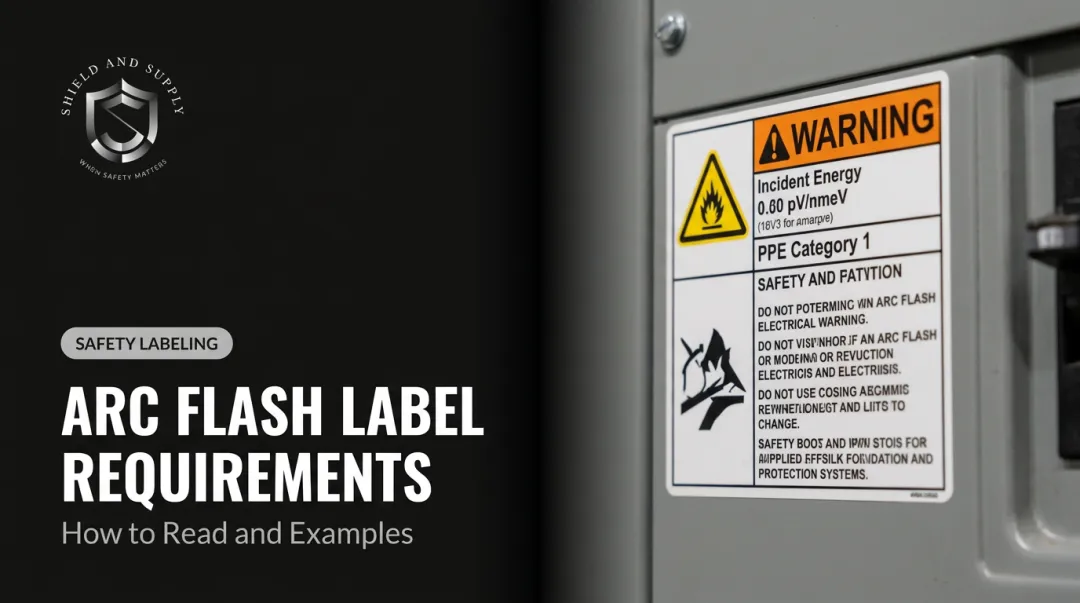
- Arc flash labels must display system voltage, arc flash boundary, incident energy or PPE category, working distance, and study date
- Arc-rated PPE must be selected based on calculated incident energy or NFPA 70E PPE category; standard clothing does not meet compliance
- Assessments must be reviewed at least every five years, or after any significant electrical system change
The Arc Flash Regulatory Framework: OSHA, NFPA 70E, and IEEE 1584
The OSHA Standards That Govern Arc Flash
There is no dedicated "arc flash standard" in the Code of Federal Regulations. Instead, three OSHA regulations form the legal backbone of arc flash compliance:
- 29 CFR 1910.269 — Covers electric power generation, transmission, and distribution work. Section 1910.269(l)(8) requires employers to assess flame and electric-arc hazards, estimate incident heat energy exposure, and provide appropriate arc-rated clothing and PPE. The rule was published April 11, 2014, and took effect July 10, 2014.
- 29 CFR 1910.333 — Requires safety-related work practices that prevent electric shock and other injuries from direct or indirect electrical contact, including exposure near energized parts.
- 29 CFR 1910.335 — Requires eye and face protection wherever there is danger of injury from electric arcs, flashes, or flying objects resulting from electrical explosion.
Violations of these standards carry real enforcement weight. OSHA also applies the General Duty Clause (Section 5(a)(1)) to require employers to protect workers from recognized hazards — including arc flash — even where a specific regulation doesn't perfectly map to the situation.
Where NFPA 70E, NEC, and IEEE 1584 Fit In
These three standards are not federal law, but each shapes how employers meet OSHA's electrical safety requirements in practice:
- NFPA 70E — Originally developed at OSHA's request in 1975 and first published in 1979. Provides the practical compliance framework employers use to satisfy OSHA's general electrical safety requirements. OSHA guidance cites NFPA 70E as industry best practice, meaning non-compliance can support General Duty Clause citations.
- NEC Article 110.16 — Governs arc flash hazard warning markings at the installation phase. Requires equipment likely to need examination, adjustment, servicing, or maintenance while energized to carry an arc flash hazard warning. The 2026 NEC edition updated these requirements — facilities should verify their labels meet the current applicable edition.
- IEEE 1584-2018 — The engineering calculation standard. Defines the method for calculating arc flash incident energy and arc flash boundaries for three-phase AC systems operating between 208V and 15kV. NFPA 70E references incident energy analysis as a PPE selection method, and IEEE 1584 is the recognized guide for performing those calculations.
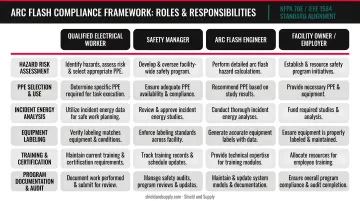
Together, the four standards divide responsibility across the compliance lifecycle:
| Standard | Role |
|---|---|
| OSHA (1910.269, 1910.333, 1910.335) | Sets the legal obligation |
| NFPA 70E | Provides the step-by-step compliance method |
| NEC 110.16 | Governs equipment labeling at installation |
| IEEE 1584-2018 | Provides engineering calculations for PPE selection and label data |
What OSHA Specifically Requires for Arc Flash Compliance
Arc Flash Risk Assessment
Under NFPA 70E Article 130.5 — which OSHA guidance directly references — employers must conduct an arc flash risk assessment before any employee approaches exposed energized conductors or circuit parts. The assessment must determine:
- Appropriate safe work practices
- Required PPE and arc ratings
- Arc flash boundary distances
- Incident energy levels at each work location
The 29 CFR 1910.269(l)(8) requirement to estimate the incident heat energy to which an employee may be exposed supports location-specific calculations, not just panel-level assessments.
The Hierarchy of Controls: De-Energize First
Both OSHA 1910.333 and NFPA 70E Article 110 treat de-energizing as the primary protective measure. Before any employee works on electrical equipment, the default expectation is that the equipment is placed in an electrically safe work condition through lockout/tagout procedures.
Energized work is only permissible when de-energizing is:
- Infeasible (for example, where de-energizing introduces greater hazards), or
- Not possible given the nature of the equipment or task
OSHA treats unnecessary energized work as a compliance failure, not an acceptable shortcut.
Energized Electrical Work Permits
When employees must work on live equipment, NFPA 70E Article 130.2 requires a documented energized electrical work permit. The permit must include:
- Justification for why the equipment cannot be de-energized
- Description of the hazards involved
- Safety measures and PPE to be implemented
- Approval from authorized management
OSHA's 2024 guidance publication (OSHA 4472-11 2024) stressed this requirement. The guidance is not a new regulation and creates no new legal obligations, but it signals where enforcement attention is currently focused.
Worker Qualification and Training
Permits require management sign-off — which means the right people need the right training. OSHA 1910.332 requires training matched to each worker's duties and the specific hazards they face. The key distinction:
- Qualified persons — trained to recognize and avoid electrical hazards; may work on or near energized parts with appropriate PPE
- Unqualified persons — must remain outside established approach boundaries at all times
OSHA inspectors routinely request training records — have them ready and current.
2024 OSHA Guidance: Current Enforcement Focus Areas
OSHA's 2024 arc flash guidance highlighted several areas receiving heightened attention:
- Arc-rated PPE requirements at all incident energy levels
- Prohibition of flammable synthetic undergarments under arc-rated clothing — 29 CFR 1910.269(l)(8)(iii) bars acetate, nylon, polyester, and rayon fabrics unless demonstrated safe for the exposure
- Correct PPE wear: untucked shirts, rolled sleeves, and unbuttoned clothing are non-compliant
- Incident energy calculations tied to specific work locations, not just main distribution panels
Arc Flash Warning Label Requirements
Which Equipment Needs a Label
Any electrical equipment operating at 50 volts or higher that has not been placed in an electrically safe work condition and may require examination, adjustment, servicing, or maintenance while energized must have an arc flash warning label. This applies broadly to:
- Electrical panels and switchboards
- Motor control centers (MCCs)
- Metal-clad switchgear
- Transformers
- Disconnect fuses
Required Label Content: NFPA 70E Article 130.5(H)
A compliant arc flash label must include all of the following:
| Data Field | Requirement |
|---|---|
| Nominal system voltage | Required |
| Arc flash boundary | Required (distance where incident energy = 1.2 cal/cm²) |
| Incident energy (cal/cm²) or PPE category | Either/or, depending on method used |
| Working distance | Required when incident energy is listed |
| Date of arc flash risk assessment | Required |
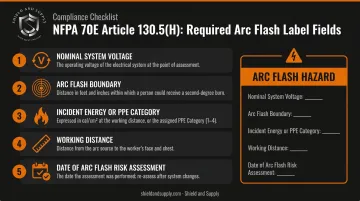
NEC 110.16 requires a general arc flash hazard warning at installation. NFPA 70E Article 130.5(H) goes further, specifying the full data set above — these values are what workers need to select correct PPE before approaching equipment.
Label Durability: Where Compliance Programs Break Down
A label that cannot be read is not a compliant label. In industrial environments, arc flash labels face constant exposure to heat, moisture, chemicals, and abrasion. Paper labels and low-grade adhesive products that fade or peel create both a safety gap and direct OSHA citation risk.
For facilities managing this durability requirement, Shield and Supply's LabelTac® Pro X industrial label printer ($1,299.99) is designed for demanding environments. It uses thermal transfer ribbons producing scratch- and chemical-resistant print, with compatible vinyl supply rolls rated to last 5–10 years indoors or outdoors.
The included LabelSuite™ Design and Print Software supports arc flash labeling applications, so safety managers can produce labels with the required NFPA 70E data fields consistently across a facility. Shield and Supply also offers a free downloadable Arc Flash Labeling Quick Guide for teams building or auditing their labeling programs.
Common Labeling Compliance Failures
OSHA citations related to arc flash labels frequently involve:
- Outdated labels — data from studies performed more than five years ago without documented review
- Missing data fields — labels that provide only a general warning without the NFPA 70E-required values
- Wrong equipment — labels applied inconsistently, or missing from covered equipment entirely
- Illegible labels — faded, damaged, or peeling labels that no longer convey usable information
Any one of these gaps can trigger an OSHA citation during inspection — address them before an auditor does.
Arc Flash PPE Requirements and Selection
Two Approved Methods Under NFPA 70E
Both methods require a completed arc flash risk assessment first. After that:
- Incident Energy Analysis Method: Uses study calculations to specify the exact arc rating (in cal/cm²) required at each piece of equipment. This approach is more precise and is necessary for complex systems or where table-based methods are impractical.
- PPE Category Method: Uses NFPA 70E Table 130.7(C)(15) to assign one of four standardized PPE categories based on task type. It's faster to apply and works well for facilities with straightforward electrical systems.
The Four PPE Categories
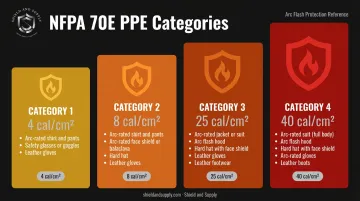
| Category | Minimum Arc Rating | Typical Protection |
|---|---|---|
| Category 1 | 4 cal/cm² | Arc-rated shirt and pants, face shield |
| Category 2 | 8 cal/cm² | Arc-rated shirt, pants, and balaclava |
| Category 3 | 25 cal/cm² | Arc flash suit jacket and pants or coverall |
| Category 4 | 40 cal/cm² | Full arc flash suit with hood |
The outer garment is only part of the equation — what's worn underneath matters just as much. No arc-rated PPE works correctly when worn over flammable synthetic undergarments. Per 29 CFR 1910.269(l)(8)(iii), fabrics that can melt onto skin or ignite and continue burning — acetate, nylon, polyester, rayon — are prohibited as base layers for workers exposed to arc flash hazards.
Beyond the Outer Garment
Complete arc flash PPE includes more than the arc-rated clothing layer:
- Arc-rated face shields or flash suit hoods (hood required for Category 3 and 4)
- Insulated rubber gloves with leather protectors rated for the shock hazard voltage
- Arc-rated hard hats where required by the selected method
- Safety glasses worn underneath face protection
- Hearing protection (arc flash events produce intense blast pressure)
OSHA 1910.335 independently requires eye and face protection wherever electric arc or flash hazards exist, regardless of NFPA 70E category.
Building and Maintaining a Compliant Arc Flash Safety Program
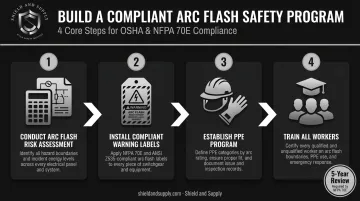
The Four Core Steps
Conduct a formal arc flash risk assessment — Commission a qualified engineer or licensed PE to perform a full arc flash study determining incident energy levels, arc flash boundaries, and safe work practices for each piece of covered equipment.
Install compliant arc flash warning labels on all equipment meeting the 50V threshold that may require energized work. Labels must include all NFPA 70E Article 130.5(H) data fields, must be durable enough for the environment, and must reflect current study data.
Establish a PPE program that specifies arc rating requirements and PPE components for each task type and equipment category.
Train all workers per OSHA 1910.332 — qualified persons on hazard recognition, approach boundaries, and PPE use; unqualified persons on boundary distances and prohibited actions.
The 5-Year Review Requirement
NFPA 70E Article 130.5(G) requires a formal review of the arc flash risk assessment at intervals not exceeding five years. But the five-year cycle is a maximum, not a schedule. Immediate updates are required whenever:
- New electrical equipment is added
- Utility service configurations change
- Protective device settings are modified
- Significant load changes alter fault current levels
Any of these changes can shift incident energy levels enough to invalidate existing labels and PPE selections — which is why ongoing review matters as much as the initial study.
Documentation OSHA Expects
Organized documentation protects a facility during OSHA inspections and incident investigations. Maintain:
- Arc flash study reports with underlying electrical system data
- Equipment labels tied to specific study data and dates
- Training records for all qualified and unqualified workers
- Energized electrical work permits (retained after completion)
- Single-line electrical diagrams supporting the assessment
Frequently Asked Questions
What are the OSHA requirements for arc flash?
OSHA requires employers to assess arc flash hazards under 29 CFR 1910.269 and 1910.333, establish electrically safe work conditions before energized work, provide appropriate PPE, and train workers on electrical hazards. NFPA 70E is the accepted framework for meeting these obligations in practice.
Is compliance with NFPA 70E mandatory?
NFPA 70E is a voluntary consensus standard, not federal law. However, OSHA references it as evidence of industry best practice and can cite employers under the General Duty Clause for failing to follow its requirements. Non-compliance carries real legal exposure.
Does OSHA require arc flash labels?
Yes. OSHA 29 CFR 1910.335 requires hazard warning on electrical equipment, and NEC 110.16 specifically requires arc flash warning markings at installation. NFPA 70E Article 130.5(H) defines the detailed data fields that must appear on the label.
What information is required on an arc flash label?
Per NFPA 70E Article 130.5(H): nominal system voltage, arc flash boundary, incident energy in cal/cm² or PPE category (with working distance when incident energy is listed), and the date the arc flash risk assessment was performed.
What is IEEE standard 1584?
IEEE 1584-2018 defines the calculation methodology for arc flash incident energy and boundaries across three-phase AC systems from 208V to 15kV — the standard engineers use when conducting incident energy analysis for PPE selection.
What is the 2-second rule for arc flash?
The "2-second rule" refers to an assumed arc duration used in incident energy calculations when no overcurrent protective device clearing time is known. Because arc duration directly affects calculated incident energy, this assumption influences the required PPE arc rating — a longer assumed duration yields higher calculated energy and more demanding PPE requirements.