Introduction
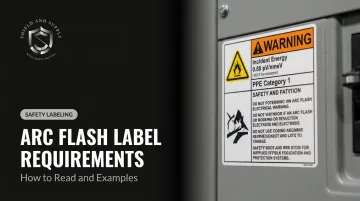
An arc flash label is the first — and sometimes only — warning a worker sees before approaching energized electrical equipment. That warning only works if the person reading it understands every field on it.
Most workers aren't formally trained to interpret arc flash labels. They know the label exists. They know it means "be careful." But translating 8.6 cal/cm² into a specific PPE selection — or knowing why standing 6 inches closer than the stated working distance matters — is a different skill entirely.
That knowledge gap is where injuries happen.
This guide covers what each field on an arc flash label means, which standards govern its contents, and how to read a complete label correctly. Two contrasting examples show the difference between a full-detail label and a generic warning.
Key Takeaways
- NFPA 70E 130.5(H) and NEC 110.16 both require arc flash labels — with different equipment triggers and content requirements
- A compliant label must include nominal system voltage, arc flash boundary, and at least one PPE method or incident energy value — never both methods at once
- Every field is a decision point: misreading incident energy vs. arc rating is a PPE selection error
- Labels must be durable, ANSI Z535-formatted, and reviewed at least every 5 years — earlier if equipment changes
- An IEEE 1584 arc flash study is the source of every data point on the label — without one, no label can be trusted
What Equipment Requires an Arc Flash Label?
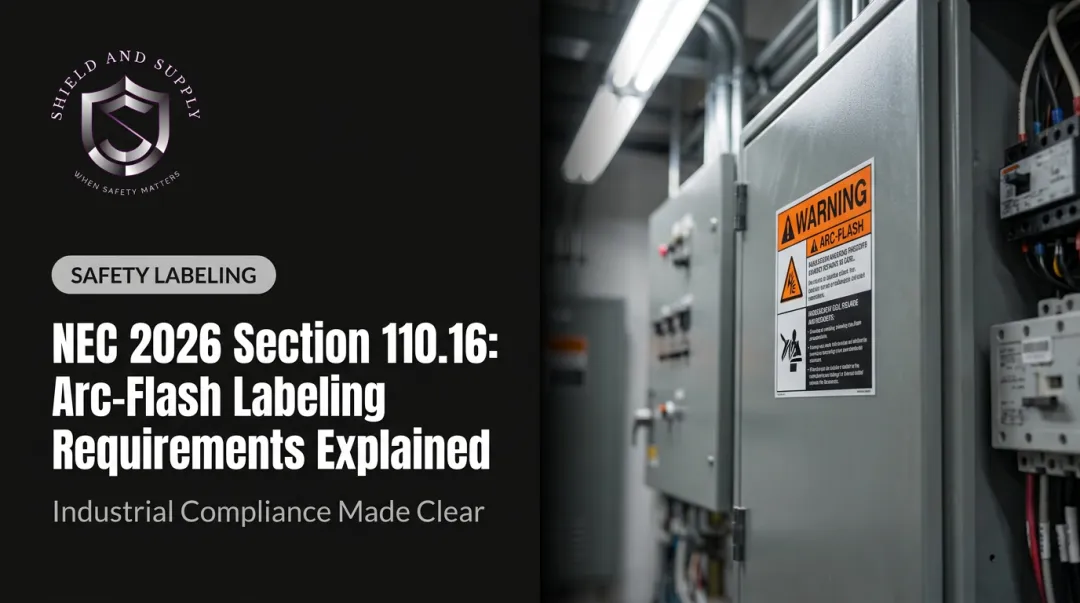
Two separate standards drive arc flash labeling requirements, and they cover different scenarios.
NEC 110.16(A): General Warning Labels
NEC 110.16(A) requires arc flash hazard warning labels on electrical equipment in non-dwelling units that is likely to require examination, adjustment, servicing, or maintenance while energized. The specific equipment types covered include:
- Switchboards and switchgear
- Enclosed panelboards
- Industrial control panels
- Meter socket enclosures
- Motor control centers
This section requires a hazard warning only — it does not mandate the full technical detail that higher-amperage equipment demands.
NEC 110.16(B): Full-Detail Labels for High-Amperage Equipment
Service equipment and feeder-supplied equipment rated 1,000 amperes or more must carry a permanent, full-detail arc flash label. This label must include the date the label was applied, not the study date. That distinction matters during inspections. The requirement applies regardless of whether energized work is anticipated.
NFPA 70E 130.5(H): Task-Driven Labeling
NFPA 70E ties its labeling requirement to a specific condition: equipment "likely to require examination, adjustment, servicing, or maintenance while energized." The same physical enclosure may require different label treatment depending on how it is serviced. This means the task determines the label requirement, not just the equipment type.
What Must Be Included on an Arc Flash Label?
Minimum Required Fields
Under NFPA 70E 130.5(H), a compliant arc flash label must include:
- Nominal system voltage
- Arc flash boundary
- At least one of the following:
- Available incident energy and corresponding working distance
- Minimum arc rating of clothing
- Site-specific level of PPE
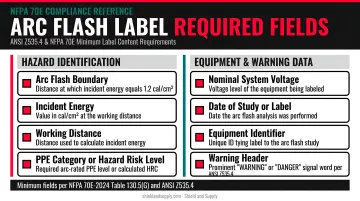
One critical rule governs option 3: a label must not display both an incident energy value and a PPE category simultaneously. NFPA 70E 130.7(C)(15) does not permit selecting a PPE category based on incident energy analysis. The two methods are separate — mixing them creates ambiguity about which value governs PPE selection.
ANSI Z535 Header Requirements
The label header signals relative hazard level at a glance:
- DANGER — white text on a red band (ANSI Z535.4)
- WARNING — black text on an orange band (ANSI Z535.4)
NFPA 70E does not specify an incident energy cutoff for when each header applies — that determination is site-specific. Many facilities use DANGER for higher-energy equipment and WARNING for lower-energy panels, but no universal threshold is codified.
Shock Hazard Boundaries
Most compliant labels also include shock hazard boundaries, even though NFPA 70E 130.5(H) does not list them as minimum required fields:
- Limited approach boundary — only qualified workers may cross this line
- Restricted approach boundary — closer to the equipment; requires additional precautions and qualified worker supervision
Both boundaries are tied to nominal system voltage.
Date and Durability Requirements
- NEC 110.16(B) requires the date the label was applied for service/feeder equipment rated ≥1,000A
- NFPA 70E requires label data to be reviewed at intervals not exceeding 5 years — including the date on the label is best practice for tracking that cycle
- NEC 110.21(B) requires field-applied hazard markings to be permanently affixed, legible, color-consistent, and durable for the environment — handwritten markings are not permitted except for variable portions
- Governing format standards: ANSI Z535.2 (facility safety signs) and ANSI Z535.4 (product safety labels)
How to Read an Arc Flash Label: Field-by-Field
Reading a label is not a passive act. Each field is a decision point. Workers should read top to bottom — in sequence — before approaching the equipment.
Reading the Header and Hazard Zone Fields
DANGER or WARNING tells you the relative severity before you read anything else. Take it seriously.
Arc Flash Boundary is the distance at which an unprotected person would receive a just-curable second-degree burn. According to OSHA, this threshold is 1.2 cal/cm². Anyone inside this boundary must wear appropriately rated arc-flash PPE without exception.
Working Distance is defined by IEEE 1584 as the distance between the potential arc source and the worker's face and chest during the assigned task. This is the reference distance at which incident energy was calculated. Typical values:
- 18 inches — low-voltage panels
- 24 inches — low-voltage switchgear
- 36 inches — medium-voltage equipment
If a worker is physically closer than the stated working distance, the actual energy exposure is higher than what the label indicates. The listed PPE may be insufficient for that closer position.
Reading the PPE and Energy Fields
Incident energy (expressed in cal/cm²) represents the thermal energy available at the working distance during an arc event. Select arc-rated clothing with an arc rating equal to or greater than the incident energy value on the label. Arc ratings are printed on garment labels by manufacturers — never select clothing rated below the label's incident energy value.
PPE Category offers an alternative approach. NFPA 70E defines four categories with minimum arc ratings:
| PPE Category | Minimum Arc Rating |
|---|---|
| Category 1 | 4 cal/cm² |
| Category 2 | 8 cal/cm² |
| Category 3 | 25 cal/cm² |
| Category 4 | 40 cal/cm² |
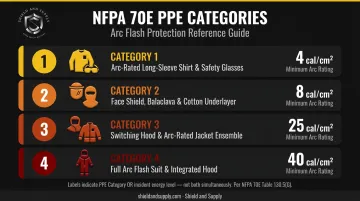
A label shows either incident energy or PPE category — not both. Workers must know which method their facility uses before selecting PPE.
Once PPE is established, the voltage and administrative fields define who can approach and confirm the study behind the label.
Reading the Voltage and Administrative Fields
Nominal system voltage establishes the shock hazard boundaries. Two boundaries apply:
- Limited approach boundary — the outer perimeter for shock protection; only qualified workers may enter
- Restricted approach boundary — closer to the equipment, carrying the highest shock risk; unqualified workers may not cross it unescorted
Administrative fields complete the label's traceability:
- Equipment ID : ties the label to a specific piece of equipment in a multi-panel facility
- Study report number : allows traceability back to the arc flash study document
- Service company : identifies who performed the analysis
- Date : tells the worker when the study data was last applied and whether a review may be due
Arc Flash Label Examples
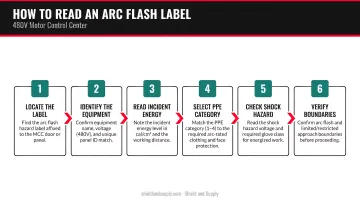
Example 1: Full Incident Energy Label (480V Motor Control Center)
This is a compliant NFPA 70E 130.5(H) label produced from a completed arc flash study:
| Field | Value |
|---|---|
| Header | DANGER |
| Arc Flash Boundary | 48 inches |
| Working Distance | 18 inches |
| Incident Energy | 8.6 cal/cm² |
| Nominal Voltage | 480V AC |
| Limited Approach Boundary | 42 inches |
| Restricted Approach Boundary | 12 inches |
| Equipment ID | MCC-3A |
| Study Date Applied | March 2023 |
How a worker uses this label in sequence:
- DANGER header — elevated hazard; proceed only if qualified and with proper PPE
- Arc Flash Boundary (48 in.) — do not cross without full arc-rated PPE; establish the perimeter
- Working Distance (18 in.) — the reference point for the energy calculation; don't work closer than this without reassessing PPE
- Incident Energy (8.6 cal/cm²) — select arc-rated clothing rated at minimum 8.6 cal/cm²; a Category 2 suit (8 cal/cm² minimum) falls short; a suit rated 10 cal/cm² or higher is required
- Shock boundaries — the restricted approach boundary at 12 inches requires additional precautions; unqualified workers stop at 42 inches
- Study date (March 2023) — within the 5-year review window; label data is current
Example 2: Generic Warning Label (208V Enclosed Panelboard, No Study Completed)
This is a NEC 110.16(A) general hazard warning label on a panel where no arc flash study has been performed:
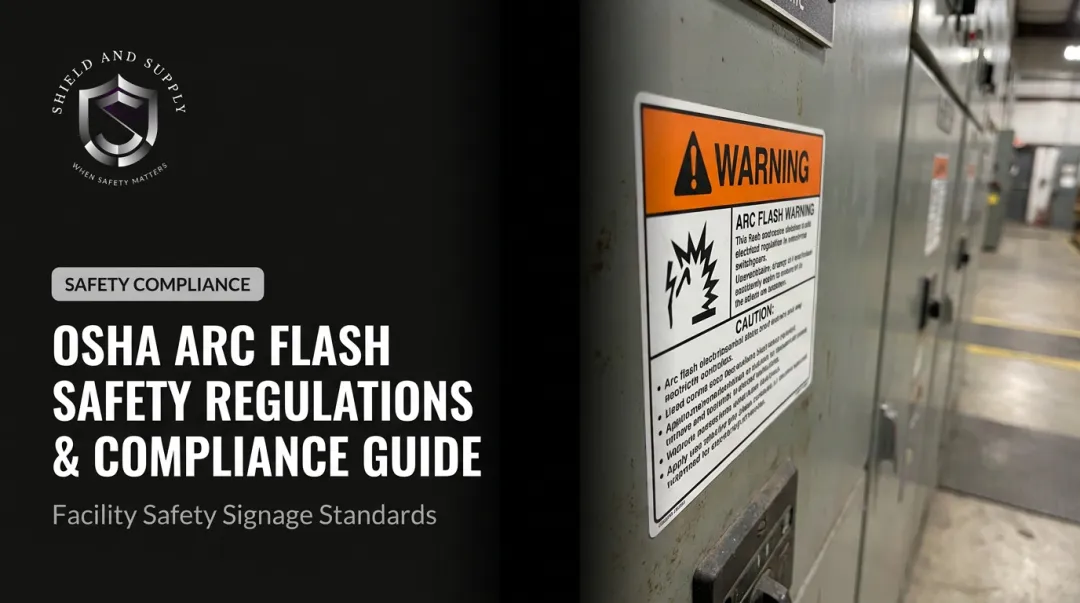
⚠️ WARNING — ARC FLASH AND SHOCK HAZARD Appropriate PPE required. Dangerous voltages and energy levels may be present. Nominal Voltage: 208V AC
What this label contains: a hazard warning, nominal voltage, and a general PPE instruction.
What it is missing: arc flash boundary, incident energy or arc rating, working distance, shock approach boundaries, equipment ID, study date.
The practical consequence: a worker relying on this label knows a hazard exists but has no information about how severe it is. They must either assume worst-case PPE or stop work until a study is completed.
The label satisfies a minimum code requirement — it does not provide adequate information for safe energized work.
Best Practices for Maintaining and Updating Arc Flash Labels
When to Update Labels
Labels must be updated in two situations:
- Immediately after any system change that could affect arc flash results — adding a feeder, replacing a transformer, changing a breaker's settings, or reconfiguring a bus
- At a minimum every 5 years, per the NFPA 70E requirement to review supporting incident energy analysis data at intervals not exceeding five years
An outdated label can be more dangerous than no label at all: it gives workers false confidence in data that no longer reflects actual hazard levels.
Durability in Industrial Environments
NEC 110.21(B) requires field-applied hazard markings to be durable enough for their environment. That rules out most standard office-grade materials:
- Standard inkjet-printed paper labels are not acceptable for most industrial applications
- Labels must resist fading, tearing, and chemical degradation
- Heat, moisture, UV exposure, and cleaning agents will degrade non-industrial materials over time
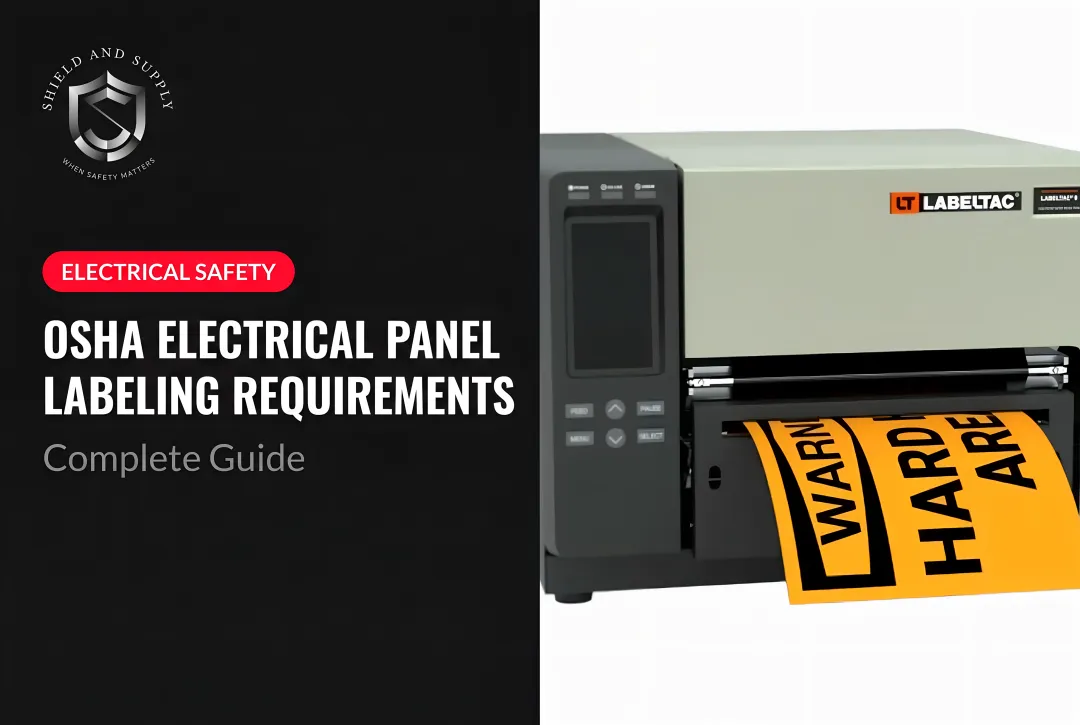
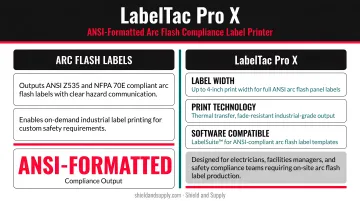
Facilities producing labels in-house should use a printer rated for compliance labeling. The LabelTac® Pro X from Shield and Supply prints ANSI-formatted arc flash labels using pre-built templates in the included LabelSuite™ software, with vinyl supply rolls rated for 5–10 years indoors or outdoors — meeting NEC 110.21(B) durability requirements without additional material sourcing.
Label Placement
Labels must be:
- Affixed directly to the equipment they describe
- Visible before the worker opens any door or panel
- Not obscured by adjacent equipment, paint, or placement inside an enclosure
Audit label condition and placement as part of every routine electrical safety inspection. A label that can't be read before the door opens has failed its purpose.
Conclusion
Every field on an arc flash label is a decision point:
- Arc flash boundary — tells you where to stop
- Working distance — anchors the incident energy calculation
- Incident energy or PPE category — determines what protection to wear
- Voltage rating — defines who is qualified to work there at all
Safety managers and technicians should treat label audits — checking accuracy, legibility, currency, and placement — as an ongoing part of their electrical safety program, not a one-time compliance checkbox. Equipment ages, systems change, and a label accurate in 2019 may not reflect today's hazard level.
When labels fall out of date, so does the protection they're meant to provide. Scheduling periodic arc flash studies and replacing labels after any system modification keeps your facility's hazard data current — and keeps workers safe.
Frequently Asked Questions
What is required on an arc flash label?
NFPA 70E 130.5(H) requires at minimum: nominal system voltage, arc flash boundary, and at least one of the following — incident energy with working distance, minimum arc rating of clothing, or site-specific PPE level. NEC 110.16(B) adds a date requirement for service and feeder-supplied equipment rated 1,000A or more.
Are arc flash labels required by NFPA 70E, NEC, or OSHA?
All three apply. NFPA 70E 130.5(H) specifies label content; NEC 110.16 mandates labeling on specific equipment types with stricter requirements for equipment rated ≥1,000A. OSHA addresses arc flash hazards through the General Duty Clause and 29 CFR 1910.335(b)(1), which requires safety signs warning employees of electrical hazards.
What is the NEC code for arc flash labels?
NEC Article 110.16 governs arc flash labeling. Section 110.16(A) covers general hazard warning labels on equipment likely to be worked on while energized. Section 110.16(B) requires permanent, full-detail labels with the date the label was applied for service and feeder-supplied equipment rated 1,000A or more.
How often do arc flash labels need to be updated?
Per NFPA 70E, the underlying arc flash analysis must be reviewed at intervals not exceeding five years. Labels must also be updated immediately whenever electrical system changes occur that could affect the analysis — any outdated label must be replaced before energized work begins.
How should equipment be labeled for arc flash hazards?
Labels must follow ANSI Z535 format (DANGER or WARNING headers), be permanently affixed in a clearly visible location, and meet the durability requirements of NEC 110.21(B). They must include all minimum information fields required by NFPA 70E 130.5(H). Handwritten or inkjet-on-paper labels are not acceptable in most industrial environments.
What standards cover arc flash labeling?
Four primary standards apply:
- NFPA 70E — governs label content and workplace labeling requirements
- NEC Article 110.16 — specifies which equipment must be labeled
- IEEE 1584-2018 — provides the hazard calculation methodology that generates label data
- ANSI Z535 — governs label format and design