Introduction
An unlabeled breaker during an emergency can get someone killed. Electrical panels distribute power across entire facilities, and when circuits aren't clearly identified, maintenance workers and emergency responders are left guessing. That guessing carries real consequences: wrong circuit energized, lockout bypassed, live parts contacted.
According to the Bureau of Labor Statistics, 130 workers died from electrical exposure in 2024 alone. The Electrical Safety Foundation International (ESFI) reports nonfatal electrical injuries jumped 59% between 2021–22 and 2023–24.
Missing labels, vague circuit descriptions, and absent warning signs are a common thread in those incidents.
This guide covers the specific OSHA regulations governing electrical panel labeling: what information labels must include, clearance requirements, how NEC and NFPA 70E fit in, and practical steps to stay compliant.
Key point up front: OSHA has no single "electrical panel labeling standard." Compliance is built from several overlapping regulations — primarily 29 CFR 1910.303 and 1910.335 for general industry, and 1926.403 for construction.
Key Takeaways
- OSHA requires electrical panel labeling under 29 CFR 1910.303(e), (f), and 1910.335(b), covering equipment markings, circuit identification, and hazard warning signs
- Every breaker must be labeled with a specific, legible purpose that identifies the circuit it controls — not generic labels like "spare" or "lights"
- Arc flash labels aren't directly mandated by OSHA, but a 2006 OSHA interpretation letter confirms known hazards must be communicated; NFPA 70E is the widely accepted standard for doing so
- Minimum panel clearance for 600V or less is 3 ft deep × 30 in. wide × 6.5 ft high, and that space must remain clear of storage at all times
- Violations carry penalties up to $16,550 per serious violation and $165,514 for willful or repeated violations
Key OSHA Requirements for Electrical Panel Labeling
OSHA's electrical labeling requirements aren't contained in one place. They're spread across Subpart S of 29 CFR 1910, and knowing which regulation covers which obligation matters when an inspector shows up.
29 CFR 1910.303(e) — Equipment Marking
This regulation prohibits using electrical equipment unless it bears the manufacturer's name or trademark, plus necessary ratings: voltage, current, wattage, or other relevant values. The markings must be durable enough to withstand the operating environment.
This applies to the equipment as manufactured — but it also governs field-applied labels when equipment is modified or relocated.
29 CFR 1910.303(f) — Circuit Identification
This is the core regulation requiring breaker and circuit directory labels. Every service, feeder, and branch circuit must be legibly marked at its disconnecting means or overcurrent device to indicate its purpose — unless the location and arrangement make that purpose self-evident, a standard OSHA inspectors rarely accept without clear documentation.
Penciled directory cards don't meet the durability standard.
29 CFR 1910.335(b) — Alerting Techniques
Safety signs, symbols, and accident prevention tags must be used wherever necessary to warn employees about electrical hazards that could cause injury from shock, burns, or equipment failure. This regulation drives the warning and hazard labels posted on panel doors and enclosures.
High-Voltage Equipment Requirements
For rooms or areas containing exposed live parts:
- 1910.303(g)(2)(iii): Entrances must be marked with conspicuous warning signs forbidding unqualified persons to enter
- 1910.303(h)(2)(iii)(B): Metal-enclosed switchgear and similar equipment over 600V must bear "appropriate caution signs"
- 1910.303(h)(5)(iii)(B): The required sign text reads: "DANGER–HIGH VOLTAGE–KEEP OUT"
Construction Sites: 29 CFR 1926.403(g) and (h)
Construction sites follow parallel requirements under Subpart K. The two core obligations mirror the general industry rules:
- Equipment identification: All electrical equipment must carry manufacturer identification and ratings
- Circuit marking: All disconnecting means must be legibly marked to indicate their purpose
Durability standards apply here too — and the construction environment sets a higher bar than most office or light commercial settings.
What Information Must Appear on an Electrical Panel Label
Electrical panel labels aren't one-size-fits-all. OSHA and NEC each specify distinct categories of information — and each category has its own rules for what counts as compliant.
Circuit Directory and Breaker Identification
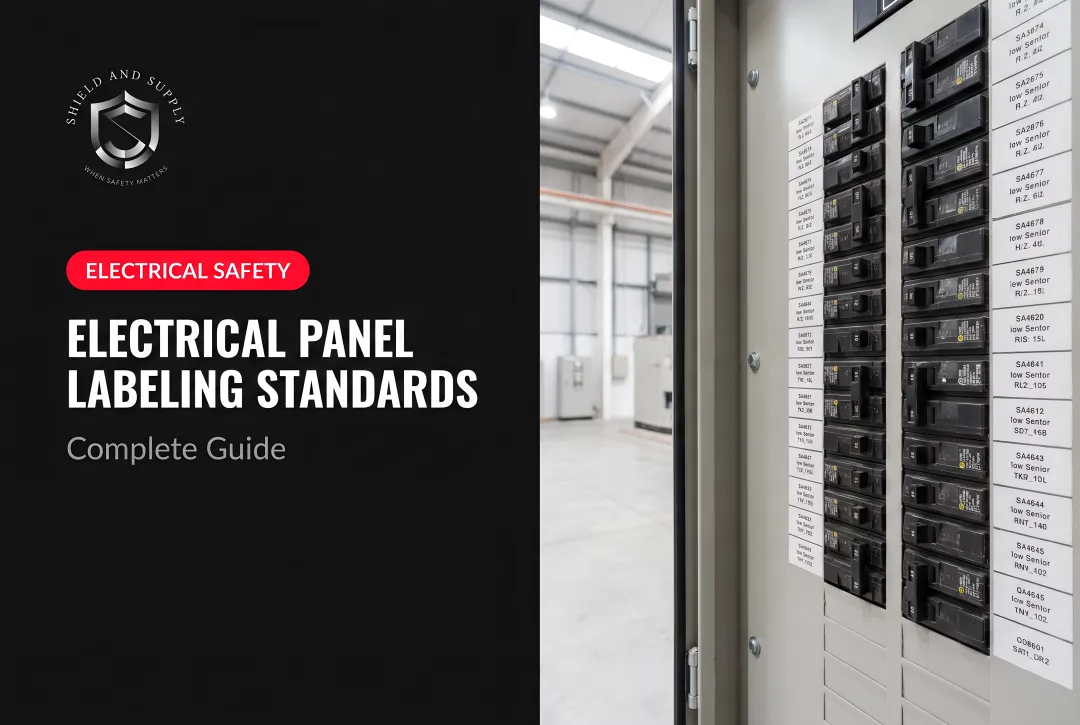
Each breaker or overcurrent device must identify — with enough specificity that a worker can confidently act on it — which load, area, or equipment it controls.
Vague entries fail the standard:
- ❌ "Spare"
- ❌ "Lights"
- ❌ "Misc."
Acceptable entries are specific:
- ✅ "CNC Machine #3 — Bay 4"
- ✅ "HVAC Unit — Roof West"
- ✅ "Server Room Outlets — Row B"
Equipment Ratings
Nominal system voltage, amperage, and where applicable wattage must be marked on the equipment. Manufacturers handle this for standard installations — but when equipment is modified, relocated, or custom-assembled, field-applied labels must carry updated, accurate ratings.
Hazard and Warning Signs
Panel enclosures and electrical rooms require posted safety signs. ANSI Z535 establishes the formatting standard most facilities follow:
| Signal Word | Color | Meaning |
|---|---|---|
| DANGER | Red | Will result in death or serious injury |
| WARNING | Orange | Could result in death or serious injury |
| CAUTION | Yellow | Could result in minor or moderate injury |
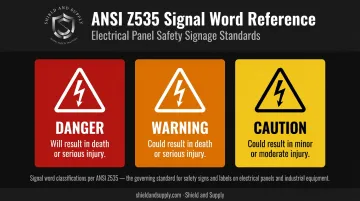
Common required signs include "Danger: High Voltage," "Warning: Authorized Personnel Only," and for rooms with exposed live parts above 600V, the verbatim OSHA text: "DANGER–HIGH VOLTAGE–KEEP OUT."
Hazard signs address access and voltage warnings — arc flash labels go further, communicating the specific energy hazards workers face when the panel is energized.
Arc Flash Labels
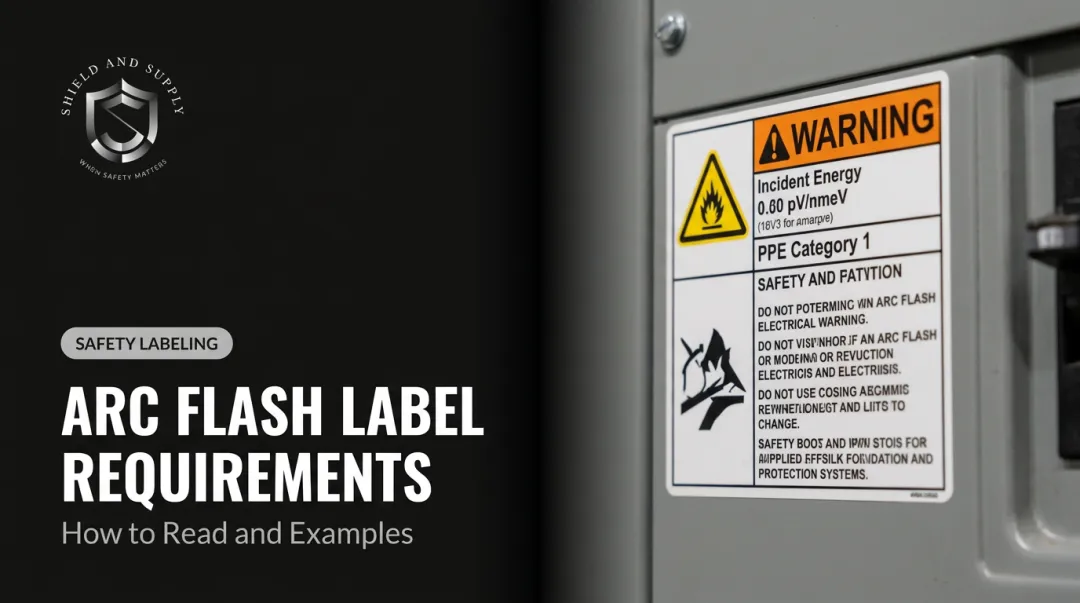
OSHA does not directly mandate NFPA 70E arc flash labels. However, OSHA's 2006 letter of interpretation confirms that a known arc flash hazard must be communicated under 1910.303(e) and 1910.335(b). Following NFPA 70E's arc flash labeling requirements is the widely accepted path for satisfying that obligation.
NFPA 70E arc flash labels typically include:
- Nominal system voltage
- Arc flash boundary
- Incident energy (in cal/cm²) or PPE category
- Working distance
- Equipment name or identifier
Series Combination Rating Label
Per 1910.303(f)(5), when circuit breakers are applied in series combination ratings, the panel must be field-labeled with this exact text:
"Caution — Series Combination System Rated ___ Amperes. Identified Replacement Component Required."
This is a verbatim requirement. Paraphrasing doesn't satisfy it.
How NEC and NFPA 70E Standards Complement OSHA
OSHA sets the legal floor for panel labeling — NEC and NFPA 70E specify exactly how to meet it.
The Regulatory Relationship
OSHA's performance-based requirements tell you what to achieve — legible, durable, accurate labeling. NEC and NFPA 70E tell you how to achieve it with specificity. Following these consensus standards is how most facilities demonstrate compliance when an OSHA inspector asks for justification.
Key NEC Panel Labeling Codes
- NEC 408.4(A): Every circuit and circuit modification must be legibly identified with a clear, evident, and specific purpose — this mirrors and extends OSHA's circuit identification requirement
- NEC 210.5(C)(1)(b): The identification method for conductors in branch circuit panelboards must be permanently posted at the panel
- NEC 110.21(B): Field-applied markings must be of sufficient durability to withstand the environment
As of March 2026, the 2023 NEC is in effect in 25 states, the 2020 NEC in 15 states, and most remaining states use the 2017 or 2008 editions. Because NEC is adopted into local law in virtually every jurisdiction, it's effectively mandatory — not just advisory.
NFPA 70E's Role
NFPA 70E governs electrical safety work practices, including arc flash hazard assessment and PPE selection. OSHA's 2006 interpretation letter confirmed that employers who conduct hazard assessments and label per NFPA 70E satisfy OSHA's hazard assessment and PPE requirements under 1910.132 — making NFPA 70E arc flash labeling the accepted compliance path for the arc flash communication obligation under 1910.303(e) and 1910.335(b).
OSHA Electrical Panel Clearance Requirements
Labeling is only half the equation. OSHA also mandates that panels remain physically accessible — and blocked panels are a frequent citation trigger.
600V or Less: 29 CFR 1910.303(g)(1)
For equipment at 600V or less that may require servicing while energized:
| Requirement | Minimum |
|---|---|
| Depth (0–150V, all conditions) | 3.0 ft |
| Depth (151–600V, Condition A) | 3.0 ft |
| Depth (151–600V, Condition B) | 3.5 ft |
| Depth (151–600V, Condition C) | 4.0 ft |
| Width | Equipment width or 30 in., whichever is greater |
| Headroom (installed before Aug. 13, 2007) | 6.25 ft |
| Headroom (installed on or after Aug. 13, 2007) | 6.5 ft |
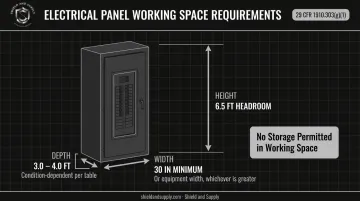
Working space must allow at least a 90-degree opening of equipment doors. Working space cannot be used for storage — no exceptions.
Over 600V: 29 CFR 1910.303(h)(3)
Higher voltage equipment requires more space. Table S-2 clearances range from 3 ft at 601–2,500V Condition A to 12 ft above 75kV Condition C. All rooms containing exposed live parts above 600V must be kept locked or under qualified-person observation at all times, with "DANGER–HIGH VOLTAGE–KEEP OUT" signs posted at entrances.
Stacked pallets, shelving, and equipment carts in front of panels are among the most common clearance violations OSHA investigators document. If an inspector finds blocked access, the citation applies regardless of how well the panel itself is labeled — so clearance audits belong on the same checklist as label inspections.
Best Practices for Achieving and Maintaining Compliance
Regulations tell you what's required. These practices tell you how to stay there — without scrambling before an inspection.
Use Durable, Environment-Appropriate Label Materials
OSHA and NEC both require markings that withstand the operating environment. In industrial settings, that means labels must resist:
- Heat and temperature cycling
- Moisture and humidity
- Chemical exposure
- UV degradation
- Physical abrasion
Paper labels and hand-written tape don't meet this standard. Industrial-grade vinyl or polyester labels with scratch- and chemical-resistant printing are the baseline for most panel applications.
For facilities sourcing materials, LabelTac® vinyl supply rolls from Shield and Supply are weatherproof and rated for 5–10 years indoors or outdoors. High-temperature specialty supplies are also available for environments where heat resistance is a factor.
Standardize Label Content and Formatting
Consistent formatting across every panel in a facility reduces confusion and speeds up emergency response. At minimum:
- Follow ANSI Z535 signal word conventions (Danger/Warning/Caution) with correct colors for all hazard signs
- Establish a naming and numbering convention for circuit directories that every employee and contractor can interpret without explanation
- Update the directory immediately whenever circuits are added, removed, or reassigned
When every panel follows the same convention, identifying circuits during an emergency takes seconds instead of guesswork — and that consistency also satisfies OSHA's legibility requirements.
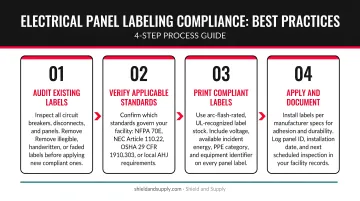
Conduct Periodic Labeling Audits
At minimum, audit all panels annually — or after any electrical work. Check that every label is:
- Present and accounted for
- Legible (not faded, obscured, or damaged)
- Accurate (reflects current circuit assignments)
- Durable enough to last until the next audit
Document the results and any corrective actions. That documentation demonstrates due diligence if an OSHA inspector asks.
Integrate Labeling Into the Work Order Process
Audits catch problems after the fact. Work order integration prevents them. Require that any electrical modification, new circuit installation, or equipment change automatically triggers a label update task before the work order closes.
This stops the gradual drift into non-compliance — a familiar pattern where system changes outpace label updates, leaving panels full of "spare" entries and outdated directories.
For facilities that need to produce consistent, compliant labels in-house, the LabelTac® Pro X (printing up to 4" wide) and LabelTac® 9 (printing up to 9" wide) handle everything from breaker identification strips to full-format arc flash and hazard warning labels. Both printers include LabelSuite™ labeling software and carry a full lifetime warranty.
Frequently Asked Questions
Does OSHA require electrical panels to be labeled?
Yes. OSHA requires electrical panel labeling under multiple regulations — primarily 29 CFR 1910.303(e) for equipment identification, 1910.303(f) for circuit marking at all disconnecting means, and 1910.335(b) for hazard warning signs. All markings must be legible, accurate, and durable for the environment.
What are the OSHA requirements for electrical panels?
OSHA's panel requirements under 29 CFR 1910.303 Subpart S cover equipment marking, legible circuit identification, hazard warning signs, working space clearances, and adequate illumination. Construction sites follow parallel requirements under 29 CFR 1926.403.
What labels are required on electrical panels?
Required labels include circuit directory and breaker identification, manufacturer and voltage/current rating markings, hazard warning signs (such as "Danger: High Voltage"), arc flash labels (required where arc flash hazards exist) communicating incident energy or PPE category, and the series combination rating label when applicable.
What is the OSHA rule for electrical panel clearance?
29 CFR 1910.303(g)(1) requires a minimum working space of at least 3 ft deep (varying by voltage and conditions), 30 inches wide, and 6.5 ft high in front of panels at 600V or less — and that space must remain clear of storage at all times. Higher voltage equipment requires greater clearances per Table S-2.
What is the NEC code for panel labeling?
NEC 408.4(A) is the primary code — every circuit and modification must be legibly identified with a clear, evident, and specific purpose. NEC 210.5(C) requires the identification method to be permanently posted at the panelboard. NEC 110.21(B) governs durability requirements for field-applied markings.
Does OSHA require NFPA labels on electrical panels?
OSHA does not directly mandate NFPA 70E arc flash labels. However, OSHA's 2006 interpretation letter confirmed that known arc flash hazards must be communicated under 1910.303(e) and 1910.335(b). Following NFPA 70E arc flash labeling requirements meets this obligation in practice.