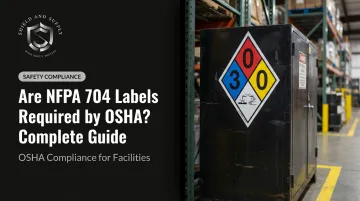
The short answer: OSHA does not require NFPA 704 labels under its Hazard Communication Standard (29 CFR 1910.1200). But that doesn't mean they're optional everywhere — and using them incorrectly can still trigger a compliance violation. This guide breaks down exactly when NFPA 704 is required, when it's permitted, and what you need to do to stay compliant either way.
TLDR: Quick Answers on NFPA 704 and OSHA Requirements
- OSHA's HazCom Standard (29 CFR 1910.1200) does not mandate NFPA 704 labels, but explicitly permits them as a workplace labeling alternative
- Local Authorities Having Jurisdiction (AHJ), like fire departments, can make NFPA 704 legally binding at your facility
- Shipped containers must always carry all six GHS/HazCom 2012 label elements; NFPA 704 only works as an alternative for workplace/secondary containers
- Employee training is mandatory when using NFPA 704; OSHA inspectors will test worker comprehension during inspections
What Is the NFPA 704 Label?
The NFPA 704 label — commonly called the "fire diamond" — is a system developed by the National Fire Protection Association to communicate the hazards of stored or used materials to emergency responders. Its official title is the Standard System for the Identification of the Hazards of Materials for Emergency Response, currently in its 2022 edition.
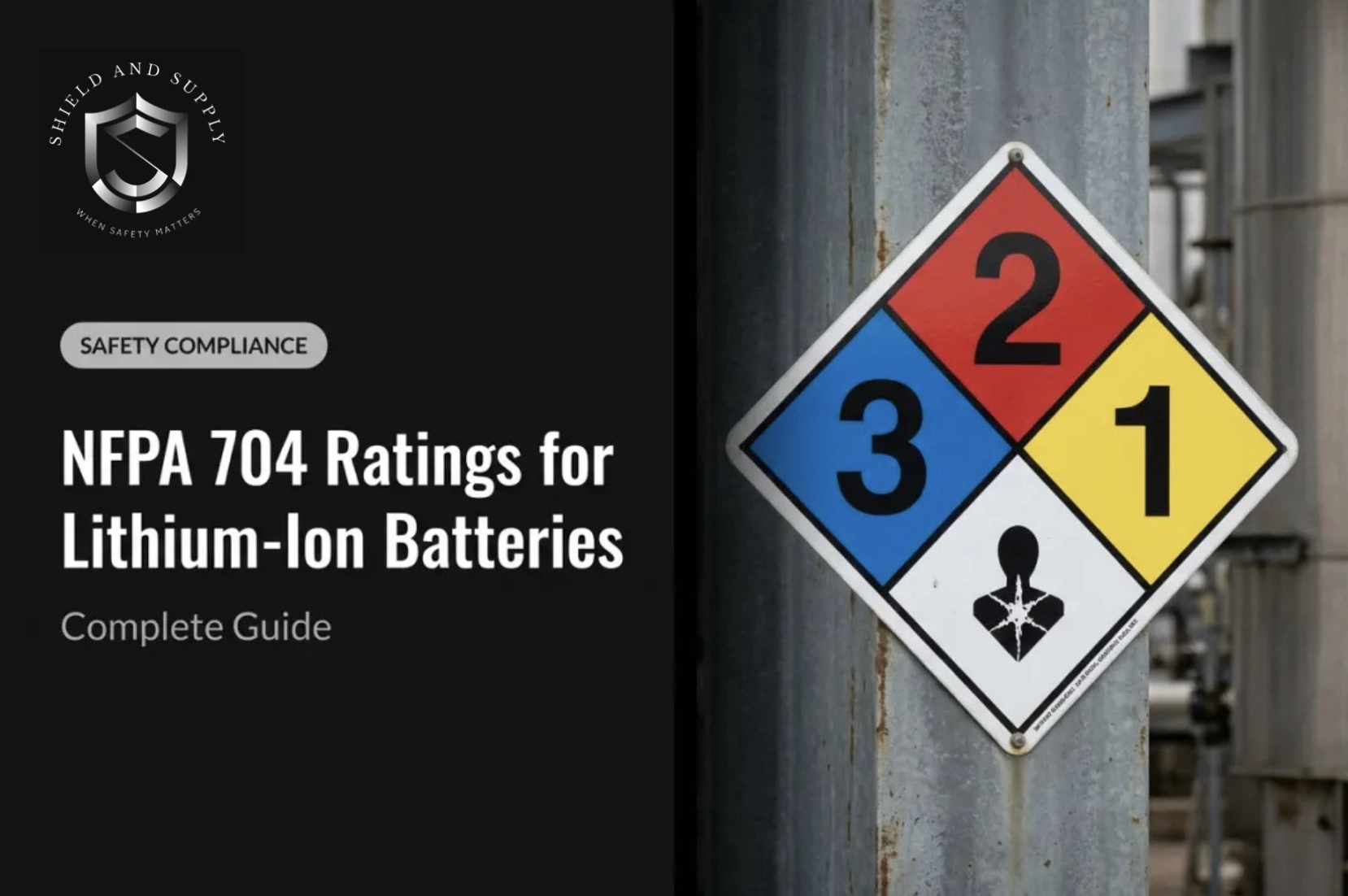
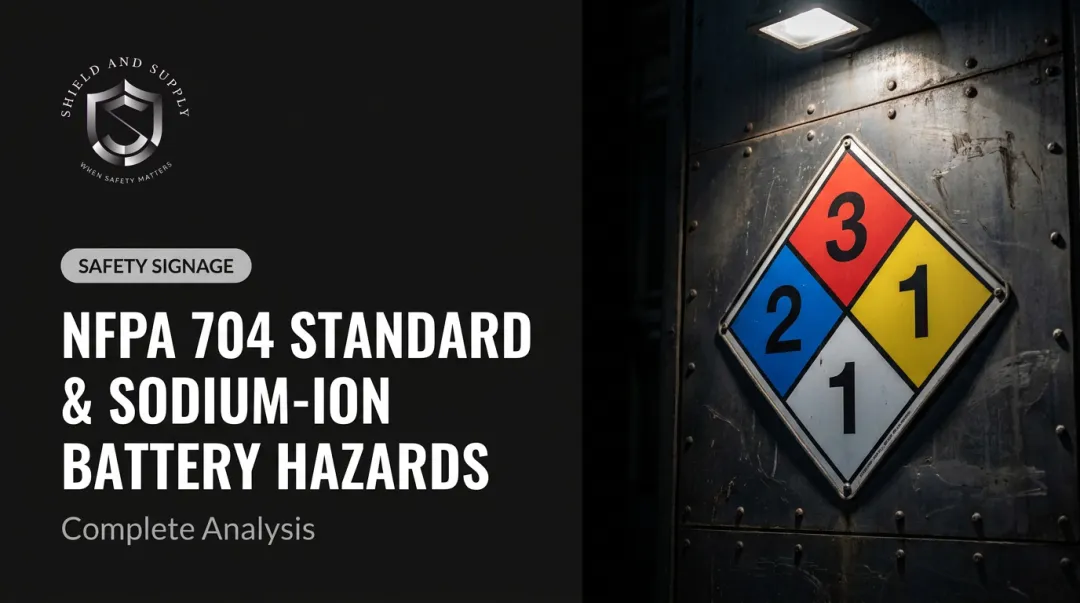
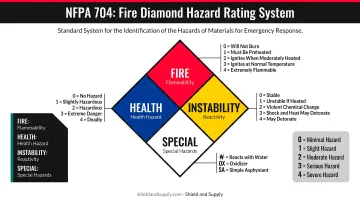
The diamond uses four color-coded quadrants:
- Blue (9 o'clock) — Health hazard
- Red (12 o'clock) — Flammability
- Yellow (3 o'clock) — Instability/reactivity
- White (6 o'clock) — Special hazards (OX for oxidizer, W with strikethrough for water-reactive, SA for simple asphyxiant)
Each quadrant displays a 0–4 numerical rating, where 0 means minimal hazard and 4 means the most severe.
Who Is NFPA 704 Actually For?
NFPA 704 is designed primarily for emergency responders — firefighters and hazmat teams — who need a rapid hazard assessment before entering a building or storage area. You'll see it posted on exterior walls, building entrances, and storage room doors.
That's a fundamentally different purpose from GHS/HazCom labels, which are designed for workers handling individual chemical containers day-to-day. This audience distinction is the key to understanding every compliance question that follows.
Does OSHA Require NFPA 704 Labels?
No federal OSHA general industry standard universally mandates NFPA 704 labeling. OSHA's clearest statement on the matter comes directly from the HazCom 2012 final rule (77 FR 17574, March 26, 2012):
"Neither the proposal nor final rule prohibits the use of NFPA or HMIS rating systems."
That's a permissive statement, not a mandate. OSHA acknowledges NFPA 704 and allows its use — but stops well short of requiring it under HazCom.
The Standard vs. Law Distinction
NFPA 704 is a consensus standard, not a law. It tells you how to label hazardous materials using the diamond system, but it doesn't specify when you must. The legal obligation only kicks in when an outside authority adopts it.
The Role of Local AHJs
This is where NFPA 704 can become legally required at your specific facility. Authorities Having Jurisdiction (AHJ) — fire departments, building officials, local fire code authorities — can mandate NFPA 704 through:
- Local fire codes that adopt NFPA standards
- Fire department permit requirements
- Building inspection conditions
- State emergency planning regulations
A concrete example: Monroe, Ohio's fire department requires NFPA 704 placarding for any facility storing 100 gallons or more of flammable or hazardous liquid, gas, or solid. That threshold makes it legally mandatory there — regardless of what federal OSHA says.
Before assuming NFPA 704 labels are optional at your facility, check with your local fire marshal.
Where OSHA Does Reference NFPA
OSHA incorporates NFPA standards elsewhere in its regulations. For example, 29 CFR 1910.307 references NFPA 70 (the National Electrical Code) for hazardous classified electrical locations. NFPA 704 specifically, however, has not been made universally mandatory under general industry standards.
The practical takeaway: federal OSHA won't cite you for missing a diamond label on its own — but your local fire marshal might. Knowing which authority governs your facility is the first step toward getting this right.
NFPA 704 Under OSHA's HazCom Standard (29 CFR 1910.1200)
What HazCom Actually Requires
For shipped containers, 29 CFR 1910.1200(f)(1) requires chemical manufacturers, importers, and distributors to include six specific label elements:
- Product identifier
- Signal word
- Hazard statement(s)
- Pictogram(s)
- Precautionary statement(s)
- Name, address, and phone number of the responsible party
An NFPA 704 diamond alone does not satisfy these requirements. Never use it as the sole label on a shipped container.
Workplace Container Flexibility
For workplace or secondary containers, OSHA gives employers more room. Under 29 CFR 1910.1200(f)(6), employers may use alternative labeling systems — including NFPA 704 or HMIS — provided:
- The system includes a product identifier
- It provides at least general hazard information
- It doesn't conflict with required HCS information
- Employees are trained to understand it
The OSHA HazCom FAQ explicitly permits NFPA and HMIS rating systems on workplace containers under these conditions.
How OSHA Inspectors Evaluate Compliance
Using NFPA 704 as a workplace label doesn't automatically mean you're compliant. OSHA enforcement guidance (including CPL 02-02-038 and its successor CPL 02-02-079) establishes that compliance officers interview employees to test understanding. If a worker can't explain what a specific NFPA rating means or identify the hazard it represents, the labeling system can be found non-compliant — even if the diamonds are properly posted.
That interview risk often traces back to one specific training gap: the NFPA and GHS scales run in opposite directions, and workers trained on one system frequently misread the other.
The Number Scale Problem You Must Address in Training
This directional conflict catches facilities off guard more than almost any other HazCom issue:
| System | Scale | Most Hazardous |
|---|---|---|
| NFPA 704 | 0–4 | 4 = most hazardous |
| GHS/HazCom | 1–4 | 1 = most severe |
A worker conditioned to GHS categories might read an NFPA "1" rating as low-severity — and act on that assumption near a highly flammable chemical. Your HazCom training needs to address this scale reversal explicitly, with examples tied to the specific chemicals in your facility.
NFPA 704 vs. GHS/HazCom Labels: Key Differences
The two systems aren't competing — they're designed for different audiences answering different questions.
| Feature | NFPA 704 | GHS/HazCom Label |
|---|---|---|
| Primary audience | Emergency responders | Workers handling chemicals daily |
| Placement | Buildings, exterior walls, storage rooms | Individual containers |
| Health hazards covered | Acute only | Acute and chronic |
| Chemical identity | Not included | Required (product identifier) |
| Precautionary information | Not included | Required |
| Supplier information | Not included | Required |
| Required on shipped containers | No | Yes |
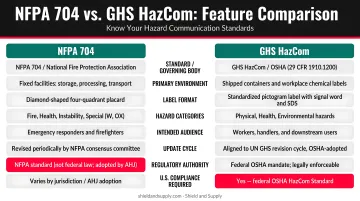
The OSHA QuickCard OSHA 3678 provides a side-by-side comparison of both systems and makes this point directly: NFPA 704 provides basic information for emergency personnel responding to a fire or spill, while HazCom 2012 informs workers about chemical hazards under normal conditions and foreseeable emergencies.
The practical takeaway: GHS labels are always required on shipped containers. NFPA 704 serves a complementary emergency response role. Facilities that try to use one in place of the other will have compliance gaps — both in daily worker safety and emergency response readiness.
When NFPA 704 Is Required and How to Stay Compliant
Scenarios Where NFPA 704 Becomes Mandatory
- Local fire codes — Most common trigger; many jurisdictions have adopted NFPA codes through local ordinance
- AHJ directives — Fire marshals or building officials may require them as a condition of occupancy or permit
- Storage thresholds — Some jurisdictions set quantity triggers (Monroe, Ohio: 100 gallons; Missouri emergency planning guidance references 10,000 lbs for hazardous chemicals and 500 lbs for extremely hazardous substances)
- Insurance or corporate EHS policies — Some organizations mandate them beyond what regulation requires
Best Practices for Compliance
If NFPA 704 labels are part of your workplace labeling program, these steps keep you on solid ground:
- Verify each NFPA diamond against the current SDS for that chemical — inventories change, and outdated ratings create liability
- Train employees on what each quadrant means, the 0–4 scale, special hazard symbols (OX, W, SA), and the inverse relationship with GHS severity categories
- Resolve any conflicts between NFPA and GHS labels for the same chemical — contradictions are a direct compliance risk
- Document your training program so that if an OSHA inspector interviews workers, you have written evidence of due diligence
- Confirm labels are accessible and legible during every shift, including low-light conditions
Sizing and Placement
Per NFPA 704, labels must be visible to emergency responders from a safe distance. At minimum, they should appear on:
- At least two exterior walls of a facility
- Each entryway to a room or storage area
- Each principal means of access to exterior storage areas
Specific size requirements are determined by your AHJ based on viewing distance (referenced in NFPA 704 Chapter 9). Contact your local fire marshal for the dimensions that apply to your facility.
Printing NFPA 704 Labels In-House
For facilities managing multiple hazardous materials across large floor plans, keeping NFPA 704 labels current is an ongoing operational task. Pre-printed labels go out of date when chemical inventories change, and ordering replacements creates delays that leave noncompliant signage in place.
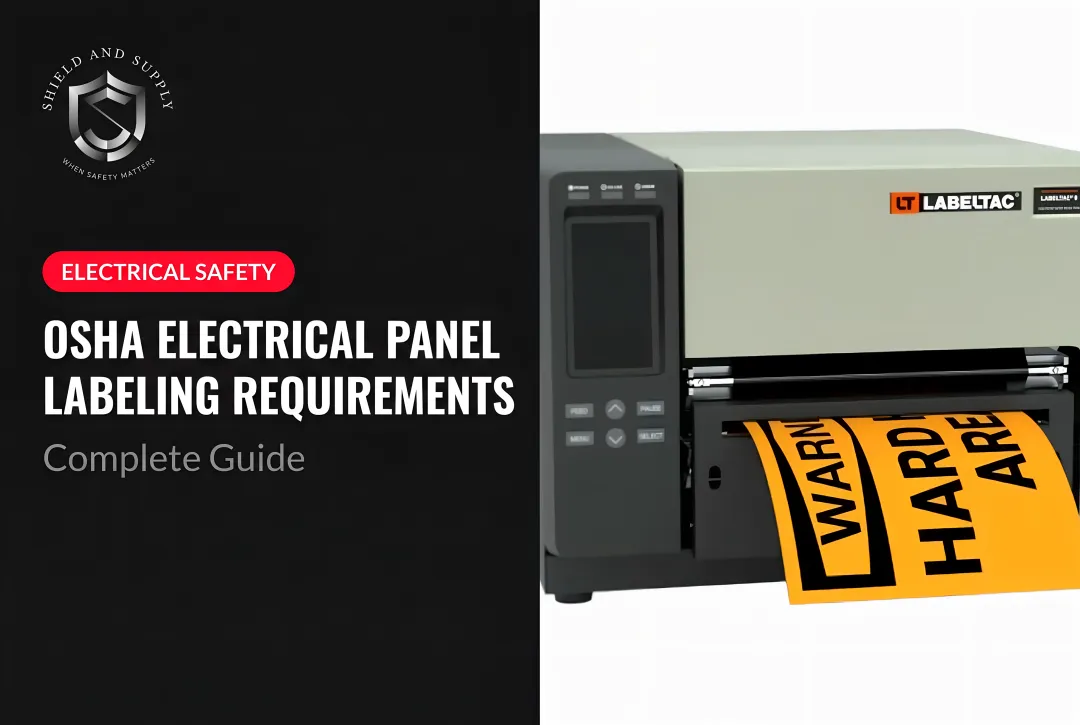
Industrial label printers solve that problem at the source. Shield and Supply's LabelTac® 9 prints labels up to 9 inches wide — wide enough for exterior wall and door placement where viewing distance demands larger format. The LabelTac® Pro X handles widths up to 4 inches, suited for interior storage room applications.
Both printers include LabelSuite™ design software and ship with a full lifetime warranty.
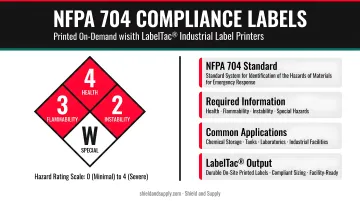
The vinyl supply rolls are rated for 5–10 years indoors or outdoors, and when paired with LabelTac® print ribbons, produce scratch- and chemical-resistant output — durable enough to remain legible for emergency responders across years of industrial use.
Frequently Asked Questions
Frequently Asked Questions
Are NFPA 704 labels acceptable workplace labels?
Yes. OSHA explicitly permits NFPA 704 as an alternative labeling system for workplace and secondary containers under HazCom 2012 (29 CFR 1910.1200), provided employees are trained to understand the rating system and the labels contain no information that conflicts with the required GHS label elements.
What are the OSHA requirements for workplace labeling?
OSHA requires workplace containers to display the full set of shipped GHS/HazCom 2012 label elements — or use an alternative system such as NFPA 704 or HMIS. That alternative must communicate all required physical and health hazard information through a combination of the label, employee training, and SDS access, and must not contradict HCS requirements.
What is the OSHA 1910.1200 regulation?
29 CFR 1910.1200 is OSHA's Hazard Communication Standard. It requires chemical manufacturers, importers, and employers to communicate hazards through container labels, Safety Data Sheets, and employee training. The standard was revised in 2012 to align with the United Nations' Globally Harmonized System (GHS) of Classification and Labelling of Chemicals.
Does OSHA reference NFPA?
Yes. OSHA references NFPA standards in several regulations — for example, NFPA 70 (National Electrical Code) in 29 CFR 1910.307. Under HazCom 2012, OSHA acknowledges NFPA 704 as a permitted workplace labeling alternative, though no universal federal mandate requires it across all general industry facilities.
What are the key differences between a GHS label and an NFPA 704 diamond?
GHS labels are applied at the container level for daily worker use. They include six required elements — chemical identity, pictograms, signal words, hazard statements, precautionary statements, and supplier information — and cover both acute and chronic health effects. NFPA 704 diamonds are area-level indicators for emergency responders, showing acute hazard severity on a 0–4 scale without naming the specific chemical or addressing long-term risks.