Introduction
When a firefighter arrives at a warehouse storing lithium-ion batteries, the NFPA 704 fire diamond on the door is often the first safety communication they see. That label shapes their initial decisions — what PPE to use, what suppression agent to deploy, what precautions to take before entering.
For Li-ion batteries, that diamond reads 0-1-0. Those numbers look reassuringly low: no significant flammability, minimal health risk, stable chemistry. That reading is misleading in practice.
Li-ion batteries are capable of thermal runaway: a self-sustaining cascade of heat, toxic gas release, and re-ignition that bears almost no resemblance to what a "0-1-0" label implies.
Understanding that gap — between what the NFPA 704 rating communicates and what a real Li-ion incident looks like — is essential for safety managers, facility operators, and anyone responsible for hazard communication compliance.
This guide breaks down each quadrant of the Li-ion fire diamond, explains why the "010" rating requires careful interpretation, covers display requirements, and compares NFPA 704 to the other standards that govern Li-ion battery safety.
Key Takeaways
- Li-ion batteries carry a standard NFPA 704 rating of 0-1-0 — flammability 0, health 1, instability 0 — with the white quadrant typically blank
- The rating reflects baseline material chemistry — not thermal runaway, which can exceed 1,000°F and is not captured by this placard system
- Health rated "1" for minor electrolyte irritation; both "0" scores reflect the sealed cell design under normal operating conditions
- NFPA 704 is an emergency identification tool — it doesn't replace NFPA 855 or FM Global DS 8-1 for storage compliance
- Facilities storing Li-ion batteries must post properly formatted NFPA 704 placards at storage entrances and access points
What the NFPA 704 Rating System Is
NFPA 704 — the Standard System for the Identification of the Hazards of Materials for Emergency Response — is maintained by the National Fire Protection Association and was first adopted in 1960. The most current edition is NFPA 704-2022.
The Four-Quadrant Diamond
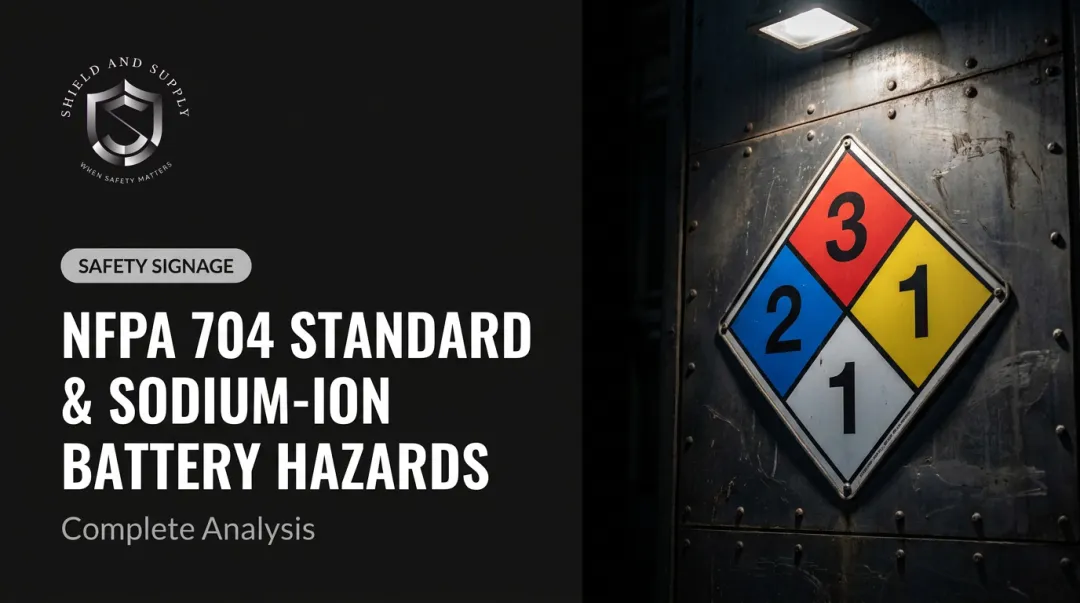
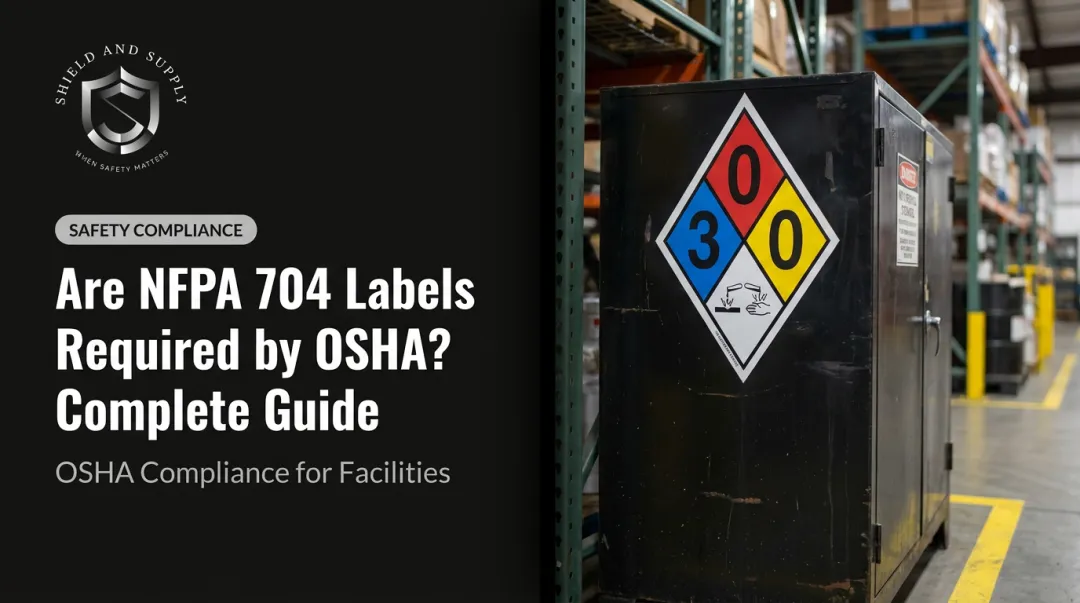
The system uses a square-on-point diamond with four color-coded quadrants:
| Quadrant | Position | Rates | Scale |
|---|---|---|---|
| Red | Top (12 o'clock) | Flammability | 0–4 |
| Blue | Left (9 o'clock) | Health hazard | 0–4 |
| Yellow | Right (3 o'clock) | Instability | 0–4 |
| White | Bottom (6 o'clock) | Special hazards | OX, W̶, SA |
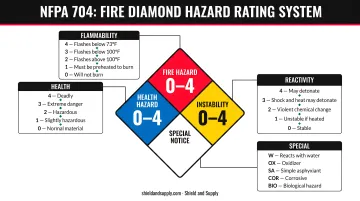
Ratings run from 0 (minimal hazard) to 4 (severe hazard). The white quadrant uses symbol codes rather than numbers: OX for oxidizer, W with a slash for unusual water reactivity, and SA for simple asphyxiant gas.
The System's Intended Purpose
NFPA 704 exists to give emergency responders immediate, actionable information during the first minutes of a fire or hazmat incident: what protective equipment to use, which suppression agents are safe, and what special precautions apply.
One critical design limitation: NFPA 704 rates a material's chemical properties under baseline, normal conditions. It was never designed to characterize dynamic failure modes. As you'll see in the next section, that gap matters significantly when applying the system to Li-ion batteries.
How Ratings Are Assigned
Ratings are based on a material's physical and chemical properties, including:
- Flash point and boiling point
- Water reactivity
- LD50 toxicity data
- Oxidizing potential
They're assigned by the manufacturer, facility management, or the Authority Having Jurisdiction (AHJ) — the AHJ holds final say.
For Li-ion batteries, the chemistry varies by cell type (NMC, LCO, LFP, and others). The "0-1-0" designation represents the most widely accepted rating for standard commercial Li-ion cells, though facilities should verify against product-specific Safety Data Sheets for their exact battery type.
The NFPA 704 "010" Rating for Li-ion Batteries
Battery University documents the standard Li-ion NFPA 704 rating as 0-1-0: flammability (red) = 0, health (blue) = 1, instability (yellow) = 0. Here's what each number actually means.
Flammability (Red) — Rated 0
Per NFPA 704-2022, a rating of 0 applies to materials that cannot be ignited even when exposed to 820°C (1,500°F) for five minutes. Li-ion batteries qualify because sealed cell enclosures don't have a measurable flash point — the rating system was built around flash point thresholds, and solid/semi-solid sealed cells don't meet the criteria for a higher classification.
Important limitation: A "0" is not a safety clearance. If a cell ruptures or vents, the released internal electrolyte becomes a separate flammability hazard that this quadrant doesn't capture.
Health (Blue) — Rated 1
A health rating of 1 indicates a material that can cause significant irritation with only minor residual injury. For Li-ion batteries, this reflects potential skin and respiratory irritation from electrolyte contact or off-gassing during minor cell damage or low-level venting.
This rating covers normal-use exposure scenarios. It does not reflect the toxic gas profile produced during thermal runaway — during a full runaway event, batteries can release hydrogen fluoride and other combustion byproducts far beyond what a "1" suggests.
Instability (Yellow) — Rated 0
An instability rating of 0 means the material is normally stable and not reactive with water. Standard sealed Li-ion cells earn this rating because the cell casing prevents the internal chemistry from contacting external agents under normal conditions.
If a cell is physically ruptured, internal lithium compounds can react with moisture. NFPA 704 rates baseline material stability — not breach scenarios. Facilities storing large battery banks should account for this gap with supplemental hazard documentation beyond the placard.
Special Hazards (White) — Typically Blank
The white quadrant is left blank for standard Li-ion batteries. Under NFPA 704 definitions, they don't qualify as:
- OX (oxidizers)
- SA (simple asphyxiant gases)
- W (formally water-reactive materials)
Some AHJs or facility-specific safety plans add non-standard notations to flag thermal runaway risk or re-ignition potential. These aren't official NFPA 704 symbols, but local fire authorities can permit them as part of a site-specific hazard communication plan.
Why "010" Doesn't Capture the Full Li-ion Hazard
NFPA 704 rates chemistry at rest. Thermal runaway is chemistry in catastrophic failure — the two look nothing alike, and that gap has real consequences for anyone using the fire diamond as a primary risk reference.
State of Charge Changes Everything
NFSA's 2024 research on Li-ion protection standards documented side-by-side testing showing that a 100% SOC battery module exhibited faster thermal runaway propagation and more volatile combustion compared to a 30% SOC module. FSRI testing of e-scooter battery packs recorded peak heat release rates reaching 1.1 MW during intentional thermal runaway events.
NFPA 704 doesn't incorporate state of charge, so the "010" label looks identical whether a battery sits at 10% or 100% — two substantially different risk profiles.
The Toxic Gas Profile
The "1" health rating implies minor irritation. What thermal runaway actually produces is acute toxic exposure at concentrations well beyond standard occupational limits.
OSHA identifies thermal runaway byproducts that include:
- Hydrogen fluoride (HF)
- Hydrogen chloride (HCl)
- Hydrogen cyanide (HCN)
- Carbon monoxide (CO)
- Phosphoryl fluoride (POF₃)
- Black carbon and other hazardous particulates
A peer-reviewed study published in Scientific Reports measured HF emissions from burning Li-ion batteries at 20 to 200 mg per Wh of battery capacity. TEEX's November 2024 emissions characterization report found CO concentrations up to 500 times OSHA's 8-hour limit of 50 ppm, formaldehyde up to 150 times its 8-hour limit, and ethylene up to 446 times its OSHA limit during Li-ion fire events.
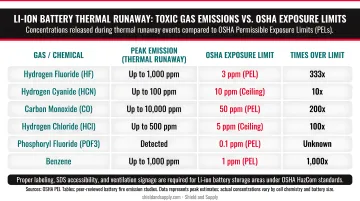
OSHA recommends SCBA or supplied-air respirators for anyone entering areas where Li-ion thermal runaway has occurred — the "1" health rating alone doesn't communicate that level of respiratory risk.
Re-ignition and Water Complexity
Li-ion fires are not resolved when visible flames are suppressed. OSHA notes that damage can cause failure immediately or over time, and heat from one failing cell can trigger chain reactions in adjacent cells.
Water is used for cooling, but applying it to a breached cell introduces additional complications — fluorine released from some lithium batteries can combine with water vapor to produce hydrofluoric acid. None of this is communicated by the fire diamond. That's not a flaw in NFPA 704; it's a limitation that safety programs need to address explicitly.
How NFPA 704 Labels Are Applied in Facilities
Placement Requirements
Per NFPA 704 and AHJ guidance, placards should be posted at minimum on:
- Two exterior walls of the facility or building
- Each access point to a room or storage area where hazardous materials are present
- Each principal means of access to exterior storage areas
The goal is visibility from a safe distance before responders commit to approach. AHJ guidance specifies that hazard rating numbers must be readable from at least 50 feet.
Size and Readability Standards
Required letter/symbol height scales with viewing distance:
| Viewing Distance | Minimum Character Height |
|---|---|
| 50 ft | 1 inch |
| 75 ft | 2 inches |
| 100 ft | 3 inches |
| 200 ft | 4 inches |
Exterior placards require weatherproof, weather-resistant materials and backings. The AHJ has authority to specify additional local requirements beyond the baseline standard.
On-Site Printing for Compliance Flexibility
Storage configurations change. Battery quantities shift. When ratings or placard locations need updating, waiting on an external vendor creates compliance gaps.
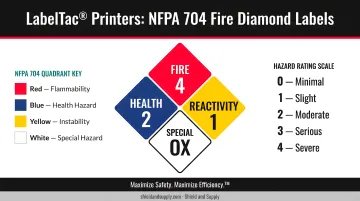
On-site printing solves this directly. Shield and Supply's LabelTac® printers with LabelSuite™ software let safety teams produce compliant NFPA 704 placards in-house, including:
- Weatherproof vinyl rated for 5–10 years indoors or outdoors
- Widths up to 9 inches on the LabelTac® 9, covering exterior building signage formats
- Correct dimensions for every viewing distance tier without waiting on outside fulfillment
NFPA 704 vs. Other Li-ion Battery Safety Standards
NFPA 704 is one piece of a larger regulatory picture. Safety managers working with Li-ion batteries need to understand where it fits — and where it doesn't reach.
NFPA 855: Installation Standard for ESS
NFPA 855 (Standard for the Installation of Stationary Energy Storage Systems, current edition: 2026) governs the physical design, installation, separation distances, and fire protection requirements for battery energy storage systems. It addresses what NFPA 704 doesn't cover: the physical environment around the batteries, not just the label on the door.
Facilities need both standards. They address entirely different aspects of the hazard.
The NFPA 13 Gap
NFPA 13 (Automatic Sprinkler Systems) does not currently include prescriptive fire protection criteria specifically for Li-ion battery storage. NFSA confirms this directly — bulk Li-ion storage lacks broad prescriptive sprinkler criteria in NFPA 13, making FM Global Data Sheet 8-1 the primary reference for bulk storage fire protection design. FM DS 8-1 Section 2.4.2 covers new Li-ion cells in rack, solid-pile, and palletized storage, with separate criteria triggered when ceiling height exceeds 40 feet or battery SOC is above 60%.
OSHA HCS and EPCRA 311/312
OSHA's Hazard Communication Standard creates separate obligations. OSHA has confirmed that Li-ion batteries do not qualify for the HCS "article" exemption because they can leak, spill, or break during normal use or foreseeable emergencies. That means manufacturers and importers must classify hazards and provide compliant Safety Data Sheets.
EPCRA Sections 311 and 312 (Tier II reporting) apply to facilities required to maintain an SDS for hazardous chemicals under OSHA standards. EPA guidance notes potential exemptions including the consumer product exemption, but facilities storing batteries in industrial quantities should verify specific reporting obligations with their legal or EHS counsel.
NFPA 704 compliance does not satisfy SDS requirements or Tier II reporting obligations. These are parallel, not interchangeable.
NFPA 704 gives emergency responders a baseline orientation at the door. It doesn't address the full scope of Li-ion failure risk. A complete compliance posture requires all four layers:
- NFPA 704 for hazard communication labels
- NFPA 855 for installation and separation requirements
- FM DS 8-1 for bulk storage fire protection design
- OSHA HCS / EPCRA 311–312 for SDS obligations and Tier II reporting
Safety managers should audit facilities against each standard independently — a NFPA 704 placard in place doesn't confirm compliance with the others.
Frequently Asked Questions
What is the NFPA code for lithium-ion batteries?
NFPA 704 is the standard used to communicate Li-ion battery hazard levels via the fire diamond placard. NFPA 855 governs energy storage system installation. The applicable "NFPA code" depends on context — labeling, storage design, and fire protection each point to different standards.
What NFPA standards apply to lithium-ion battery storage?
NFPA 855 governs stationary ESS installation. NFPA 704 covers hazard identification labeling. NFPA 13 lacks prescriptive Li-ion bulk storage criteria, so FM Global Data Sheet 8-1 serves as the practical reference for fire protection design in those applications.
What is the NFPA 704 rating for lithium-ion batteries?
The standard rating is 0-1-0: red flammability = 0 (won't burn under normal conditions), blue health = 1 (minor irritation from electrolyte exposure), yellow instability = 0 (normally stable). The white special hazards quadrant is typically blank.
What is the NFPA 704 placard for lithium-ion batteries?
The placard is the four-color fire diamond with "0" in the red top quadrant, "1" in the blue left quadrant, "0" in the yellow right quadrant, and a blank white bottom quadrant. It must be posted per NFPA 704 Section 4.3 placement requirements and sized for readability at the relevant viewing distance.
What is the 40-80 rule for lithium-ion batteries?
The 40-80 rule is a battery longevity guideline — keep charge between 40–80% SOC to reduce electrochemical stress and extend lifespan. It's not an NFPA standard or fire code requirement. Research links lower SOC to less severe thermal runaway, but NFPA 704 does not incorporate SOC-based hazard ratings.
What does Section 4.3 of NFPA 704 specify?
Section 4.3 specifies where hazard identification signs must be posted — building exteriors, storage room access points, and process areas. Chapter 9 addresses size and legibility requirements. The AHJ retains authority to require additional posting beyond the standard baseline.