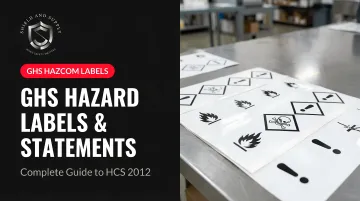
This guide covers everything safety managers, facility managers, and procurement officers need to know: what GHS is, how OSHA's HCS 2012 aligned with it, the six required label elements, all nine pictograms, hazard and precautionary statements, secondary container obligations, and what the 2024 update means for your label inventory.
Key Takeaways
- GHS is the UN's global chemical classification framework; OSHA adopted it in 2012 via the revised Hazard Communication Standard (HCS, 29 CFR 1910.1200).
- Every shipped GHS label must include six required elements — product identifier, supplier info, signal word, hazard statements, precautionary statements, and pictograms.
- Nine GHS pictograms exist; OSHA mandates eight — the environmental symbol is non-mandatory.
- Secondary containers not used immediately by the transferring employee must be labeled by the employer.
- A 2024 OSHA final rule aligns HCS with GHS Revision 7, with phased compliance deadlines through 2028.
GHS and HCS 2012: Understanding the Relationship
What GHS Is — and What It Isn't
The Globally Harmonized System of Classification and Labeling of Chemicals (GHS) was developed by the United Nations. The mandate to create it came from the 1992 UN Conference on Environment and Development; the first edition was adopted in December 2002 and published in 2003.
GHS is not international law. It's a set of recommendations that each country incorporates into its own regulatory framework. Countries can adopt all of it, part of it, or none of it — which is why label requirements vary across borders even when they reference GHS.
OSHA's Hazard Communication Standard Before 2012
OSHA's Hazard Communication Standard (HCS) dates to 1983. Its core purpose: ensure workers know about chemical hazards in their workplace. Before the 2012 revision, manufacturers had wide latitude in how they communicated those hazards. Different formats, different terminology, different symbols — technically compliant across the board, but functionally inconsistent in practice.
That inconsistency created two problems: workers couldn't reliably interpret labels from different manufacturers, and it created trade barriers for companies operating across multiple countries.
What Changed in 2012 — and Again in 2024
Those two problems — worker confusion and international trade friction — drove OSHA to revise HCS in 2012, aligning it with GHS Revision 3. The result is what's commonly called HCS 2012 (29 CFR 1910.1200). The final employer compliance deadline was June 1, 2016.
Then in May 2024, OSHA published another final rule aligning HCS with GHS Revision 7, effective July 19, 2024. Compliance deadlines are phased:
| Party | Chemical Type | Deadline |
|---|---|---|
| Manufacturers, importers, distributors | Substances | January 19, 2026 |
| Employers | Substances | July 20, 2026 |
| Manufacturers, importers, distributors | Mixtures | July 19, 2027 |
| Employers | Mixtures | January 19, 2028 |
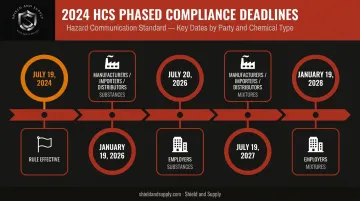
With the substance deadline for manufacturers and importers set for January 2026, facilities should verify their label inventory against the 2024 rule well before that date.
The 6 Required Elements of Every GHS Label Under HCS 2012
Under HCS 2012, every label on a hazardous chemical container shipped through commerce must include exactly six elements. These requirements apply to chemical manufacturers, importers, and distributors. Employers have separate obligations for workplace labels, addressed later in this guide.
Product Identifier
The product identifier is the name, code number, or batch number that links the label to its Safety Data Sheet. The same identifier must appear on both the label and Section 1 of the SDS — this is what ties the label directly to its hazard documentation. A mismatched identifier between the label and SDS is a compliance failure even if both documents are otherwise complete.
Signal Word
Only two signal words exist under HCS 2012:
- "Danger" — more severe hazards
- "Warning" — less severe hazards
Only one signal word can appear on a label, regardless of how many hazards a chemical presents. If any hazard classification warrants "Danger," that word takes precedence and "Warning" must not appear.
Hazard Statements
Hazard statements are standardized phrases describing the nature and degree of a chemical's hazard. They're assigned based on classification — not written by the manufacturer. A chemical with multiple hazards must list all applicable statements, though combining similar ones for readability is permitted.
Examples:
- "Highly flammable liquid and vapour" (H225)
- "Fatal if swallowed" (H300)
Precautionary Statements
Four categories, each serving a different purpose:
- Prevention — how to minimize exposure or avoid the hazard
- Response — first aid and emergency actions after exposure
- Storage — safe storage conditions
- Disposal — how to properly discard the chemical or container
OSHA permits combining statements to save space, but the most critical information must always remain visible.
Pictograms
Pictograms are the red-bordered diamond symbols on a white background. The following section breaks down each symbol and its corresponding hazard classification. A red frame without a symbol is not a valid pictogram and cannot appear on a final shipped label.
Supplier Information
The label must include the name, address, and phone number of the manufacturer, importer, or other responsible party. Workers and emergency responders need a direct contact during an incident — this requirement ensures that contact is always on the label.
GHS Pictograms: All 9 Symbols and What They Mean
Pictograms communicate hazard information across language barriers instantly. GHS defines nine pictograms covering 29 hazard classes. OSHA mandates eight under HCS; the ninth (environmental hazard) is non-mandatory but may appear as supplemental information.
Health Hazard Pictograms
| Symbol | Hazard Classes | What Workers Should Know |
|---|---|---|
| Skull & Crossbones (GHS06) | Acute toxicity — fatal or highly toxic substances | Chemical can kill or cause severe harm via ingestion, skin contact, or inhalation |
| Exclamation Mark (GHS07) | Irritants, skin/eye sensitizers, low-level acute toxicity, respiratory irritation, narcotic effects | Hazards are real but less immediately life-threatening than skull-and-crossbones chemicals |
| Health Hazard (GHS08) | Carcinogens, reproductive toxins, respiratory sensitizers, mutagens, target organ toxicity, aspiration toxicity | Signals long-term or chronic risk — effects may not show up right away |
Quick distinction: skull and crossbones = acute, severe, immediate. Exclamation mark = acute but less severe. Health hazard = chronic or systemic risk.
Physical Hazard Pictograms
| Symbol | Hazard Classes | What Workers Should Do |
|---|---|---|
| Flame (GHS02) | Flammable gases, liquids, solids; pyrophoric and self-reactive materials | Eliminate ignition sources; follow hot work procedures |
| Exploding Bomb (GHS01) | Explosives, self-reactive chemicals, organic peroxides | Handle with extreme caution; avoid shock, friction, and heat |
| Flame Over Circle (GHS03) | Oxidizers that can intensify fires | Keep away from flammables; do not store near combustibles |
| Gas Cylinder (GHS04) | Gases under pressure — compressed, liquefied, dissolved | Secure cylinders upright; keep away from heat sources |
| Corrosion (GHS05) | Skin burns, serious eye damage, corrosive to metals | Use appropriate PPE including face shield and chemical-resistant gloves |
Environmental Pictogram
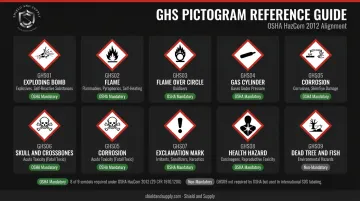
Dead Tree/Fish (GHS09) — Indicates aquatic toxicity. This is the only GHS pictogram not required by OSHA for HCS compliance, but it frequently appears on labels and always warrants special disposal handling. Chemicals bearing this symbol should not be rinsed down drains or disposed of in regular waste streams.
Pictograms never stand alone. The symbol tells you the hazard category — the signal word, hazard statements, and precautionary statements tell you the severity and exactly what to do about it.
Hazard Statements and Precautionary Statements Explained
Hazard statements and precautionary statements are frequently mixed up in training — and the confusion has real consequences. Workers end up knowing a chemical is dangerous without knowing what to do about it.
The distinction is straightforward:
- Hazard statements describe what the danger is
- Precautionary statements describe what to do about it
Hazard Statements (H-Codes)
Hazard statements are standardized and assigned H-codes under GHS. The manufacturer doesn't choose the language — the text is prescribed based on how the chemical is classified. This means the same hazard reads identically on every product from every manufacturer worldwide.
A chemical with multiple hazards must list every applicable statement. Common examples:
- H225 — Highly flammable liquid and vapour
- H301 — Toxic if swallowed
- H314 — Causes severe skin burns and eye damage
When auditing a label, the H-codes give you a quick cross-reference to the classification and the corresponding SDS sections.
Precautionary Statements (P-Codes)
P-codes are also standardized and assigned based on classification. OSHA permits combining statements, but the most stringent requirements must always appear. Plain examples by category:
- Prevention (P210): "Keep away from heat, hot surfaces, sparks, open flames and other ignition sources. No smoking."
- Response (P301+P330+P331): "IF SWALLOWED: Rinse mouth. Do NOT induce vomiting."
- Storage (P403+P235): "Store in a well-ventilated place. Keep cool."
- Disposal (P501): "Dispose of contents/container in accordance with local regulations."
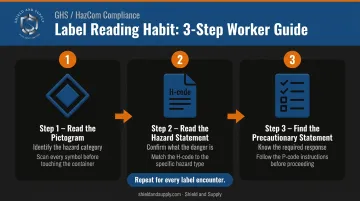
When training workers, build this three-step habit for every label encounter:
- Read the pictogram to identify the hazard category
- Read the hazard statement to confirm what the danger is
- Find the corresponding precautionary statement to know the required response
That order gives workers a repeatable process — not just awareness, but action.
Secondary Containers, Workplace Labels, and Replacement Labels
What Secondary Containers Are — and When They Need Labels
A secondary container is any container a hazardous chemical is transferred into in the workplace: spray bottles, smaller drums, work vessels, dispensing containers. The immediate-use exemption is narrow — it only applies when the container is used within the same shift by the same person who filled it, and only while it remains under their direct control.
If the container might be used by another employee, or if it persists beyond the shift, it needs a label. Many facilities misapply this exemption; the safer compliance position is to label anything that isn't genuinely consumed within a single, controlled use.
At minimum, secondary container labels require:
- The product identifier
- Hazard information — words, symbols, pictograms, or a combination — sufficient to alert workers to the physical and health hazards
Printing Compliant Secondary Labels On-Demand
Employers — not manufacturers — are responsible for secondary container labels. Your facility needs a reliable way to produce compliant labels whenever chemicals are transferred, containers are refilled, or labels become damaged.
Shield and Supply's LabelTac® printers paired with LabelSuite™ labeling software handle this on-site. The LabelTac® Pro X prints label widths from ½" to 4"; the LabelTac® 9 handles larger formats up to 9" wide, capable of printing up to 2,500 labels per day. Both use vinyl supply rolls rated for 5–10 years indoors or outdoors, with chemical-resistant print ribbons built for tough environments.
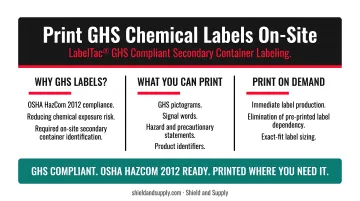
LabelSuite™ supports GHS label creation and comes included with every printer at no additional cost.
Replacement Labels
OSHA requires that illegible, damaged, or detached labels be replaced immediately with fully compliant labels. No container should be left unlabeled, even temporarily. Having an on-site printer eliminates the gap between a damaged label and a replacement.
Employer Responsibilities Under HCS 2012
The Four Core Obligations
HCS 2012 puts four requirements on every employer with hazardous chemicals in the workplace:
- Compliant labels — all hazardous chemical containers must be labeled
- Safety Data Sheets — an up-to-date SDS for every hazardous chemical, accessible to all workers during their shift
- Written Hazard Communication Program — a facility-specific written program covering how the employer will meet HCS requirements
- Employee training — before first chemical exposure and whenever a new chemical hazard is introduced
What Training Must Cover
Training isn't just "here's where the SDSs are." OSHA's 29 CFR 1910.1200(h) requires workers to understand:
- How to read and interpret each label element
- Where to find SDSs and how to use them
- What to do in case of exposure or spill
- Proper PPE selection and use
- The company's internal labeling system for secondary containers
Penalty Exposure
The financial stakes are real. Per OSHA's current penalty schedule (effective January 15, 2025):
- Serious violation: up to $16,550
- Willful or repeated violation: up to $165,514
A single inspection finding multiple secondary containers with missing or illegible labels can generate multiple serious citations. That math adds up quickly.
The 2024 Update: What to Review Now
Those penalties make the 2024 final rule impossible to ignore. OSHA introduced new hazard classifications — aerosols, flammable gases, chemicals under pressure, and desensitized explosives — alongside revised small-container labeling provisions and updated SDS requirements. Employers should:
- Audit current label inventory against the 2024 rule
- Track inbound supplier labels for substances (manufacturer deadline: January 19, 2026)
- Update training materials as new SDS and label formats arrive
- Consult OSHA's compliance timeline for deadlines specific to your chemical inventory
For facilities managing this review, Shield and Supply offers free GHS safety resource guides (available at info@shieldandsupply.com), along with LabelTac® printers and LabelSuite™ software for producing compliant labels in-house.
Frequently Asked Questions
What must a label contain under HazCom 2012 GHS?
Every hazardous chemical container must include six elements: product identifier, supplier information, signal word, hazard statements, precautionary statements, and pictograms. All six are required — any missing element makes the label non-compliant.
What are the 5 key elements of HCS?
The five pillars of HCS are: hazard classification, labeling, Safety Data Sheets (SDS), employee information and training, and a written hazard communication program.
What is the difference between GHS and HCS?
GHS is the UN's international framework for classifying and labeling chemicals; HCS is OSHA's enforceable U.S. regulatory standard. In 2012, OSHA revised HCS to align with GHS, making them compatible — but HCS is the binding law for U.S. workplaces, not GHS itself.
What happened to the Hazard Communication Standard in 2012?
OSHA revised HCS to align with GHS Revision 3, standardizing the six label elements and the 16-section SDS format across all U.S. manufacturers and importers. This replaced the previous system where companies used inconsistent formats to communicate chemical hazards.
Are GHS labels required on secondary containers?
Yes, unless the container is an immediate-use vessel controlled by the same employee within a single shift. Any secondary container that persists or changes hands requires at minimum the product identifier and relevant hazard information — the employer, not the original manufacturer, is responsible for this.
What are the physical requirements for a GHS-compliant label?
Labels must be legible and durable under normal use conditions. Pictograms require a red border on a white background with clearly visible symbols. A blank red diamond without a symbol is not a valid pictogram and is not permitted on final shipped labels.