Introduction
If you work in manufacturing, warehousing, or any industrial facility that handles hazardous chemicals, GHS precautionary statements are the instructions workers rely on to avoid injury. These standardized phrases appear on every compliant chemical label and safety data sheet, telling handlers what to do before, during, and after contact with a hazardous substance.
Getting them right is a compliance requirement, not a suggestion.
Under OSHA's Hazard Communication Standard (29 CFR 1910.1200), precautionary statement text is a mandatory label element — not optional guidance. Hazard Communication ranks as the No. 2 most cited OSHA violation, with 3,213 violations recorded in FY 2023 alone. Incomplete or missing P-statements are a fast path to a citation.
Understanding the P-code system is the first step toward avoiding that outcome. This guide covers how the system works, a complete reference list of all five categories, and how precautionary statements get assigned to specific chemicals.
Key Takeaways
- P-codes are reference codes; OSHA requires the statement text to appear on labels and SDSs — not the code numbers
- Five categories: General (P1xx), Prevention (P2xx), Response (P3xx), Storage (P4xx), Disposal (P5xx)
- Precautionary statements are triggered by hazard classification, not selected at the discretion of the label author
- All GHS label elements, including P-statements, appear in SDS Section 2
- OSHA's 2024 HazCom final rule updated compliance dates: verify your labels against current deadlines
What Are GHS Precautionary Statements?
A precautionary statement is a standardized phrase describing measures workers and handlers must take to minimize or prevent adverse effects from a hazardous chemical. The definition comes directly from OSHA's Hazard Communication Standard, which mirrors the language established by the United Nations' Globally Harmonized System (GHS).
Precautionary Statements vs. Hazard Statements
These two elements are frequently confused, but they serve distinct roles on a label:
| Element | Code Prefix | Purpose | Example |
|---|---|---|---|
| Hazard Statement | H-code | Describes the nature and degree of the hazard | "Extremely flammable liquid and vapor" |
| Precautionary Statement | P-code | Describes what to do about the hazard | "Keep away from heat and ignition sources" |
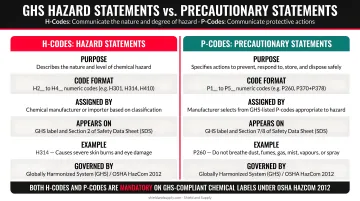
H-codes tell you what the danger is. P-codes tell you what to do about it. Both are required on GHS-compliant labels and work in tandem; neither communicates a complete safety picture on its own.
OSHA adopted GHS through HazCom 2012, and the 2024 final rule updated the standard to align primarily with GHS Rev. 7 (with Rev. 11 now published internationally for reference).
One point that trips up many facilities: only the statement text must appear on printed labels. The P-code number itself is a classification and database reference tool, not a required label element under 29 CFR 1910.1200(f)(1).
How the P-Code System Works
Each precautionary statement carries a code beginning with "P" followed by three digits. The structure follows a consistent logic:
- First digit = category: 1 (General), 2 (Prevention), 3 (Response), 4 (Storage), 5 (Disposal)
- Remaining digits = specific statement within that category
- Numbering is not consecutive — gaps exist intentionally across all categories
Combination Codes and Placeholder Text
Three formatting conventions appear throughout the P-code list:
- "+" (combination codes) — Two or more statements joined into a single instruction that must appear together. For example,
P305+P351+P338reads: "IF IN EYES: Rinse cautiously with water for several minutes. Remove contact lenses, if present and easy to do. Continue rinsing." - "..." (placeholder text) — Indicates the manufacturer must supply specific details. P501, for instance, reads "Dispose of contents/container to ..." — the ellipsis requires the correct disposal method for that product.
- "/" (slash) — Indicates a choice between alternative phrases within the statement.
A Note on Obsolete Codes
Some P-codes from earlier GHS revisions have been deleted in recent updates. UN GHS Rev. 11 removed codes including P201, P202, P310, P311, P312, P313, P314, P315, and several combination codes. These may still appear on older SDSs.
When auditing labels:
- Verify against OSHA's current Appendix C for US compliance
- Check the OSHA 2024 HazCom transition dates before updating any label libraries
Complete List of GHS Precautionary Statements and P-Codes
The tables below present all current active P-codes organized by category, sourced from UN GHS Rev. 11 and OSHA Appendix C. For US workplace compliance, always defer to OSHA Appendix C as the authoritative source, not the UN document directly.
A note on placeholders: Many P-codes contain "…" or bracketed text (for example, "Store at temperatures not exceeding …°C/…°F"). These are fill-in fields that manufacturers must complete with product-specific information on the actual label or SDS.
General Precautionary Statements (P1xx)
These three statements apply broadly regardless of specific hazard type and appear on most chemical labels.
| Code | Statement |
|---|---|
| P101 | If medical advice is needed, have product container or label at hand |
| P102 | Keep out of reach of children |
| P103 | Read carefully and follow all instructions |
Prevention Precautionary Statements (P2xx)
Prevention statements cover actions to take before and during handling to prevent exposure. They address ignition control, inhalation and contact prevention, and PPE requirements.
| Code | Statement |
|---|---|
| P203 | Obtain, read and follow all safety instructions before use |
| P210 | Keep away from heat, hot surfaces, sparks, open flames and other ignition sources. No smoking |
| P211 | Do not spray on an open flame or other ignition source |
| P212 | Avoid heating under confinement or reduction of the desensitizing agent |
| P220 | Keep away from clothing and other combustible materials |
| P222 | Do not allow contact with air |
| P223 | Do not allow contact with water |
| P230 | Keep diluted with … |
| P231 | Handle and store contents under inert gas/… |
| P232 | Protect from moisture |
| P233 | Keep container tightly closed |
| P234 | Keep only in original packaging |
| P235 | Keep cool |
| P236 | Keep only in original packaging; Division … in the transport configuration |
| P240 | Ground and bond container and receiving equipment |
| P241 | Use explosion-proof [electrical/ventilating/lighting/…] equipment |
| P242 | Use non-sparking tools |
| P243 | Take action to prevent static discharges |
| P244 | Keep valves and fittings free from oil and grease |
| P250 | Do not subject to grinding/shock/friction/… |
| P251 | Do not pierce or burn, even after use |
| P260 | Do not breathe dust/fume/gas/mist/vapours/spray |
| P261 | Avoid breathing dust/fume/gas/mist/vapours/spray |
| P262 | Do not get in eyes, on skin, or on clothing |
| P263 | Avoid contact during pregnancy and while nursing |
| P264 | Wash hands [and …] thoroughly after handling |
| P265 | Do not touch eyes |
| P270 | Do not eat, drink or smoke when using this product |
| P271 | Use only outdoors or with adequate ventilation |
| P272 | Contaminated work clothing should not be allowed out of the workplace |
| P273 | Avoid release to the environment |
| P280 | Wear protective gloves/protective clothing/eye protection/face protection/hearing protection/… |
| P282 | Wear cold insulating gloves and either face shield or eye protection |
| P283 | Wear fire resistant or flame-retardant clothing |
| P284 | In case of inadequate ventilation wear respiratory protection |
Note: P201, P202, P281, and P285 are obsolete in current GHS revisions and may appear on older SDSs. If you encounter these codes on existing documentation, check whether your SDSs need updating to current GHS revision standards.
Response Precautionary Statements (P3xx)
Response statements cover emergency first-aid steps for different exposure routes and fire or spill scenarios. Many appear as combination codes that must be used together.
Important: P301, P302, P303, P304, P305, P306, P308, P370, and P371 are trigger codes — they identify the exposure route or situation but are never used alone on a label. Each must be combined with one or more action codes (such as P330, P331, P340, P351, etc.) to form a complete instruction. See the combination codes table below.
| Code | Statement |
|---|---|
| P301 | IF SWALLOWED: |
| P302 | IF ON SKIN: |
| P303 | IF ON SKIN (or hair): |
| P304 | IF INHALED: |
| P305 | IF IN EYES: |
| P306 | IF ON CLOTHING: |
| P308 | IF exposed or concerned: |
| P316 | Get emergency medical help immediately |
| P317 | Get medical help |
| P318 | IF exposed or concerned, get medical advice |
| P319 | Get medical help if you feel unwell |
| P320 | Specific treatment is urgent (see … on this label) |
| P321 | Specific treatment (see … on this label) |
| P322 | Specific treatment is urgent (see … on this label) |
| P323 | Specific treatment (see … on this label) |
| P330 | Rinse mouth |
| P331 | Do NOT induce vomiting |
| P332 | If skin irritation occurs: |
| P333 | If skin irritation or rash occurs: |
| P334 | Immerse in cool water [or wrap in wet bandages] |
| P335 | Brush off loose particles from skin |
| P336 | Immediately thaw frosted parts with lukewarm water. Do not rub affected area |
| P337 | If eye irritation persists: |
| P338 | Remove contact lenses, if present and easy to do. Continue rinsing |
| P340 | Remove person to fresh air and keep comfortable for breathing |
| P342 | If experiencing respiratory symptoms: |
| P351 | Rinse cautiously with water for several minutes |
| P352 | Wash with plenty of water/… |
| P353 | Rinse affected areas with water [or shower] |
| P354 | Immediately rinse with water for several minutes |
| P360 | Rinse immediately contaminated clothing and skin with plenty of water before removing clothes |
| P361 | Take off immediately all contaminated clothing |
| P362 | Take off contaminated clothing |
| P363 | Wash contaminated clothing before reuse |
| P364 | And wash it before reuse |
| P370 | In case of fire: |
| P371 | In case of major fire and large quantities: |
| P372 | Explosion risk |
| P373 | DO NOT fight fire when fire reaches explosives |
| P375 | Fight fire remotely due to the risk of explosion |
| P376 | Stop leak if safe to do so |
| P377 | Leaking gas fire: Do not extinguish, unless leak can be stopped safely |
| P378 | Use … to extinguish |
| P380 | Evacuate area |
| P381 | In case of leakage, eliminate all ignition sources |
| P390 | Absorb spillage to prevent material damage |
| P391 | Collect spillage |
Key combination codes for Response:
| Combination | Combined Statement |
|---|---|
| P304+P340 | IF INHALED: Remove person to fresh air and keep comfortable for breathing |
| P305+P351+P338 | IF IN EYES: Rinse cautiously with water for several minutes. Remove contact lenses, if present and easy to do. Continue rinsing |
| P303+P361+P353 | IF ON SKIN (or hair): Take off immediately all contaminated clothing. Rinse affected areas with water [or shower] |
| P370+P378 | In case of fire: Use … to extinguish |
Note: P310, P311, P312, P313, P314, P315, P302+P317, and P304+P317 are obsolete in current GHS revisions.
Storage Precautionary Statements (P4xx)
Storage statements address conditions including temperature limits, ventilation requirements, segregation, and container type.
| Code | Statement |
|---|---|
| P401 | Store in accordance with … |
| P402 | Store in a dry place |
| P403 | Store in a well-ventilated place |
| P404 | Store in a closed container |
| P405 | Store locked up |
| P406 | Store in a corrosion resistant/… container with a resistant inner liner |
| P407 | Maintain air gap between stacks or pallets |
| P410 | Protect from sunlight |
| P411 | Store at temperatures not exceeding …°C/…°F |
| P412 | Do not expose to temperatures exceeding 50°C/122°F |
| P413 | Store bulk masses greater than … kg/… lbs at temperatures not exceeding …°C/…°F |
| P420 | Store separately |
Active combination codes for Storage:
| Combination | Combined Statement |
|---|---|
| P403+P235 | Store in a well-ventilated place. Keep cool |
| P410+P412 | Protect from sunlight. Do not expose to temperatures exceeding 50°C/122°F |
Disposal Precautionary Statements (P5xx)
| Code | Statement |
|---|---|
| P501 | Dispose of contents/container to … |
| P502 | Refer to manufacturer or supplier for information on recovery or recycling |
| P503 | Refer to manufacturer/supplier … for information on disposal/recovery/recycling |
For P501, the "…" placeholder must be completed with the legally permitted disposal pathway for that specific product — for example, a licensed hazardous waste facility, applicable municipal regulations, or a specific treatment process.
How Precautionary Statements Are Assigned to Chemicals
P-statements aren't selected from a list at random. The assignment process follows a defined classification pathway.
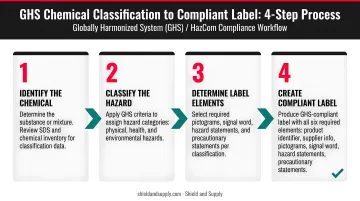
The Classification-to-Label Pipeline
- Classify the chemical by hazard class (e.g., flammable liquid, acute toxicity, skin corrosion) and hazard category (Category 1, 2, 3, etc.)
- Identify the applicable H-codes — each hazard class/category combination maps to specific hazard statements
- Consult OSHA Appendix C — the corresponding P-codes are prescribed in the standard's allocation tables for each H-code
- Compile the label using the required statement text (not just the codes)
Worked Example: Flammable Liquid Category 1 (H224)
A common industrial solvent classified as Flammable Liquid Category 1 carries the hazard statement: "Extremely flammable liquid and vapor." Per OSHA Appendix C, this classification triggers the following P-codes:
- Prevention: P210, P233, P240, P241, P242, P243, P280
- Response: P303+P361+P353, P370+P378
- Storage: P403+P235
- Disposal: P501
Each of those statement texts — not just the codes — must print on the product label and appear in SDS Section 2. Missing even one creates a compliance gap during an OSHA inspection.
Rules for Mixtures and Conflicting Statements
Single-substance labeling is straightforward. Mixtures are more complex — when a product contains multiple hazardous components, the assignment rules shift:
- Precautionary statements must be included for each hazardous component unless the mixture has been assessed as a whole
- When similar statements apply from multiple hazard classifications, OSHA Appendix C requires using the most stringent (most protective) version
- A precautionary statement can only be omitted if the manufacturer can demonstrate it is inappropriate for that specific substance or mixture
Where Precautionary Statements Appear: GHS Labels and SDS
On the Container Label
Under 29 CFR 1910.1200(f)(1), all shipped hazardous chemical containers must display six mandatory elements:
- Product identifier
- GHS hazard pictogram(s)
- Signal word
- Hazard statement(s)
- Precautionary statement(s)
- Supplier identification (name, address, phone number)
The precautionary statement text is required. P-code numbers do not need to appear on the printed label — they're a reference tool for classification databases and SDS authoring software.
Labels must be legible, in English, and prominently displayed. Pictograms use black hazard symbols on a white background with a red border wide enough to remain clearly visible.
On the Safety Data Sheet
All GHS label elements — including precautionary statements — appear in SDS Section 2: Hazard(s) Identification, as required by OSHA Appendix D. Section 2 is the primary checkpoint when auditing SDS records for P-statement accuracy and completeness.
Producing Compliant Labels In-House
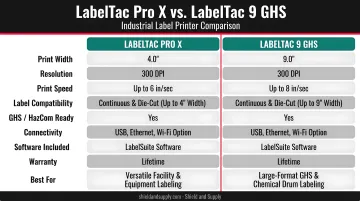
Facilities that label secondary containers, transfer substances between vessels, or maintain in-house chemical stores need a reliable way to print accurate GHS labels on demand. Shield and Supply's LabelTac® Pro X and LabelTac® 9 are purpose-built for industrial GHS labeling — both include LabelSuite™ labeling software at no extra cost and carry a full lifetime warranty on parts and labor.
Facilities that label secondary containers, transfer substances between vessels, or maintain in-house chemical stores need a reliable way to print accurate GHS labels on demand. Shield and Supply's LabelTac® Pro X and LabelTac® 9 are purpose-built for industrial GHS labeling — both include LabelSuite™ labeling software at no extra cost and carry a full lifetime warranty on parts and labor.
| LabelTac® Pro X | LabelTac® 9 | |
|---|---|---|
| Price | $1,299.99 | $3,999.00 |
| Label Width | ½" to 4" | 4" to 9" |
| Software Included | LabelSuite™ ($299.99 value) | LabelSuite™ ($299.99 value) |
| Warranty | Lifetime (parts & labor) | Lifetime (parts & labor) |
Vinyl supply rolls are engineered to last 5–10 years, and print ribbons are scratch- and chemical-resistant — keeping labels legible even on containers stored alongside the substances they identify.
Frequently Asked Questions
What are the required elements of a GHS-compliant label?
A GHS label must include six elements: product identifier, GHS hazard pictogram(s), signal word, hazard statement(s), precautionary statement(s), and supplier identification. All of this information can be sourced directly from the chemical's SDS Section 2.
Which SDS section lists GHS label elements and precautionary statements?
Section 2 (Hazard Identification) contains all required GHS label elements, including applicable precautionary statements and hazard statements. Check this section first when auditing SDS records for completeness.
What are GHS hazard statements and are they required on labels?
Hazard statements describe the nature and degree of a chemical's hazard — for example, "Highly flammable liquid and vapor." They are required on GHS labels under 29 CFR 1910.1200(f)(1) and are distinct from precautionary statements, which cover protective actions instead.
What do H-codes mean on GHS labels?
H-codes are standardized reference codes for hazard statements. The numbering indicates hazard type: H2xx = physical hazards, H3xx = health hazards, H4xx = environmental hazards. Each H-code assigned to a chemical triggers a corresponding set of required P-codes per OSHA Appendix C.
Are signal words required on GHS labels, and which ones are used?
Yes, signal words are mandatory. Only two are used: "Danger" for more severe hazards and "Warning" for less severe hazards. The appropriate word is determined by the hazard classification category assigned to the chemical.
What are examples of GHS precautionary statements?
Examples across categories:
- P210: Keep away from heat, hot surfaces, sparks, and open flames
- P304+P340: If inhaled, remove person to fresh air and keep comfortable for breathing
- P405: Store locked up