Introduction
A missing label on a pressure vessel or electrical panel is rarely just an inconvenience. In a busy facility, it can mean a worker makes a dangerous assumption, an OSHA inspector writes a citation, or a machine sits idle while someone tracks down the service manual.
The pressure is real. Manufacturing facilities recorded a 2.7 total recordable case (TRC) rate per 100 workers in 2024, with warehousing and storage reaching 4.8 TRC — well above the private industry average. The National Safety Council estimated $181.4 billion in total preventable work injury costs in 2024, including $54.9 billion in wage and productivity losses alone.
Most facility managers know labeling matters. But its day-to-day value often goes unappreciated until an audit flags a gap or an incident report lands on someone's desk.
This article covers the five most practical uses of industrial equipment labels, with specific focus on how each one affects safety outcomes, compliance standing, and operational efficiency on the floor.
Key Takeaways
- Hazard communication labels put safety warnings exactly where workers need them — at the point of risk
- Regulatory compliance labels serve as documented proof during audits; gaps can expose facilities to OSHA fines up to $165,514 per willful violation
- Asset identification labels connect physical equipment to digital tracking systems for better inventory control
- Operating instruction labels reduce procedural errors by placing critical parameters directly on equipment
- Maintenance scheduling labels keep service intervals on track and help prevent costly unplanned downtime
What Are Industrial Equipment Labels?
Industrial equipment labels are physical identifiers and information carriers affixed directly to machinery, tools, and equipment. Their job is practical: communicate hazards, confirm compliance, and guide safe operation — not promote a brand.
They appear across virtually every category of industrial equipment:
- Forklifts and material handling vehicles
- CNC machines, presses, and conveyor systems
- Electrical panels and control cabinets
- Pressure vessels and chemical storage
- Generators, compressors, and HVAC systems
The functional range is wide. A "High Voltage – Keep Clear" warning decal and a barcode asset tag linking to a CMMS maintenance record are both industrial equipment labels — they just serve different roles.
What every label type shares is a single non-negotiable: durability. A label that fades, peels, or turns illegible within months cannot protect anyone. In environments with heat, chemical exposure, or heavy abrasion, vinyl supply rolls rated for 5–10 years — indoors or outdoors — set the minimum bar. Shield and Supply's vinyl rolls, designed for LabelTac® printers, meet that standard.
The 5 Essential Uses of Labels for Industrial Equipment
Each use below addresses a distinct operational need. Together, they form a complete labeling system for any industrial environment.
Hazard Communication and Worker Safety
This is the foundational use. Hazard labels make dangers impossible to ignore by communicating risks — high voltage, crush points, hot surfaces, rotating parts, chemical exposure — at the exact location where those risks exist.
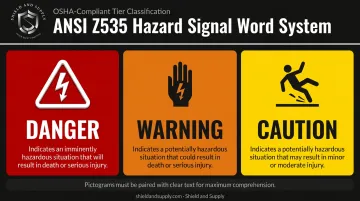
Effective hazard labels follow ANSI Z535 and OSHA-compliant conventions:
- Red for DANGER (immediate, life-threatening hazard)
- Orange for WARNING (serious injury risk)
- Yellow for CAUTION (minor injury potential)
- Standardized pictograms paired with concise text so any worker, regardless of language or experience, can interpret the warning quickly
That last point matters more than it might seem. A 2023 peer-reviewed study of fiberboard industry employees found mean safety sign comprehension of only 66.6%, with warning signs averaging just 53.2%. Symbols alone don't cut it — labels need to pair pictograms with clear text, and placement matters as much as design.
Why this translates to operational value:
Hazard labels reduce reliance on memory and verbal instruction. During high-pressure shifts, cross-training scenarios, or new employee onboarding, a persistent point-of-use warning does what a one-time safety briefing cannot: it's always there.
Unaddressed hazards carry measurable financial weight beyond the human cost — workers' compensation claims, OSHA citations, and potential work stoppages all add up fast.
Key metrics this affects:
- Total Recordable Incident Rate (TRIR)
- Near-miss report frequency
- Workers' compensation costs
- Days Away From Work (DAFW)
- Equipment-related accident frequency
When it matters most: High operator turnover, multiple-shift operations, new equipment installations, or facilities undergoing layout changes — anywhere verbal safety training alone can't keep pace with changing conditions.
Regulatory Compliance and Certification
Industrial equipment in the US operates under a dense web of labeling mandates:
- OSHA 29 CFR 1910.1200 (HazCom) requires chemical containers to display product identifiers, signal words, hazard statements, pictograms, precautionary statements, and responsible party contact information
- OSHA 1910.145 governs accident prevention signs and tags for general industry
- OSHA 1910.147 (lockout/tagout) requires durable tagout devices with legends such as "Do Not Start" or "Do Not Operate"
- OSHA 1910.303 requires electrical equipment to carry manufacturer identification, voltage ratings, and "DANGER – HIGH VOLTAGE – KEEP OUT" marking on exposed live-part locations over 600 volts
- NEC (NFPA 70) mandates arc-flash hazard warnings on electrical equipment
Certification marks — UL, CSA, CE, RoHS — must also appear on qualifying equipment to demonstrate conformance with applicable safety and manufacturing standards.
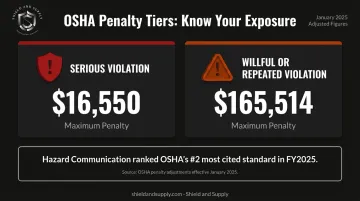
The financial exposure is concrete. Current OSHA maximum penalties (adjusted January 15, 2025) reach $16,550 per serious violation and $165,514 per willful or repeated violation. And Hazard Communication ranked as OSHA's #2 most frequently cited federal standard in FY2025 — meaning inspectors are actively looking for labeling gaps.
A real example: a 2021 OSHA citation against JBS Foods included an $8,582 penalty for a chain hoist where manufacturer identifying marks were defaced and the safe working load wasn't indicated. Compliance gaps that seem minor in daily operations become expensive when an inspector arrives.
Key metrics this affects:
- OSHA citation frequency
- Audit pass rate
- Compliance-related downtime
- Client quality scorecard performance
This matters most during third-party audits, hazardous chemical handling, electrical panel installations, pressure vessel operations, and any equipment exported internationally.
Equipment Identification and Asset Tracking
In a facility with dozens of machines that look identical — or assets spread across multiple buildings — identification labels provide the baseline for organized inventory control. A typical asset label includes:
- Serial number and model code
- Asset ID assigned by the facility
- Manufacturing or installation date
- Barcode or QR code linked to a digital asset management system
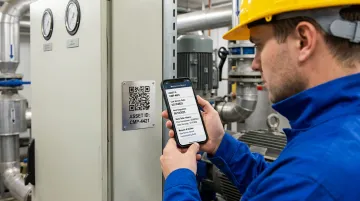
That QR code is where the real value sits. Platforms like Fiix, UpKeep, IBM Maximo Mobile, and SAP myAsset all support barcode and QR code scanning to pull up work order history, downtime records, and depreciation data in the field. A technician scans the label on a conveyor motor and has its full maintenance history in seconds.
This directly supports preventive maintenance scheduling, repair documentation, theft deterrence, and accurate depreciation tracking.
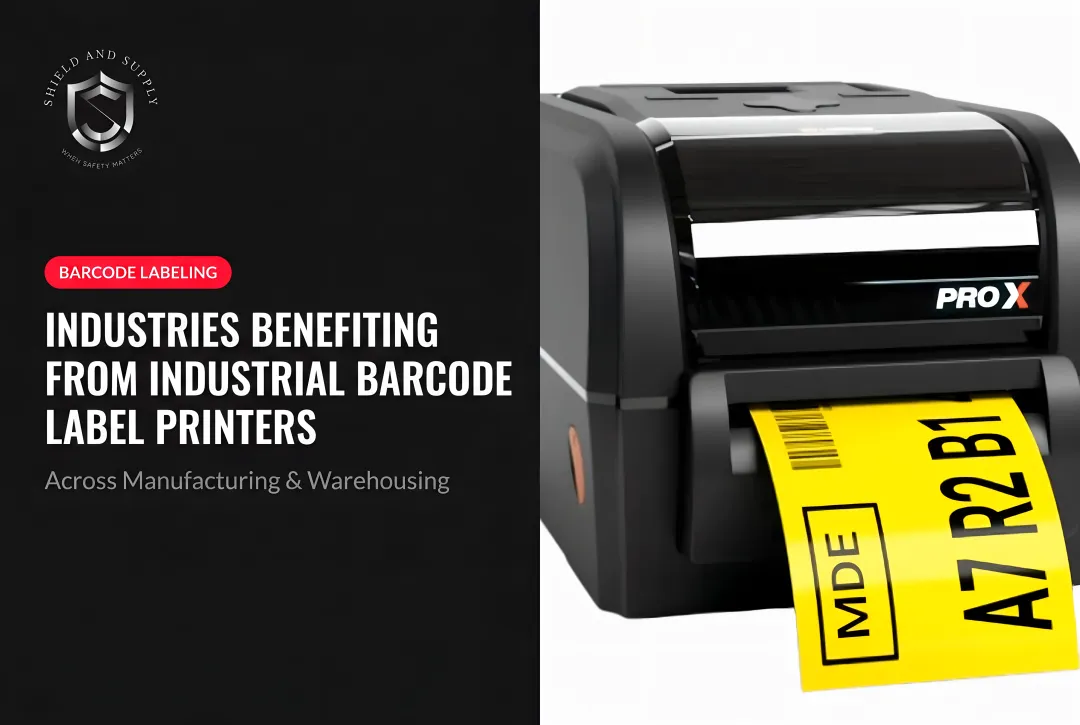
Facilities that print asset ID labels in-house using the LabelTac® 9 (which handles widths up to 9" for larger equipment tags) or LabelTac® Pro X paired with LabelSuite™ software can generate facility-specific asset tags on demand — no waiting on external print orders when a label gets damaged or equipment gets relocated.
Key metrics this affects:
- Asset utilization rate
- Inventory accuracy
- Time to locate equipment
- Theft and loss incidents
- Maintenance schedule adherence
Operating Instructions at the Point of Use
Operational labels place critical usage parameters directly on the equipment surface — voltage ratings, maximum load limits, fluid types, startup and shutdown sequences, torque specifications. The operator doesn't need to consult a manual; the answer is right there.
Fewer procedural errors happen when the correct parameters are visible at the moment of action. This matters most for newer employees still building familiarity with equipment, and for facilities running multiple shifts where what one crew knows doesn't automatically carry over to the next.
A simple label reading "Max Load: 2,000 lbs." on a storage rack or "Hydraulic Fluid Only – ISO 46" on a reservoir can prevent misuse that leads to equipment damage or injury. These aren't sophisticated interventions — they're persistent, reliable reminders that work whether or not a supervisor is present.
Key metrics this affects:
- Operator error rate
- Time-to-competency for new hires
- Production throughput consistency
- Equipment misuse incidents
Maintenance and Service Scheduling
Maintenance labels keep service intervals on track without depending solely on digital systems or supervisor follow-up. Common formats include:
- Inspection date tags showing next-due date
- Lubrication point markers identifying the correct fluid and interval
- Filter change and calibration due-date labels
- Part replacement schedule stickers on wear components
QR-code-enabled service labels add a layer of functionality — scan the label on a compressor, and you're looking at its service manual, parts list, and maintenance log directly on a mobile device. Platforms like UpKeep and Fiix both document this workflow, linking physical asset labels to live maintenance records in the field.
Deloitte estimates unplanned downtime costs industrial manufacturers roughly $50 billion annually, with poor maintenance reducing productive capacity by 5% to 20%. A maintenance label that prompts a $200 oil change on schedule can prevent a $20,000 bearing failure three months later.
Key metrics this affects:
- Mean time between failures (MTBF)
- Unplanned downtime hours
- Preventive vs. reactive maintenance ratio
- Equipment lifespan
What Happens When Labels Are Missing or Ignored
Unlabeled or degraded equipment forces workers to guess at hazards or fall back on informal knowledge that doesn't transfer between shifts — and that inconsistency is where incidents occur.
The downstream costs span safety, compliance, and operations:
- Safety incidents trigger OSHA investigations and production shutdowns
- Failed compliance audits produce regulatory fines and stalled certifications
- Untracked assets and missed maintenance intervals lead to unexpected equipment failures and reactive repair costs
- Onboarding friction increases when new employees work without point-of-use guidance
A single unlabeled machine can trigger facility-wide scrutiny. OSHA conducted 34,625 inspections in FY2024, and inspectors who find one labeling violation often look harder for others. With serious violations running up to $16,550 each and willful violations reaching $165,514, the cost of neglect adds up fast.
How to Get the Most Value from Industrial Labels
Labels work best as a system, not a patchwork. That means covering every function — safety, compliance, asset ID, operation, and maintenance — consistently across all equipment, not just the highest-risk assets.
Practical principles for getting it right:
Match materials to the environment. Vinyl works for most general industrial settings. For extreme heat, chemical immersion, or outdoor UV exposure, specialty supplies — high-temperature, chemical-resistant, or UV-stable materials — are necessary. A label that fails in six months provides a false sense of security.
Run scheduled label audits. Monthly or quarterly walkthroughs to identify damaged, outdated, or missing labels catch compliance gaps before an inspector does. This is faster and cheaper than reacting after an incident.
Place labels at the point of interaction. Operator eye level, directly on or adjacent to the hazard or component being addressed. A warning label tucked behind an access panel has zero protective value.
Print in-house when possible. Waiting on external print orders when a label gets damaged or equipment moves creates gaps. Shield and Supply's LabelTac® Pro X (up to 4" wide) and LabelTac® 9 (up to 9" wide) let facilities produce durable, OSHA-compliant labels on demand using LabelSuite™ software — both printers include a full lifetime warranty and LabelSuite™ at no additional cost.
Conclusion
The five uses of industrial equipment labels — hazard communication, regulatory compliance, asset identification, operating instructions, and maintenance scheduling — aren't isolated functions. They work together as the operational backbone of a safe, efficient, and auditable facility.
Consistent labeling isn't a one-time project. Equipment changes, regulations update, and labels degrade over time. A reliable labeling system requires periodic audits, durable materials that hold up in harsh environments, and a clear process for reprinting when standards shift or new personnel come on board.
Shield and Supply's industrial labeling products — from LabelTac® printers with lifetime warranties to OSHA-compliant floor marking and safety signage — are built for exactly this kind of ongoing system. Facilities that keep their labeling current protect workers, maintain compliance standing, and eliminate the small operational breakdowns that compound into bigger problems.
Frequently Asked Questions
What is the purpose of labeling equipment?
Equipment labels serve five core purposes: hazard communication, regulatory compliance, asset identification, operating guidance, and maintenance scheduling. These functions protect workers, support audit readiness, and keep daily operations traceable.
What does OSHA require on labels?
OSHA's HazCom standard (29 CFR 1910.1200) requires chemical labels to include a signal word, hazard pictograms, hazard statements, precautionary statements, and product/manufacturer identification. Additional OSHA standards cover lockout/tagout tags, electrical markings, and equipment labels — specific requirements vary by application type.
What is the standard for equipment tagging?
ANSI Z535 is the primary US standard for safety sign and label design, covering color coding, signal words, and symbol formats. OSHA standards govern required label content across categories such as hazardous chemicals, electrical equipment, and lockout/tagout applications.
What are industrial labels?
Industrial labels are durable, information-bearing labels designed for direct application to machinery and equipment in demanding environments. They're built to withstand heat, chemicals, abrasion, and UV exposure while staying legible throughout the equipment's service life.
What are some examples of labeling?
Common industrial label types include "High Voltage – Keep Clear" warning decals, serial number and barcode asset tags, "Max Load: 2,000 lbs." operational labels, inspection due-date service tags, and UL or CSA certification marks.
What are examples of industrial equipment?
Industrial equipment includes forklifts, CNC machines, conveyor systems, electrical control panels, pressure vessels, generators, compressors, welding equipment, and HVAC systems. In short, any powered or mechanized equipment used in manufacturing, construction, warehousing, or utilities.