The challenge is that not every operation treats labeling this way. Many facilities run desktop printers past their duty cycle limits, use label stock that fails under heat or moisture, or operate printers disconnected from their ERP or WMS platforms. The result isn't dramatic — it compounds quietly until a mis-scan, a failed audit, or a compliance violation makes the cost visible.
This article breaks down which industries depend most heavily on industrial barcode label printers, what specific operational problems these printers solve, and what happens when labeling infrastructure doesn't keep up.
Key Takeaways
- Industrial barcode label printers are purpose-built for continuous, high-volume output in demanding environments — desktop devices can't handle the workload or the conditions
- Manufacturing, warehousing, healthcare, food and beverage, and chemical industries all depend on them for traceability and compliance
- 70% of logistics organizations report weekly barcode readability issues, according to a 2025 GS1 US/VDC report — a direct consequence of under-spec labeling infrastructure
- Regulatory mandates (FDA UDI, FSMA, GHS/OSHA, GMP) make industrial-grade label output a legal requirement in several sectors
- Matching printer specs to volume, environment, and integration needs lowers cost-per-label and reduces unplanned downtime
What Is an Industrial Barcode Label Printer?
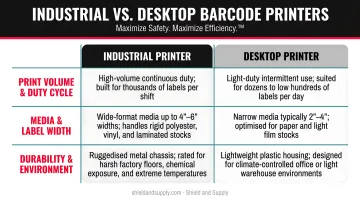
Industrial barcode label printers are high-duty-cycle devices built for continuous, high-volume output in production, warehousing, and field environments. Three factors separate them from desktop or office printers:
- Build quality — metal chassis and ruggedized components rated for industrial environments
- Duty cycle — engineered to run thousands of labels per shift without performance loss
- Media versatility — compatible with specialty stocks including heat-resistant, reflective, and weatherproof vinyl
Manufacturers including Zebra, Honeywell, and SATO all classify industrial printers as a distinct category — positioned specifically for manufacturing, logistics, healthcare, and government applications where unplanned downtime or a mislabeled shipment carries real compliance and cost consequences.
Where These Printers Actually Live
These devices are deployed on:
- Production lines printing work-in-progress and batch labels in real time
- Warehouse receiving docks and shipping stations
- Distribution centers generating pallet and compliance labels
- Pharmaceutical packaging operations producing unit-dose and UDI labels
- Chemical facilities printing GHS hazard labels on-site
Every label an industrial printer outputs connects a physical item to a digital system — ERP, WMS, or MES. That connection is a live data entry point. Its accuracy and durability affect every downstream decision, from inventory counts to compliance audits.
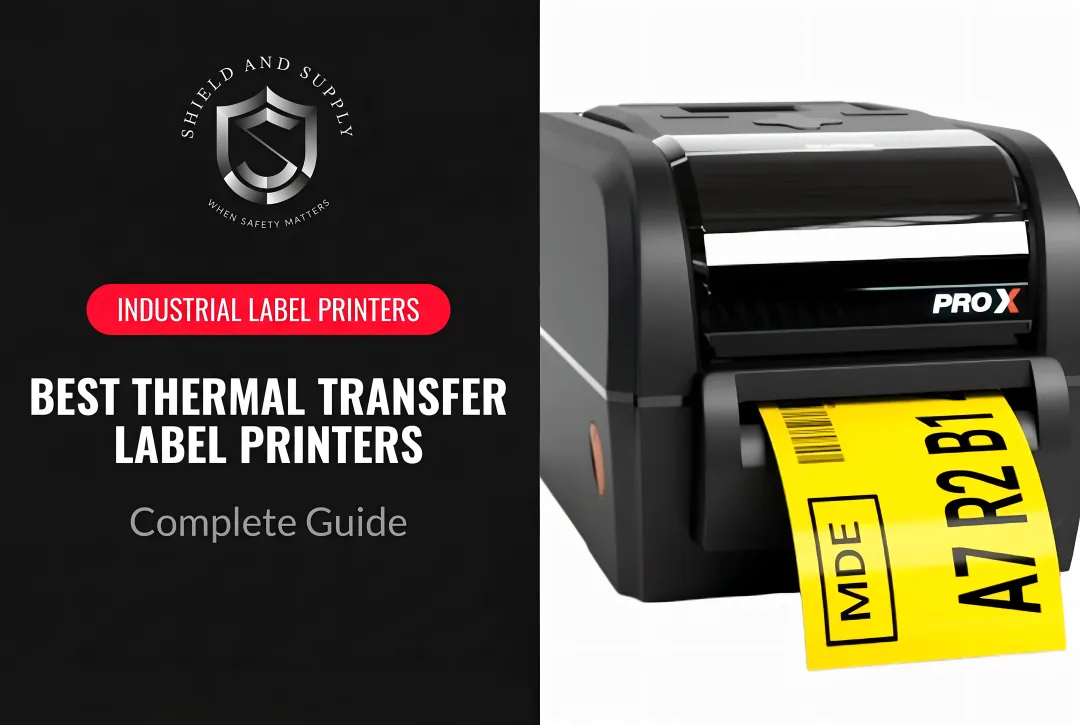
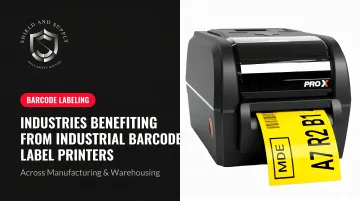
Shield and Supply's LabelTac® line meets these demands directly. The LabelTac® 9 handles up to 2,500 labels per day with a metal chassis and built-in Ethernet. The LabelTac® Pro X delivers the same rugged build in a more compact footprint. Both carry a Full Lifetime Warranty on all parts and labor.
Core Industries That Rely on Industrial Barcode Label Printers
Manufacturing
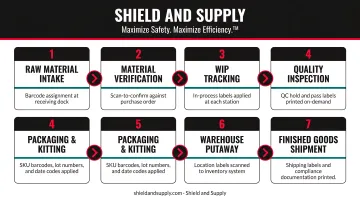
Manufacturing is the most demanding environment for industrial barcode printers. Labels are required at every stage — raw material intake, work-in-progress, quality checkpoints, finished goods shipment — and they must be accurate, consistent, and durable enough to survive heat, oil, and vibration on the production floor.
In facilities running MES platforms, industrial printers integrate directly to generate WIP labels in real time. That integration eliminates manual data entry and gives production teams batch-level traceability, quality checkpoint visibility, and a defensible audit trail for ISO or GMP compliance.
Why label accuracy matters in manufacturing:
- A single mislabeled component or batch can cascade into defective product, rework cycles, or regulatory violations
- GMP rules under 21 CFR Part 211 Subpart G require special controls for labeling — including 100% examination for cut labeling or automated prevention of incorrect labeling from being processed
- Manual labeling introduces unnecessary errors; ERP-integrated automated labeling reduces both manual data entry and duplicate data maintenance, according to Loftware's 2022 white paper
KPIs directly affected:
- Defect rate and rework cost
- First-pass yield
- Production line throughput
- Compliance audit pass rate
High-mix, high-volume environments — automotive, electronics, food manufacturing — place the greatest demands on industrial printers because label content varies constantly and environmental conditions (heat, oil exposure, vibration) will degrade anything short of industrial-grade label stock.
Warehousing and Logistics
Every scan in a warehouse management system depends on a label printed accurately and remaining legible through handling, storage, and transport. One failed read anywhere in the fulfillment chain creates a ripple of manual lookups and inventory errors.
Industrial printers support the full fulfillment cycle, typically integrated with WMS platforms to auto-generate labels tied to live order data:
- Inbound receiving
- Pick-and-pack
- Pallet labeling
- Carrier-compliant shipping labels
The readability problem is real and current:
According to 2025 research from GS1 US and VDC, 70% of logistics organizations experience barcode readability issues on a weekly basis. That's not an edge case — it's a systemic operational drain. Every failed scan requires a manual lookup, which slows throughput and introduces errors into inventory records.
Carrier compliance adds another layer of risk:
Shipping labels must meet GS1-128 dimensional and barcode quality standards. A label that doesn't scan at the carrier's dock doesn't just get delayed — it can trigger chargebacks or compliance violations with major retail partners. Industrial printers maintain consistent print quality across thousands of labels per shift; desktop alternatives don't.
KPIs directly affected:
- Order accuracy rate
- Pick error rate
- Shipping compliance rate
- Throughput per shift
- Return and chargeback rate
Peak seasons expose the gap fastest. Q4 retail fulfillment and e-commerce surges push label volumes to levels where under-spec duty cycles become bottlenecks — and missed SLAs become visible failures.
Healthcare and Pharmaceuticals
No industry carries higher stakes for label accuracy. A misread patient wristband, a mislabeled drug batch, or a failed UDI scan can have consequences that go well beyond a compliance citation — and the regulatory framework reflects that.
What industrial printers support in healthcare:
- Patient wristbands and specimen labels
- Prescription packaging and unit-dose labeling
- Medical device UDI (Unique Device Identification) codes
- Cold chain pharmaceutical labels for refrigerated or frozen products
The regulatory requirements are non-negotiable:
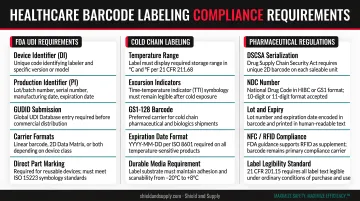
The FDA requires device labels to present UDI in both easily readable plain text and machine-readable AIDC form — a direct barcode output requirement. On the pharmaceutical side, 21 CFR Part 211 Subpart G mandates documented controls for labeling and packaging materials, including sampling, examination, and special controls for cut labeling.
Cold chain applications add another layer of complexity. Pharmaceutical labels may need to maintain adhesion and barcode legibility from -196°C to +120°C for cryogenic storage. Standard office label stock fails at these extremes — industrial-grade media with cold-adhesion properties is required.
KPIs directly affected:
- Medication error rate
- Label scan readability rate
- Regulatory audit compliance rate
- Cold chain label failure rate
- Recall response time
Facilities processing high volumes of unit-dose packaging, specialty drugs, or implantable medical devices face the greatest compliance burden. In these settings, high-resolution output and compatible label materials aren't a preference — they're a requirement.
More Industries That Benefit from Industrial Barcode Labeling
Beyond the three core sectors above, several other industries depend on industrial barcode printers for daily operations.
Food and Beverage
Food manufacturers must track lot codes, expiration dates, and country-of-origin information — and they must do it with labels that survive moisture, refrigeration, and cold chain handling.
The regulatory pressure is substantial. Under FSMA Section 204 and 21 CFR Part 1 Subpart S, facilities handling foods on the FDA's Food Traceability List must maintain records for 2 years and provide traceability information to FDA within 24 hours of a request. That response window requires label-based traceability systems that are reliable and audit-ready.
Labeling errors aren't hypothetical: about one-third of foods reported to the FDA's Reportable Food Registry as serious health risks from 2009 to 2014 involved undeclared allergens — a category directly tied to labeling failures.
Chemical and Industrial Materials
Chemical manufacturers are required to print GHS-compliant hazard labels that include product identifiers, signal words, hazard statements, pictograms, precautionary statements, and supplier identification. Under OSHA 1910.1200, workplace labels must remain legible and prominently displayed.
The financial risk for non-compliance is concrete: OSHA maximum penalties after January 15, 2025 reach $165,514 per willful or repeated violation. Industrial printers paired with chemical-resistant label stock let facilities print compliant labels on-site whenever formulations or packaging change.
Retail, Automotive, and Electronics
- Retail backroom operations — managing large SKU counts, seasonal repricing — require print speed and consistency that desktop printers can't sustain across a shift
- Automotive and electronics manufacturing — require high-resolution, small-format labels that survive heat, oil, and physical abrasion across multi-year product lifecycles
- Specialty label materials — heat-resistant, reflective, and chemical-resistant stocks — meet the durability demands both sectors face in production environments
LabelTac® printers support specialty supply options including High Temperature Supply, Reflective Supply, and Metallic Supply — purpose-built for the conditions these industries operate in every day.
What Happens When Industrial Barcode Labeling Is Neglected
The consequences of under-investing in labeling infrastructure don't arrive as a single event. They accumulate.
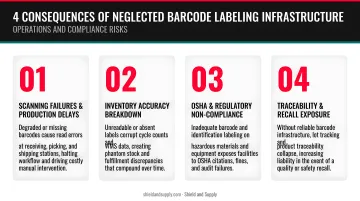
Common operational consequences:
- Inconsistent print quality triggers mis-scans, forcing manual lookups that slow throughput and push errors into inventory or patient records
- Labels that fade, peel, or smear in harsh environments cause lost shipments, unidentified inventory, failed quality inspections, and compliance findings
- Desktop equipment not rated for volume creates bottlenecks at production lines, shipping docks, or medication carts — at exactly the moments when throughput matters most
- Rework, chargebacks, regulatory fines, and recall events compound over time, each tracing back to labeling failures that seemed minor in isolation
A 70% weekly barcode readability rate in logistics signals labeling infrastructure that was never matched to the environment or volume it was asked to handle. The equipment, materials, and maintenance practices all contribute — and all need to be right.
How to Get the Most from Your Industrial Barcode Printer
The printer is the starting point, not the complete solution.
Match the Printer to the Environment
Three hardware factors determine whether a printer performs or becomes a bottleneck:
- Duty cycle should exceed your average daily label volume with headroom for peak periods
- Label material must be compatible with the environment — heat, moisture, chemical exposure, or UV all require specific supply types
- Connectivity (Ethernet, USB) should allow integration with existing WMS, ERP, or MES systems to eliminate manual label generation
Software Is Part of the System
Once connectivity is established, label design software determines how efficiently teams can act on it. Shield and Supply includes LabelSuite™ free with every LabelTac® printer — it supports OSHA, GHS, 5S, and pipe marking templates out of the box. Centrally managed templates reduce design errors and reprint waste without requiring IT involvement.
Track Labeling as an Operational Metric
Beyond setup, the ongoing numbers matter. Track scan failure rates, reprint frequency, and label-related error incidents. These figures tell you whether your current setup is meeting demand as volume scales or product lines change. A printer that handled 800 labels per day adequately may not be the right tool at 1,800.
For questions about which LabelTac® model fits your environment, contact Shield and Supply at 1-877-514-0727 or info@shieldandsupply.com.
Conclusion
Industrial barcode label printers are operational infrastructure. Their reliability, accuracy, and durability have direct consequences for throughput, regulatory compliance, and safety — consequences that show up in daily operations whether or not the labeling system gets explicit attention.
Manufacturing, warehousing, healthcare, food and beverage, and chemical operations all share the same core need: consistent, high-quality label output that connects physical items to digital systems without failure. The right printer, matched to the right environment and integrated into existing workflows, meets that need reliably — eliminating mislabels, compliance gaps, and the downtime that follows.
Shield and Supply's LabelTac® industrial printers come with a full lifetime warranty and include LabelSuite™ software, so facilities in any of these industries can get up and running without additional software costs or guesswork. Call 877-514-0727 or email info@shieldandsupply.com to find the right fit for your operation.
Frequently Asked Questions
What industry does label printing fall under?
Label printing falls under NAICS 323111 (Commercial Printing), covering establishments that print labels on purchased stock. Industrial barcode label printing is a distinct sub-category focused on high-volume, ruggedized output for manufacturing, logistics, and healthcare operations.
What is the difference between a label printer and a barcode printer?
A barcode printer specifically outputs machine-readable codes (1D, 2D, QR), while a label printer is a broader category covering text, graphics, and compliance information. Industrial barcode label printers combine both functions, producing compliant, scannable labels at production volumes.
What is the difference between industrial printing and commercial printing?
Commercial printing focuses on consumer-facing print runs like packaging and marketing materials, typically handled by print shops. Industrial printing refers to on-demand, high-volume label output integrated into production workflows, prioritizing durability, speed, and system integration over visual design.
Which industries require industrial barcode label printers for regulatory compliance?
Pharmaceuticals (FDA/UDI/GMP), food and beverage (FSMA/USDA), chemicals (GHS/OSHA), and medical devices (UDI) all have labeling mandates that require accurate, auditable, and durable label output. In these sectors, industrial-grade printers are a compliance requirement, not a preference.
How durable do industrial barcode labels need to be?
Durability requirements vary by environment: chemical-resistant stock for industrial settings, cold-adhesion materials for cold chain and pharmaceutical applications, and heat-resistant stock for automotive and electronics manufacturing.
Can industrial barcode printers integrate with warehouse or production management systems?
Industrial-grade barcode printers support WMS, ERP, and MES integration via Ethernet or USB connectivity. LabelTac® printers include built-in Ethernet as standard, enabling auto-generated labels tied to live system data — eliminating manual entry and reducing labeling errors at scale.