Labeling is rarely treated as a strategic variable. It should be. For facilities applying hundreds or thousands of labels per shift, the choice between on-demand printing and pre-printed industrial labels has measurable consequences for cost, throughput, and compliance outcomes.
This article breaks down exactly where pre-printed industrial labels deliver operational advantages on high-volume lines — and what it costs when that decision gets made by default rather than design.
Key Takeaways
- Pre-printed labels arrive ready to apply — no on-site printing equipment, ribbon changes, or setup delays
- At volume, they lower per-label cost by cutting consumable overhead and printer maintenance
- Controlled press production means consistent barcode quality across every label in a run
- Industrial face stocks (polyester, polypropylene) resist chemical exposure, heat, and abrasion that degrade thermal-printed labels
- GHS and OSHA formatting is built in, cutting per-shift compliance verification time
What Is a Pre-Printed Industrial Label?
A pre-printed industrial label is produced in bulk before it reaches the production floor — arriving with all static content already applied. Hazard symbols, regulatory text, barcode blocks, color fields, and safety pictograms are all printed using professional press technology during manufacturing.
This distinguishes them from on-demand labels, where content is printed at the point of application using thermal transfer or inkjet printers. Pre-printed labels are the right tool when content is fixed and volume is high. On-demand printing remains the right tool for variable data: lot numbers, serialized barcodes, batch dates.
Both approaches have their place. Pre-printed labels dominate in environments like these:
Common applications:
- Chemical and hazardous material storage areas requiring GHS/HazCom labels
- Manufacturing assembly lines with stable SKUs and consistent label formats
- Warehouse racking systems needing standardized identification
- Any environment where OSHA or GHS compliance labeling must be applied at volume
Choosing pre-printed labels is ultimately a workflow decision — one that shapes throughput, compliance consistency, and total labeling cost across every shift.
Key Advantages of Pre-Printed Industrial Labels for High-Volume Lines
Each advantage below connects to metrics that facility managers and operations teams actually track — throughput, scan success rate, compliance exposure, and label cost per unit.
Advantage 1: Lower Cost Per Label at Scale
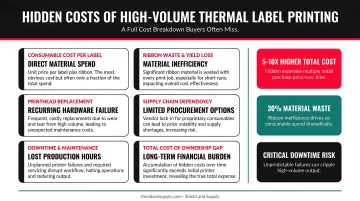
On-demand thermal printing carries a cost structure that becomes increasingly inefficient at volume. The per-label price of a thermal print includes ribbon consumption, printhead wear, wasted media from jams and test prints, and labor for setup and calibration — costs that don't appear on a single label but compound quickly across a shift.
Pre-printed labels produced on industrial presses benefit from economies of scale. Unit cost drops as run volume increases, and the per-label overhead of on-site printing disappears entirely.
High-volume thermal printing carries several hidden costs that procurement teams routinely underestimate:
- Ribbon consumption per label — wax, wax/resin, and resin options each carry different cost and durability trade-offs
- Printhead cleaning every 1 million linear inches or every two media rolls, per Zebra's maintenance guidance — a recurring labor and supply cost
- One incorrectly printed roll wastes approximately $10–$20 in media alone, before factoring in ribbon and labor
- Managing multiple consumable SKUs (ribbons, media, printheads) versus a single pre-printed label order
Bulk pre-printed orders also reduce order frequency and often qualify for volume pricing. For procurement teams managing label spend across multiple lines or locations, consolidating to pre-printed supply simplifies vendor management without sacrificing quality.
This advantage matters most when: facilities apply 500+ labels per shift, SKUs and label formats are stable, and operations teams want to reduce labeling infrastructure complexity.
Advantage 2: Consistent Quality That Keeps Production Lines Moving
Every thermal or inkjet printer on a production floor introduces variability. Printheads wear, ribbons wrinkle, media jams — and each failure mode degrades print quality in ways that create downstream problems: failed barcode scans, scanner exceptions, manual rework, and line stoppages.
Pre-printed labels are produced under controlled press conditions. Barcode contrast, text clarity, and color accuracy are identical across every label in a run, with no mid-shift degradation as supplies deplete.
Barcode quality is a verified, graded metric — not a binary pass/fail. GS1's 2D barcode verification framework evaluates symbols against ISO/IEC print-quality parameters, with GS1 US guidance specifying that GS1-128 symbols meet a minimum print-quality grade of 1.5 under ISO/IEC 15416.
A thermally printed label degraded by a worn printhead may fall below that threshold mid-shift. A pre-printed label from a controlled press run won't.
On automated lines, the consequences are direct:
- A single unreadable barcode triggers a manual scan exception
- Conveyor-integrated scanners halt or flag misreads
- Workers pulled off task to resolve exceptions reduce units-per-hour output
- Downstream order fulfillment errors compound from mislabeled product
Pre-printed labels remove these failure points before the shift begins.
KPIs impacted: line throughput (units per hour), barcode scan success rate, reprint/rework rate, unplanned line stoppages.
This advantage matters most when: lines use conveyor-integrated barcode verification, customers require verified barcode grades, or label errors trigger downstream fulfillment problems.
Advantage 3: Compliance-Ready Formatting and Industrial Durability
For GHS, OSHA, and hazardous material labeling, pre-printed labels provide two advantages that on-demand printing cannot reliably match: verified formatting and materials engineered to survive the environment.
On the compliance side, the regulatory stakes are concrete. OSHA lists Hazard Communication (29 CFR 1910.1200) as the second most frequently cited standard in FY 2025, with serious violations carrying penalties up to $16,550 per violation and willful or repeated violations reaching $165,514 per violation. A non-compliant label — wrong pictogram, illegible text, missing signal word — creates direct audit and liability exposure.
On-demand printing introduces compliance risk through operator error (wrong template), thermal print fading on chemical drums, and labels that peel or degrade before inspection. Pre-printed labels with locked-in formatting eliminate these failure modes.
Shield and Supply's pre-printed industrial safety labels — including GHS labels, OSHA header labels, HazCom die-cut labels, Arc Flash labels, and NFPA labels — are designed to meet OSHA and GHS standards out of the box, reducing the verification burden on safety coordinators before each application.
On the durability side, industrial face stocks outperform thermal-printed alternatives in harsh conditions:
| Face Stock | Temperature Range | Key Resistance |
|---|---|---|
| Polyester (2 mil) | -40°F to 300°F | Chemical, outdoor UV, abrasion |
| Polypropylene | Varies by grade | Moisture, chemical, wash-down |
| Standard thermal media | Limited | Vulnerable to heat, solvents, UV |
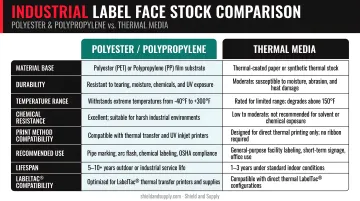
Direct thermal labels — which use heat-sensitive media without a ribbon — are particularly vulnerable to environmental exposure, fading under UV, heat, or solvent contact.
Bottom line: if your facility handles hazardous materials, operates in wash-down or high-heat zones, or faces regular OSHA and GHS audits, on-demand printing is a compliance liability that pre-printed labels eliminate at the source.
What Happens When Pre-Printed Labels Are Skipped
Facilities that default to ad-hoc on-demand printing at high volume don't just miss efficiency gains — they accumulate risk across multiple dimensions simultaneously.
Quality degradation mid-shift is the most common failure pattern. As ribbon supplies deplete and printheads accumulate wear, barcode contrast drops and text clarity degrades. Workers applying labels at the end of a shift may not notice the difference. Downstream scanners will.
Compliance exposure compounds when label stock isn't controlled. An operator using an outdated template, a faded label on a chemical drum, or a peeling label in a wash-down area — each one is a potential OSHA citation. With HazCom violations generating thousands of serious citations per year, the probability isn't hypothetical.
Cost creep is rarely tracked — but it's consistently real. Common contributors include:
- Emergency label reorders when supplies run out mid-shift
- Unplanned printer maintenance that stops the line
- Rework labor for mislabeled product caught downstream
- Wasted thermal media from jams and failed print runs
None of these costs appear on a single line item — they accumulate quietly across shifts, maintenance logs, and rework orders. Pre-printed labels eliminate most of them before they start.
How to Get the Most Value from Pre-Printed Industrial Labels
Pre-printed labels deliver their full advantage only when the process around them is controlled. A bulk run of poorly designed or outdated labels creates a different set of problems.
Three practices that determine outcomes:
Finalize label designs before ordering. Every label in a bulk run reflects the template approved at order time. Use Shield and Supply's LabelSuite™ Software to verify label layouts — GHS formatting, barcode placement, and compliance text — before committing to a high-volume print run. Catching errors at this stage prevents costly obsolescence.
Match order volume to actual consumption. Over-ordering creates obsolescence risk when products or compliance standards change. Same-day order processing and nationwide shipping from Shield and Supply let facilities order in efficient quantities without building excess safety stock that a regulatory update could render useless.
Monitor performance between orders. Review scan failure rates, adhesion complaints, and compliance audit findings on a regular cadence. If labels are peeling in a specific environment or barcodes are failing in a particular zone, the next pre-printed order is the right time to address it with a material or format change — before the problem scales.
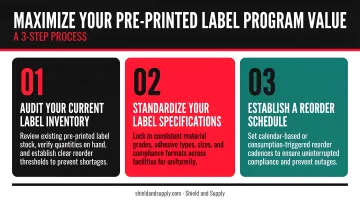
Facilities that treat pre-printed label supply as a managed program — reviewed against performance data and updated alongside regulatory changes — see compounding benefits over time. Those that treat it as a one-time procurement decision tend to encounter the same preventable problems repeatedly.
Conclusion
For high-volume industrial lines, pre-printed labels are a control mechanism. They lock in cost structure, print quality, and compliance formatting before a single shift begins. In a process where variability is expensive, that consistency isn't a convenience — it's operational discipline.
The advantages compound with scale. At 500 labels per shift, the gap between pre-printed supply and on-demand thermal printing is measurable. At 5,000 labels per shift, the difference is hard to ignore. Cost per label drops, reject rates tighten, and compliance exposure shrinks — and all three scale with volume.
Treat pre-printed industrial labels as an ongoing operational strategy: reviewed and updated as products and regulations change, matched to actual consumption, and evaluated against performance data. The long-term value isn't in a single bulk order. It comes from treating label supply the same way you'd treat any other critical input — actively managed, not just replenished.
Frequently Asked Questions
What is a pre-printed label?
A pre-printed label is produced in bulk before reaching the point of application, with all static content — text, barcodes, safety symbols, regulatory text — already printed using professional press technology. It arrives ready to apply without any on-site printing equipment or setup.
What does high-volume printing mean?
High-volume printing refers to producing a large quantity of labels in a single production run — typically hundreds to thousands per shift. It's standard practice in manufacturing, warehousing, and industrial facilities that require consistent, rapid labeling.
How do we benefit from a high-speed printing press?
High-speed press production delivers consistent quality across every label in a bulk run, lowering per-label cost through economies of scale. It also eliminates the speed limits and consumable costs that come with desktop or thermal printers on the floor.
Is it better to print at 300 or 600 dpi?
For industrial labels with small barcodes or dense data, 600 dpi delivers sharper resolution and more reliable scan performance — especially for 2D codes like Data Matrix. Pre-printed labels from professional presses consistently meet or exceed this standard across the entire run.
When should you use pre-printed labels instead of print-on-demand?
Pre-printed labels are the better choice when designs are stable and volumes are high — particularly for safety, compliance, and standardized labeling. Print-on-demand is better suited for variable data like lot numbers or serialized barcodes that change each batch.
How long do pre-printed industrial labels last in harsh environments?
Pre-printed labels on polyester or polypropylene face stocks with chemical-resistant coatings can stay legible and adhered through years of exposure to solvents, heat, moisture, and abrasion. That's significantly longer than standard thermal-printed labels under the same conditions.