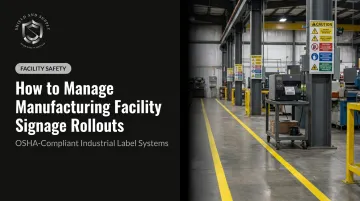
A signage rollout isn't just a procurement task. Results vary widely depending on how well teams plan compliance requirements, coordinate across departments, sequence installation around live production, and select materials that hold up in harsh industrial environments.
This article walks through the exact steps to manage a manufacturing facility signage rollout — from audit to post-installation training — plus the variables that determine success and the mistakes to avoid.
Key Takeaways
- Audit the full facility before ordering — missed locations and wrong sizes should never be field surprises
- OSHA and ANSI compliance standards must define sign specs, not just aesthetics or budget
- Phase installation by zone to keep production running and avoid safety gaps during the transition
- Material selection is non-negotiable — manufacturing environments destroy inadequate label substrates quickly
- Worker training and documentation are the steps most facilities skip — and the ones inspectors check first
How to Manage a Manufacturing Facility Signage Rollout
Step 1: Conduct a Facility-Wide Signage Audit
Walk every zone — production floor, storage areas, maintenance rooms, loading docks, and emergency egress paths. Inventory every existing sign, label, floor marking, and pipe marker by location, condition, and compliance status.
Flag each item as:
- Replace — damaged, faded, or structurally compromised
- Update — present but non-compliant with current OSHA/ANSI standards
- New installation — required by regulation but currently missing
Photograph each location with measurements, mounting surface type, and environmental exposure notes. A chemical splash zone requires different material specs than a dry assembly area — document that distinction now, not during procurement.
Step 2: Define Compliance Requirements and Sign Specifications
Map audit findings against the applicable standards stack:
| Standard | Scope |
|---|---|
| OSHA 29 CFR 1910.145 | Accident prevention signs and tags — danger, caution, safety instruction formats |
| ANSI Z535.1–.5 | Safety colors, facility signs, symbols, product labels, temporary tags |
| NFPA 70E | Arc flash label content — incident energy, arc flash boundary, PPE level |
| OSHA 29 CFR 1910.1200 | HazCom/GHS chemical labels — product identifier, signal word, pictograms |
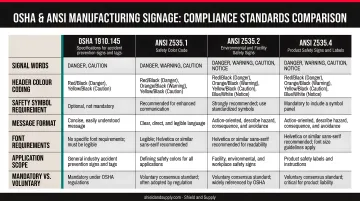
Build a master sign specification document covering required sign categories, approved colors, minimum font sizes, and material grade. This document becomes the single source of truth for every procurement and installation decision during the rollout.
Involve your EHS team — and legal or compliance advisors if applicable — to review and approve specs before any ordering begins.
Step 3: Prioritize Zones and Build a Phased Rollout Plan
Not all areas carry equal risk. Sequence installation accordingly:
Phase 1 (immediate): Electrical panels, machine pinch points, chemical storage, emergency exits, marked aisles and passageways per 29 CFR 1910.176, fire extinguisher identification, exit route markings
Phase 2: High-traffic production zones, material handling areas, equipment-specific labels
Phase 3: Lower-risk administrative, general warehouse, and support areas
Build a rollout calendar that sequences installation during planned downtime, shift changes, or maintenance windows. Identify zones that cannot go offline and plan explicitly around them. Assign zone ownership to specific supervisors who can coordinate access, communicate with workers, and sign off on completed areas.
Step 4: Procure or Produce Your Signs and Labels
Decide between three approaches:
- Pre-made signs from safety suppliers — works well for standard OSHA-format signs with no customization needed
- Custom-ordered signs from a commercial fabricator — best for large-format or rigid substrate requirements (anything wider than 9 inches)
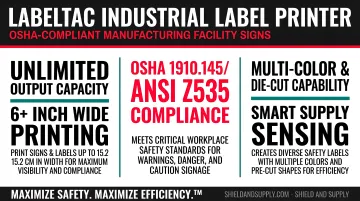
- In-house production using an industrial label printer — best for high-volume machine-specific labels, pipe markers, floor markings, and any sign type that gets updated frequently
For in-house production, Shield and Supply's LabelTac® Pro X (prints ½" to 4" wide) and LabelTac® 9 (prints 4" to 9" wide, up to 2,500 labels per day) cover most manufacturing label and sign formats. Both printers include LabelSuite™ labeling software at no additional cost, with built-in support for OSHA compliance, GHS, pipe marking, arc flash, and 5S applications.
Specialty substrates — including high-temperature, reflective, and magnetic materials — are available for zone-specific requirements.
Order or produce signs in batches aligned to your phased plan. Confirm quantities, sizes, and material grades against your master specification document before production begins.
Step 5: Install Signage Without Disrupting Production
Surface preparation determines whether adhesive labels hold long-term. Before installation:
- Clean and fully dry all surfaces before applying adhesive labels or floor tape
- Verify wall integrity for mounted signs
- Confirm floor areas are free of oil, debris, and moisture before applying floor marking tape
For SafetyTac® floor tapes, the sequence is: clean the floor, mark the layout, apply the tape, unroll to length, and secure with weight. Skipping the cleaning step is the most common failure point — oils and residue prevent adhesion and cause early peeling.
Where permanent signs are being replaced in active zones, use temporary signage or barriers to maintain safety communication during the transition window. Document each completed installation with a photograph, zone reference, installer name, and date — this creates the audit trail you'll need during compliance inspections.
Step 6: Verify Compliance, Update Records, and Train Workers
Before closing out any zone:
- Conduct a post-installation walkthrough against the master spec document — confirm every required sign is present, correctly placed, and readable at the required distance
- Update compliance records — safety compliance documentation, sign inventory log, and relevant OSHA recordkeeping
- Brief workers in each zone on new or changed signage, particularly updated machine warnings, revised emergency procedures, or new floor marking zones
- Document training completion — this isn't optional during an audit
Worker comprehension matters more than sign presence. A 2023 peer-reviewed study of 139 manufacturing employees found average safety sign comprehension of only 66.6%, with warning signs averaging just 53.2%. Signs that meet ANSI format requirements — with both symbol and text — consistently outperformed symbol-only designs.
What You Need Before Starting Your Rollout
The quality of a signage rollout is largely determined before the first sign ships. Inadequate preparation causes compliance gaps, installation delays, and materials that fail early.
Equipment and Tools
- Surface cleaners and drying materials for adhesive surface prep
- Mounting hardware appropriate for wall type (drywall, concrete, steel)
- Floor tape rollers or weight applicators for marking installation
- Lift or scaffolding for overhead or high-wall placements
- If printing in-house: confirm your printer handles required media widths and that supply stock (vinyl rolls, ribbons) covers all planned phases
Sign Materials and Specifications
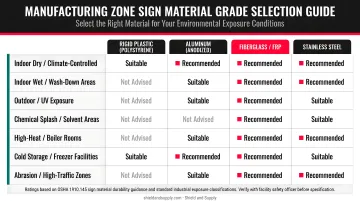
Match material grade to environmental exposure — this decision has the most direct impact on service life:
- Standard vinyl (5–10 year rated): general production zones with no chemical or extreme heat exposure
- High-temperature supply: areas near ovens, furnaces, or heat-generating equipment
- Chemical-resistant laminated vinyl: splash zones, cleaning chemical exposure areas
- SafetyTac® floor tapes: forklift traffic zones, washdown areas, extreme temperature environments
OSHA requires electrical equipment markings to be "of sufficient durability to withstand the environment involved" (29 CFR 1910.303) and HazCom labels to remain legible throughout each work shift. Non-compliant or degraded labels can trigger citations during inspections — selecting the right material grade upfront eliminates that exposure. Shield and Supply's technical support team can advise on matching materials to specific zone conditions (1-877-514-0727).
Stakeholder and Compliance Readiness
With materials confirmed, the next step is aligning the people responsible for approving, scheduling, and maintaining the rollout:
- Obtain written sign-off from EHS, operations management, and maintenance leads before work begins
- Verify the rollout timeline doesn't conflict with active regulatory inspections, ISO audits, or internal reviews — completing the rollout before rather than during those events eliminates unnecessary risk
- Confirm HazCom update obligations: under the 2024 OSHA final rule, employers must update workplace chemical labeling and HazCom programs for substances by July 20, 2026
Key Factors That Determine Rollout Success
Even well-planned rollouts fail when teams underestimate three key factors.
Material Durability for the Industrial Environment
Safety+Health reports that manufacturing environments expose labels to extreme heat, moisture, chemicals, oils, solvents, repeated handling, washdowns, UV radiation, and temperature swings — all of which cause fading, peeling, and adhesive failure.
Research material specifications from the actual product data sheet for each zone type. Generic "industrial grade" claims aren't sufficient — verify chemical resistance ratings and temperature range against your facility's actual conditions before ordering.
OSHA and ANSI Compliance Accuracy
OSHA's NAICS 32 manufacturing sector data shows 19 citations for 1910.1200 (HazCom) and 6 citations for 1910.303 (electrical) across recent inspections — with penalties reaching into the tens of thousands per inspection. A sign that looks professional but uses the wrong signal word or color for its hazard class is a compliance liability, not a safety asset.
Build a compliance review checkpoint into the design phase, not the installation phase. Catching a non-compliant sign before printing costs nothing. Replacing installed signs costs time, materials, and production disruption.
Stakeholder Communication and Worker Buy-In
Compliance on paper means little if workers don't understand what changed or why. Frontline behavior follows familiarity — employees who aren't briefed on new floor zones or signal colors are less likely to act on them.
Communicate before and during installation, not after:
- Brief supervisors on sign changes and their purpose before work begins
- Add sign-change context to pre-shift communications throughout the rollout
- Explain what each major new zone or label means, not just that it changed
- Follow up after installation to confirm workers can identify and interpret new signs
Common Mistakes in Manufacturing Signage Rollouts
Avoid these four patterns that derail rollouts before installation is complete:
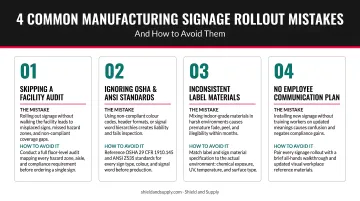
- Rushing the audit: Jumping straight to ordering signs leads to missed locations, wrong sizes, and signs that don't reflect actual hazard conditions. The audit deserves dedicated time as its own project phase.
- Ordering all signs at once: Procuring the full inventory upfront creates storage problems, version control issues, and — if a compliance requirement changes mid-rollout — a batch that needs redoing entirely. Align procurement to your phased plan.
- Choosing materials by price: Office or retail-grade labels degrade quickly on manufacturing floors. Chemical exposure, abrasion, and temperature swings can destroy inadequate materials within weeks — costing more in replacements than getting the material grade right from the start.
- Skipping training and documentation: Signs installed without worker briefings and updated compliance records leave the facility exposed during audits. These aren't administrative add-ons — they're required components of a compliant rollout.
Troubleshooting Issues During Your Rollout
Signs Arrive Wrong Size, Format, or Material
This usually happens when specifications weren't locked in writing before ordering, or when the supplier substituted materials without notice.
Before installation begins, compare every delivered item against the master spec document. Reject non-conforming items and reorder from spec. Don't install non-compliant signs even temporarily — during an inspection, inspectors treat a non-compliant sign the same as no sign at all.
Installation Is Causing Production Delays
The most common culprits: work scheduled during active production windows, surface prep running longer than estimated, or zone supervisors left out of the installation calendar.
To get back on track:
- Revisit the phased schedule with operations management
- Shift affected installations to planned downtime or off-shift windows
- Confirm every zone supervisor has a current copy of the installation calendar
Signs Are Failing Prematurely After Installation
Premature failures almost always trace back to one of two causes: the surface wasn't properly cleaned and dried before adhesive application, or the material grade isn't suited for the zone's actual conditions (heat, moisture, chemical exposure, traffic).
Remove and replace failing signs using correct surface prep. Re-evaluate the material spec for that zone and upgrade to a higher-durability substrate if needed. For floor tape failing in heavy-traffic or washdown areas, SafetyTac® 2.0 is worth a direct comparison — its more aggressive adhesive and forklift-resistant profile outperform standard floor tape in demanding environments.
Frequently Asked Questions
How long does a manufacturing facility signage rollout typically take?
Timeline depends on facility size, zone count, and whether production is in-house or outsourced. A medium-sized facility with a structured phased plan typically completes in several weeks to a few months.
What OSHA standards apply to manufacturing facility signage?
The core standards are OSHA 29 CFR 1910.145 (accident prevention signs and tags), ANSI Z535.1–.5 (safety sign design and colors), NFPA 70E (arc flash and electrical labeling), and OSHA 29 CFR 1910.1200 (HazCom/GHS chemical labels). Zone-specific requirements add to these: exit routes, electrical panels, aisles, and fire equipment locations each carry separate compliance obligations.
Should I use an in-house printer or order signs from a supplier?
In-house printing with a system like LabelTac® is better for machine-specific, pipe marking, HazCom, and frequently updated signs — faster turnaround and direct EHS control over compliance accuracy. Ordering from a commercial supplier makes more sense for large-format signs wider than 9 inches or rigid substrates that require industrial fabrication.
How do I prioritize which areas get new signage first?
Highest-hazard zones first: electrical panels, machine pinch points, chemical storage, and emergency egress routes. Then high-traffic production areas. Lower-risk general and administrative zones follow in later phases once compliance-critical areas are complete.
What materials are best for manufacturing facility signs and labels?
Industrial-grade vinyl with chemical-resistant print ribbons handles most general manufacturing zones. High-temperature material is required near heat sources; chemical-resistant laminated vinyl for splash zones. For floor markings, forklift-rated tape like SafetyTac® is standard in traffic areas. Always match material specs to the actual exposure conditions in that zone — not the average conditions across the facility.
How often should manufacturing facility signage be reviewed?
No single OSHA-mandated interval covers all sign types. Trigger reviews when equipment changes, processes are modified, standards update, or incident investigations identify new hazards. An annual walkthrough catches degradation and compliance drift before they become citation risks.