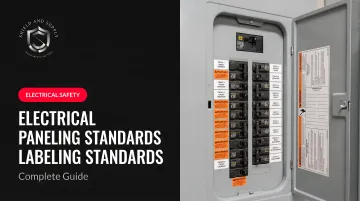
That scenario isn't rare. Unlabeled and mislabeled electrical panels remain one of the most cited compliance gaps in industrial and commercial facilities — and the consequences range from failed inspections to fatal incidents.
This guide covers everything facilities need to get labeling right: the governing standards (NEC, OSHA, NFPA 70E, and ANSI Z535), what information belongs on every panel, a step-by-step labeling process, material selection guidance, and the most common violations to avoid.
Key Takeaways
- Electrical panels must be labeled under NEC Articles 408.4(A) and 110.22(A), OSHA 29 CFR 1910.303(e) and (f), and 1910.335(b)(1)
- Every circuit breaker requires a legible, specific label — "misc" and "spare" don't comply
- Labels must include circuit identification, voltage/current ratings, fault current information, and applicable hazard warnings
- Label durability must match the environment — faded or peeling labels constitute a compliance violation
Why Electrical Panel Labeling Is Non-Negotiable
Poor panel labeling doesn't just fail inspections — it puts workers at direct risk and slows down every technician who depends on that equipment. Here's why getting it right matters.
The Safety Case
The numbers make the risk concrete. According to the Bureau of Labor Statistics' 2024 Census of Fatal Occupational Injuries, 130 workers died from electrical exposure in 2024. The Electrical Safety Foundation International (ESFI) reports 5,180 nonfatal electrical injuries involving days away from work in the 2023–2024 period — with construction, manufacturing, and utilities accounting for the majority of industry fatalities over the past decade.
The link between labeling and injury prevention is clearest in lockout/tagout (LOTO) data. NIOSH found that failure to lockout or tagout energy-control devices was a factor in 31 of 185 workplace fatalities — 17% — and specifically recommends that employers "clearly label isolation devices, such as breaker panels and control valves.**
That recommendation cuts to the core issue: a technician cannot safely apply LOTO to a circuit they can't identify. Unlabeled panels don't just fail inspections — they make safe energy isolation impossible.
The Compliance and Efficiency Case
Beyond safety, proper labeling:
- Prevents OSHA citations and failed electrical inspections
- Reduces troubleshooting time during maintenance and outages
- Supports arc flash risk assessments, which require accurate equipment identification
- Creates a documented record of panel configuration for future work
A facility with accurate, durable panel labels spends less time on emergency troubleshooting, passes inspections without corrective actions, and gives technicians the information they need to work safely every time.
Electrical Panel Labeling Standards: NEC, OSHA, NFPA 70E & ANSI Z535 Explained
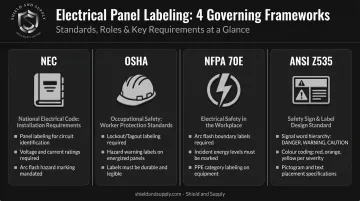
No single standard governs all electrical panel labeling. Facilities must align with four overlapping frameworks, each with a distinct role:
| Standard | Primary Role |
|---|---|
| NEC | Defines what must be labeled and how |
| OSHA | Enforces workplace compliance |
| NFPA 70E | Addresses arc flash hazards |
| ANSI Z535 | Governs safety label design |
NEC Requirements
The NEC is the foundational electrical code adopted (in various editions) across most U.S. states. As of March 2026, the 2023 NEC is in effect in 25 states, with others still operating under the 2020 or 2017 editions.
Key NEC labeling articles:
- NEC 408.4(A): Every circuit and circuit modification must be legibly identified with a clear, evident, and specific purpose. "Misc," "general," and "spare" don't comply ; the label must describe the actual load or area served. Any circuit modification triggers an immediate obligation to update the label.
- NEC 110.22(A): Disconnecting means must be identified to indicate their purpose.
- NEC 110.24(A): Service equipment in non-dwelling buildings must show the maximum available fault current and the date of the calculation , a field-marked requirement fulfilled during installation or after recalculation.
- NEC 408.4(B): Panelboards supplied by feeders (other than one- or two-family dwellings) must indicate their power supply source.
- NEC 210.5(C)(1)(b): The method for identifying branch circuit conductors must be permanently posted at each panelboard.
OSHA Requirements
Three OSHA regulations directly govern electrical panel labeling in general industry:
- OSHA 29 CFR 1910.303(e): Electrical equipment must carry markings for manufacturer identification, voltage, current, wattage, and other necessary ratings, with durability sufficient for the environment.
- OSHA 1910.303(f): Each service, feeder, and branch circuit must be legibly marked at its disconnecting means or overcurrent device to indicate its purpose, unless the purpose is self-evident.
- OSHA 1910.335(b)(1): Safety signs, symbols, or accident-prevention tags are required wherever electrical hazards could endanger employees.
One important note: OSHA has 29 approved State Plans, with 22 covering private-sector workers. State plans must be at least as effective as federal OSHA ; some are stricter. Facilities should verify local requirements, not just federal minimums.
NFPA 70E and ANSI Z535
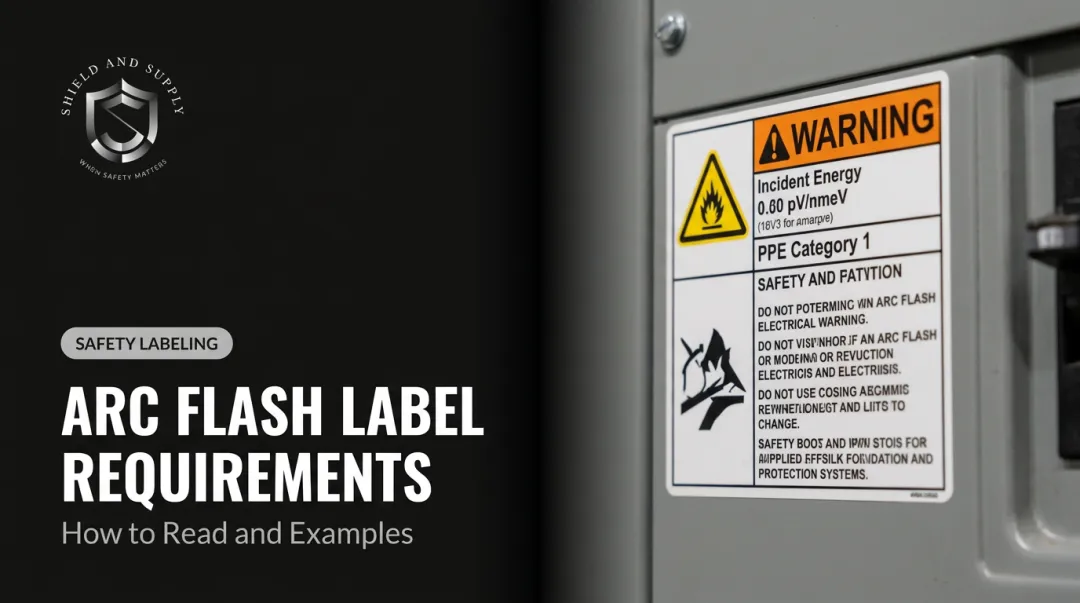
NFPA 70E (current edition: 2027) governs safe work practices around electrical hazards. Where an arc flash study has been conducted, NFPA 70E requires equipment labels showing:
- Incident energy levels
- Arc flash and shock boundary distances
- Required PPE category
- Nominal voltage
ANSI Z535.4 (2023 edition) governs how safety labels must be designed. Signal word color requirements:
- DANGER — white text on red background
- WARNING — black text on orange background
- CAUTION — black text on yellow background
Labels that no longer meet legibility standards must be replaced. This is a maintenance requirement with the same compliance weight as initial installation.
What Must Go on an Electrical Panel Label
Circuit Identification
This is the primary required element under NEC 408.4(A). Each breaker must be labeled with a specific description of the load or area it controls.
- ✅ "Kitchen Outlets — North Wall"
- ✅ "Server Room UPS — Rack A"
- ❌ "Kitchen"
- ❌ "Misc"
Outdated labels after a circuit modification are a direct code violation, not just sloppy record-keeping.
Voltage and Current Ratings
Voltage (120V, 240V, 480V) and amperage must be indicated on commercial and industrial equipment per OSHA 1910.303(e). This prevents technicians from connecting wrong-rated equipment and reduces overload risk.
Fault Current Information
Under NEC 110.24(A), non-dwelling service equipment must show:
- Maximum available fault current
- Date of the calculation
This is a field-marked requirement, meaning it must be added on-site during installation or updated whenever a recalculation occurs.
Hazard Warning Labels
Where electrical hazards exist, ANSI Z535-compliant warning labels must be affixed. Common required text includes:
- "DANGER: High Voltage — Keep Out"
- "WARNING: Arc Flash Hazard — Refer to NFPA 70E for PPE Requirements"
- Restricted-access notices per NEC 110.27(C) where applicable
Common Panel Label Abbreviations
Rounding out your labeling requirements, consistent abbreviations prevent misinterpretation across technicians and inspection teams over time:
| Abbreviation | Meaning |
|---|---|
| A/C | Air Conditioner |
| GFCI | Ground Fault Circuit Interrupter |
| WH | Water Heater |
| HVAC | Heating/Ventilation/Air Conditioning |
| CKT | Circuit |
| EWH | Electric Water Heater |
| AFF | Above Finished Floor |
Stick to recognized abbreviations. If the next technician on-site — or an OSHA inspector — can't decode your shorthand, the label isn't doing its job.
How to Label an Electrical Panel: Step-by-Step Guide
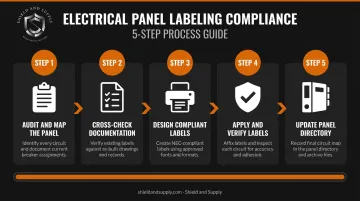
Step 1 — Audit and Map the Panel
Before applying any labels, identify what each breaker controls. In complex panels, use a circuit tracer to confirm loads without guesswork. Create a written map recording:
- Breaker position
- Circuit function and specific load
- Voltage and amperage
- Any known modifications since last label update
This map becomes the source of truth for all labels.
Step 2 — Cross-Check Against Existing Documentation
Compare your circuit map against existing labels and single-line diagrams. Flag any circuits that are:
- Unlabeled
- Mislabeled
- Modified since the last label update
NEC 408.4(A) requires labels to reflect circuit modifications immediately — any renovation or new circuit addition triggers a labeling obligation.
Step 3 — Design Compliant Labels
Use standardized language and abbreviations. For arc flash equipment, include all NFPA 70E required fields. For hazard warning labels, follow ANSI Z535.4 signal word colors and design rules.
For facilities printing labels in-house, Shield and Supply's LabelTac® Pro X and LabelTac® 9 industrial label printers handle everything from standard ½"–4" breaker labels to 4"–9" arc flash signage. Both come with LabelSuite™ software at no extra cost and a full lifetime warranty on parts and labor.
Step 4 — Apply and Verify Labels
- Place labels adjacent to or directly on the breaker they identify
- Clean surfaces before applying adhesive labels to ensure adhesion
- Confirm every circuit is labeled, all hazard warnings are present, and nothing is obscured
After application, conduct a full walk-through with the circuit map in hand.
Step 5 — Update the Panel Directory
A physical panel directory (typically inside the panel door) must reflect every labeled circuit per NEC 408.4(A). The directory and the individual breaker labels must match exactly. Discrepancies are a common inspection citation — and a real hazard during emergencies when someone needs to identify a circuit fast.
Schedule label reviews after any system changes and at minimum annually to catch fading, peeling, or outdated labels.
Choosing the Right Label Materials and Avoiding Common Violations
Material Selection
OSHA 1910.303(e) explicitly states that markings must be "of sufficient durability to withstand the environment involved." In industrial settings with heat, moisture, chemicals, or UV exposure, standard paper labels will fail — sometimes within months.
For most industrial electrical applications, industrial-grade vinyl is the minimum standard. Environments with elevated heat, chemical exposure, or high moisture may require specialty materials.
Look for vinyl supply rolls rated for 5–10 years indoors or outdoors, and high-temperature options for switchgear rooms and panel enclosures. Scratch- and chemical-resistant print ribbons keep labels legible over time — a direct compliance factor, not a cosmetic one. Shield and Supply carries both, along with options sized for LabelTac® industrial printers.
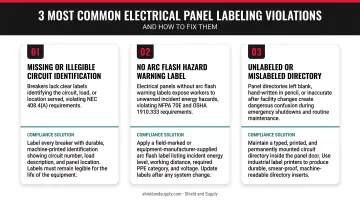
The Three Most Common Violations
1. Illegible or missing labels Handwritten marker labels fade. Pen-on-tape degrades. Use printed labels from an industrial label printer to ensure long-term legibility.
2. Outdated labels after system modifications Renovations and new circuit additions frequently happen without triggering a label update. Establish a mandatory procedure: any circuit change requires an immediate label revision before the panel is returned to service.
3. Vague or inaccurate circuit descriptions "Spare," "misc," and single-word location names don't meet NEC 408.4(A)'s specificity requirement. Enforce a labeling standard that requires specific load descriptions and prohibits generic terms.
Inspection Consequences
Inspectors check labels first. Unlabeled or mislabeled panels raise immediate red flags — even when the wiring itself is technically correct. OSHA enforcement around electrical labeling has increased, and facilities in state-plan states may face additional local requirements. Schedule a compliance audit before your next inspection cycle — not after a citation forces one.
Frequently Asked Questions
What are the OSHA requirements for labeling electrical panels?
OSHA 1910.303(e) requires electrical equipment to be marked with manufacturer identification, voltage, current, wattage, and other necessary ratings — and markings must be durable enough for the environment. OSHA 1910.303(f) requires each circuit to be labeled at its disconnecting means, and 1910.335(b)(1) requires safety signs or tags wherever electrical hazards could endanger employees.
What are the legal requirements for labeling?
Legal requirements come from multiple overlapping sources: the NEC (adopted into law by most U.S. states), OSHA regulations, and local jurisdiction codes. NEC 408.4(A) requires all circuits to be legibly and specifically identified; OSHA independently requires hazard warnings on energized equipment. Both apply in most commercial and industrial facilities.
What is the 80% rule for electrical panels?
The 80% rule means a circuit breaker should not be loaded beyond 80% of its rated ampacity on a continuous load basis. Accurate labels should reflect this limit so maintenance personnel know the safe operating capacity of each circuit.
Do circuit breakers need to be labeled?
Yes. NEC 408.4(A) explicitly requires every circuit breaker to be legibly identified with its clear, evident, and specific purpose. This applies to all circuit modifications as well. Unlabeled breakers are a direct code violation with no exemptions.
How often should electrical panel labels be updated?
Labels must be updated immediately whenever any circuit modification is made — NEC 408.4(A) requires this. Best practice is to also review all panel labels during routine inspections or at least annually to catch fading, peeling, or inaccuracies.
What label materials work best for industrial electrical panels?
Industrial-grade vinyl or polyester labels work for most applications. Environments with heat, moisture, or chemical exposure may require materials specifically rated for those conditions. NEC 110.21(b) requires durability to match the actual operating environment, so material selection is a compliance decision, not just a cost consideration.