That's why ammonia pipe labeling isn't optional. It's a defined regulatory and industry requirement governed by IIAR Bulletin 114 (now Appendix Q of ANSI/IIAR Standard 2-2021) and grounded in ANSI/ASME A13.1.
This guide breaks down exactly what belongs on every ammonia pipe marker — color codes, label components, sizing, placement, and equipment markers — so your facility can build a compliant, inspection-ready labeling system from the ground up.
Key Takeaways
- Ammonia pipe labeling follows IIAR Bulletin 114, now incorporated as Appendix Q of ANSI/IIAR Standard 2-2021
- Every compliant marker includes five elements: marker body, physical state, pressure level, system abbreviation, and directional arrow
- Marker backgrounds are Safety Orange; physical state bands are yellow (liquid) or sky-blue (vapor)
- Pressure level bands are red (high) or green (low)
- Labels must appear at direction changes, wall penetrations, equipment connections, and at minimum every 40 feet on straight runs
- A posted reference chart explaining colors and abbreviations is required under ANSI/IIAR 2-2021 Section 8.0
Why Ammonia Pipe Labeling Is a Safety and Compliance Requirement
Ammonia isn't a theoretical hazard. CDC data covering 1999–2008 found ammonia ranked second among the top five chemicals causing acute occupational injuries, with 1,153 injured persons recorded — trailing only carbon monoxide. In refrigeration-heavy industries like food processing and cold storage, that risk is concentrated and persistent.
The Regulatory Framework
Two federal programs create binding compliance obligations for facilities operating above threshold ammonia quantities:
- OSHA PSM (29 CFR 1910.119): Applies when a facility stores anhydrous ammonia at or above 10,000 lb. Requires written operating procedures, employee training, mechanical integrity programs, and process hazard analyses.
- EPA Risk Management Program (RMP): Also triggers at 10,000 lb of anhydrous ammonia. Requires a hazard assessment, prevention program, and emergency response plan.
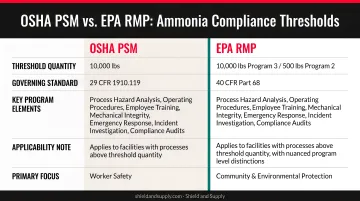
Proper pipe labeling supports both programs. Workers and emergency responders who can instantly identify pipe contents, pressure state, and flow direction make faster, better-informed decisions. Missing or inconsistent labels remove that advantage entirely — and introduce risk at exactly the moments it matters most.
What Non-Compliance Costs
The penalties are concrete. In December 2015, OSHA cited Case Farms for ammonia refrigeration PSM deficiencies at two Ohio facilities, proposing $462,000 in combined penalties — $308,000 at one location and $154,000 at the other. The citations included 16 repeated violations covering inadequate operating procedures, failure to inspect systems, and insufficient worker training.
Inadequate labeling contributes directly to those failure modes. Inspectors auditing PSM compliance will walk the pipe runs. Unlabeled or non-conforming markers are visible, documentable violations.
The Governing Standards: IIAR, ANSI/ASME A13.1, and ANSI/IIAR 2-2021
Three standards define what ammonia pipe labeling must look like. Understanding how they relate to each other clarifies which requirements are baseline, which are ammonia-specific, and which are normative versus informative.
ANSI/ASME A13.1: The Baseline
ANSI/ASME A13.1 establishes the foundational scheme for identifying piping systems across industrial, commercial, and institutional facilities. It covers aboveground piping in most installation types, sets general color conventions, and defines label content and placement principles. Any industrial pipe marking program — ammonia or otherwise — starts here.
IIAR Bulletin 114 and Its Evolution
The International Institute of Ammonia Refrigeration developed Bulletin 114 specifically to address the identification of ammonia refrigeration piping and system components. The bulletin built upon the A13.1 framework with ammonia-specific requirements: Safety Orange label backgrounds, defined color bands for physical state and pressure, standardized system abbreviations, and detailed size charts.
IIAR's own catalog confirms that Bulletin 114 has since been incorporated as Informative Appendix Q of ANSI/IIAR Standard 2-2021. Facilities now reference Standard 2 rather than a standalone bulletin.
Normative vs. Informative — What It Means in Practice
Appendix Q is labeled "informative," which means it provides recommended guidance rather than a mandatory prescription. Section 8.0 of ANSI/IIAR Standard 2-2021 contains normative labeling requirements — and those carry mandatory weight.
In practice, this creates a two-tier structure:
- Follow Appendix Q: You're using the industry's recognized best practice, and Section 8.0 is satisfied.
- Deviate from Appendix Q: You must still meet Section 8.0's normative requirements and post a reference chart documenting your alternative scheme.
Anhydrous ammonia means ammonia in its pure, water-free form. OSHA defines it as at least 99.95% pure ammonia, free from visible impurities, with water content not exceeding 33 ppm. This is the form used in industrial refrigeration — and the form IIAR standards address.
The Five Required Components of an Ammonia Pipe Marker
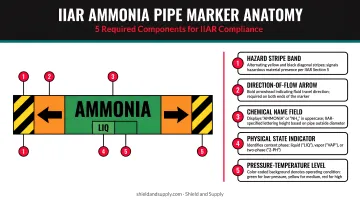
Every IIAR-compliant ammonia pipe marker communicates five categories of information, regardless of pipe size or application. Together, these components give technicians an at-a-glance read of what's inside, the operating pressure, flow direction, and system function — without needing to reference drawings or documentation.
1. Marker Body
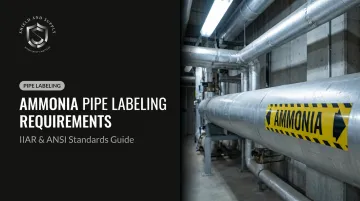
The main label background must be Safety Orange, with the word "AMMONIA" printed in black lettering centered on the orange field. Safety orange signals a warning condition — appropriate for a toxic, corrosive substance that can incapacitate at low concentrations.
2. Physical State
A circumferential color band to the left of "AMMONIA" indicates what's inside the pipe:
- "LIQ" in black on a yellow band = liquid
- "VAP" in black on a sky-blue band = vapor
- Both bands together = liquid-vapor mixture
3. Pressure Level
A second circumferential band to the right of "AMMONIA" indicates operating pressure:
- "HIGH" in black on a red band = pressure greater than 70 psig
- "LOW" in black on a green band = pressure at or below 70 psig
The 70 psig cutoff is the IIAR-defined threshold separating high and low pressure zones in ammonia refrigeration systems.
4. System Abbreviation
A piping abbreviation identifying the pipe's function appears in black lettering on the orange background, to the left of the physical state band. Common IIAR abbreviations include:
| Abbreviation | Meaning |
|---|---|
| HPL | High Pressure Liquid |
| LTRS | Low Temperature Recirculated Suction |
| HGD | Hot Gas Defrost |
| CD | Condenser Drain |
The 2019 revision of Bulletin 114 expanded the approved abbreviation list from 17 to 31 entries, covering a wider range of system configurations.
5. Directional Arrow
A black directional arrow indicates flow direction inside the pipe. It should be proportionate to the label size and may run the full length of the marker or be applied as a separate element adjacent to the marker body.
IIAR Ammonia Pipe Color Coding System
Beyond the label itself, IIAR recommends color-coding the pipe body to give personnel a quick visual status check on ammonia state, pressure, and temperature range. This is especially useful in busy machinery rooms with dense piping runs, or during emergency response when there's no time to stop and read every label.
The Five Recommended Pipe Colors
| Condition | Pipe Color | Pantone Reference |
|---|---|---|
| High Pressure Liquid | Orange | Pantone 152C |
| High Pressure Vapor | Yellow | Pantone 109C |
| Low Pressure / High Temp Liquid & Vapor | Light Blue | Pantone 298C |
| Low Pressure / Low Temp Liquid & Vapor | Dark Blue | Pantone 3015C |
| Low Pressure / Low-Low Temp Liquid & Vapor | Purple | Pantone 2617C |
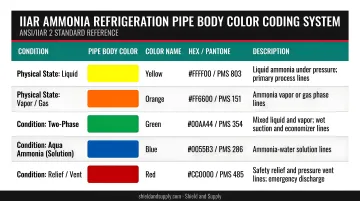
The color scheme is non-mandatory but widely adopted. Facilities can apply color using paint over pipe length or banding tape at intervals. Existing color schemes that differ from the IIAR recommendation are acceptable — provided they are documented and a legend is posted.
The Posted Reference Chart: Non-Optional
Regardless of which color scheme a facility uses, ANSI/IIAR 2-2021 Section 8.0 requires a durable legend posted in a conspicuous area accessible to operating personnel. This chart must explain all colors, abbreviations, and marker components used at the facility. Compliance with this requirement is mandatory, not optional.
Producing a durable, legible legend is straightforward with a large-format label printer. Shield and Supply's LabelTac® 9 prints up to 9 inches wide on industrial vinyl built to last 5–10 years indoors or outdoors — well-suited for a chart that needs to hold up in a refrigeration machinery room.
Label Placement and Size Requirements
Where Labels Must Appear
IIAR guidance requires markers at minimum:
- Before and after each change in direction
- Where piping terminates at equipment
- Before and after wall or roof penetrations
- At least every 40 feet on straight pipe runs
- At least once in each room or area the pipe passes through
No section of ammonia piping should go unlabeled. In large machinery rooms, that often means more markers than facilities expect.
Pipe Marker Size Chart
Marker size is determined by the pipe's outside diameter (O.D.). Using an undersized marker on a large-bore pipe is a common compliance gap: the label won't be visible at working distance.
| Pipe O.D. | Marker Width | Marker Length | Letter Height |
|---|---|---|---|
| Up to 1¼" | 1" | 8" | ½" |
| 1¼" – 2" | 1½" | 8" | ¾" |
| 2" – 7" | 2½" | 12" | 1¼" |
| 7" – 10" | 3½" | 24" | 2½" |
| Over 10" | 4½" | 32" | 3½" |
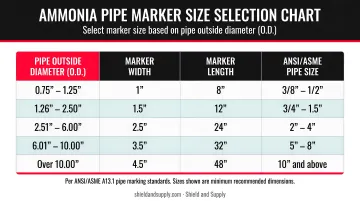
Facilities that produce markers in-house need a printer that matches their pipe range. Shield and Supply's LabelTac® Pro X accepts supply rolls from ½" to 4" wide, covering most pipe sizes. For the 4½" markers required on pipes over 10" O.D., the LabelTac® 9 handles widths from 4" to 9".
Material and Durability
Ammonia refrigeration environments are demanding. Labels must hold up to cold temperatures, condensation, and chemical exposure from the moment they're applied through the life of the installation.
Shield and Supply's industrial-grade vinyl supply rolls are built for these conditions:
- Weatherproof adhesion that holds on cold, condensation-prone piping
- 5–10 year durability rating for long-term legibility
- Print ribbons that resist scratching and chemical exposure
Equipment Component Markers and Putting It All Together
Component Markers
Pipe markers alone aren't enough. All major system components — receivers, accumulators, heat exchangers, condensers, and similar equipment — require their own component markers. Per IIAR guidance, component markers must meet these specifications:
- Background: Safety Orange with black lettering
- Width: 3½" minimum
- Lettering height: 2½"
- Length: Long enough to display the full component name
Building a Facility-Wide Labeling System
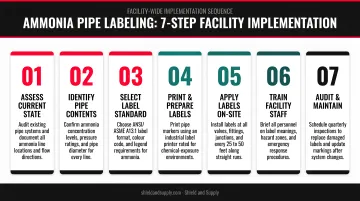
A compliant ammonia labeling program works as an integrated system — not a collection of isolated elements. Here's a practical implementation sequence:
- Audit all piping runs: Document every line, confirm pipe diameters, and map all system components
- Confirm abbreviations: Verify all abbreviations in use appear on the IIAR-approved list
- Select correct marker sizes: Match marker dimensions to pipe O.D. using the size chart above
- Apply color banding: Add pipe body color coding per the IIAR scheme, or document your existing color scheme
- Install markers at required locations: Direction changes, penetrations, equipment connections, and every 40 feet on straight runs
- Label all components: Apply component markers to receivers, condensers, accumulators, and heat exchangers
- Post the reference chart: Install a durable legend in each machinery room, accessible to operating personnel
Shield and Supply offers IIAR-compliant ammonia pipe markers and LabelTac® industrial label printers for producing on-demand markers that match any system configuration. LabelSuite™ software is included with every printer and supports pipe marker design, component labels, and reference charts.
For additional compliance support, Shield and Supply provides a free Ammonia Pipe Marking Quick Guide through their resources page. Reach the team at 1-877-514-0727 or info@shieldandsupply.com.
OSHA PSM auditors expect to find this complete system in place. Pipe markers, color coding, component labels, and a posted reference chart all need to work together — missing any one piece can create a compliance gap even when the rest is done right.
Frequently Asked Questions
What are the requirements for ammonia piping?
Ammonia piping requirements cover materials, design, and safety labeling. Copper, brass, zinc, and galvanized materials are incompatible with anhydrous ammonia and must not be used. Design must comply with ASME B31.5; labeling must follow IIAR Bulletin 114 and Appendix Q of ANSI/IIAR Standard 2-2021.
What information should pipeline markers include?
IIAR-compliant ammonia pipe markers must include five elements:
- The word "AMMONIA" on a Safety Orange background
- Physical state (LIQ or VAP) on yellow or sky-blue bands
- Pressure level (HIGH or LOW) on red or green bands
- A system abbreviation identifying the pipe's function
- A directional flow arrow
What is the color code for ammonia pipes?
All ammonia pipe markers use a Safety Orange label background. For the pipe body itself, IIAR recommends five colors: orange for high pressure liquid, yellow for high pressure vapor, light blue for low pressure/high temperature, dark blue for low pressure/low temperature, and purple for low pressure/low-low temperature.
What piping cannot be used for an ammonia system?
OSHA notes that ammonia reacts with and corrodes copper, zinc, and many alloys — particularly in the presence of moisture. Only iron, steel, and specific ammonia-resistant nonferrous alloys should be used for anhydrous ammonia piping, containers, and fittings.
What is the ASME Code for ammonia piping?
ASME B31.5 governs the design, fabrication, testing, and inspection of ammonia refrigeration piping in the U.S. ASHRAE Standard 15 also references B31.5 for refrigerant piping systems with design pressures above 15 psig.
Is there a difference between ammonia and anhydrous ammonia?
Yes. Anhydrous ammonia is pure, water-free ammonia — at least 99.95% pure, per OSHA. Aqueous ammonia is a water-ammonia solution used in other applications. Industrial refrigeration systems use anhydrous ammonia exclusively, and all IIAR standards address that form.