Two standards govern fire sprinkler identification. NFPA 13 (currently in its 2025 edition) sets installation and component sign requirements for sprinkler systems. ANSI/ASME A13.1 (2023 edition) establishes the color-coded, sized, and positioned pipe marker format used across industrial and commercial piping — including fire suppression lines. Understanding how both apply is the practical starting point for compliance.
This article covers what NFPA 13 actually requires, what ANSI/ASME A13.1 specifies for fire-quenching pipe markers, the exact color, content, size, and placement rules, and what happens when labels are missing.
Key Takeaways
- NFPA 13 requires identification signs on valves and system components, but does not define pipe marker color or size
- ANSI/ASME A13.1 is the governing pipe marking standard; fire-quenching lines (including sprinkler supply) use white text on red
- Labels must identify pipe contents by name and include a directional flow arrow; size scales with pipe outside diameter
- Place markers at valves, direction changes, wall/floor penetrations, and at regular intervals on straight runs
- Missing labels risk inspection failures, AHJ citations, contractor liability, and delayed emergency response
Does NFPA 13 Require Pipe Labels?
NFPA 13 does not require color-coded pipe markers — but that doesn't make fire sprinkler pipes exempt from labeling. The standard focuses on component identification, while other regulatory layers govern how pipes themselves get marked.
What NFPA 13 Actually Says
NFPA 13 (2022) addresses component-level identification, not pipe-content markers. Under §16.9.11, the standard requires:
- All control, drain, venting, and test connection valves must have permanently marked weatherproof metal or rigid plastic identification signs
- Signs must be secured with corrosion-resistant wire, chain, or other approved means (§16.9.11.2)
- Control valve signs must identify which portion of the building they serve (§16.9.11.3)
- Where multiple control valves exist, signs must cross-reference the location of other valves (§16.9.11.3.1)
These are valve and component signs — not the color-coded pipe markers defined by ANSI/ASME A13.1.
How the Gap Gets Filled
NFPA 13 doesn't prescribe pipe marker colors, text size, or placement intervals. Other layers of regulation step in:
- OSHA 29 CFR 1910.261 references ANSI A13.1 specifically for pulp, paper, and paperboard mills, and for chlorine, caustic, and acid lines — a narrow mandate, not a universal one
- Authorities Having Jurisdiction (AHJs) frequently require ANSI/ASME A13.1-compliant markers on fire sprinkler piping as a condition of inspection approval
- Project specifications and owner standards commonly mandate A13.1 compliance — New York State's Office of General Services specification 210553, for example, explicitly requires manufactured pipe labels for fire suppression piping to be color-coded and show flow direction per ASME A13.1
For any industrial or commercial facility, ANSI/ASME A13.1 is the baseline — even where NFPA 13 is silent, AHJs and project documents will routinely enforce it.
ANSI/ASME A13.1: The Standard That Governs Fire Sprinkler Pipe Marking
ASME A13.1-2023 — Scheme for the Identification of Piping Systems — is the current edition, issued October 25, 2023 as a revision of the 2020 edition. It covers aboveground piping in industrial, commercial, institutional, and public assembly installations.
Three Required Label Elements
Every compliant pipe marker under A13.1 must include:
- A color band identifying the hazard or fluid category
- Written text naming the exact pipe contents (the primary identifier)
- Directional flow arrows showing which way the contents move
Color is treated as a secondary identifier — it reinforces the text, not the other way around. All three elements together make a compliant label.
The Fire-Quenching Color Category
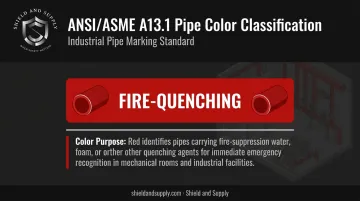
Fire suppression piping — automatic sprinkler supply lines, standpipe systems, CO2, foam, and other fire-quenching agents — falls under A13.1's fire-quenching category: white text on a red background.
This color is intentionally distinctive. In a mechanical room packed with water supply, compressed air, and process piping, the red field immediately signals fire suppression infrastructure — even to emergency responders unfamiliar with the facility layout.
Colors for Adjacent Pipe Types
Mechanical rooms typically contain several pipe types that must not be confused with fire suppression lines:
| Pipe Type | A13.1 Color Scheme |
|---|---|
| Fire-quenching (sprinkler, standpipe, foam) | White text on red |
| Other water (potable, cooling, boiler feed) | White text on green |
| Compressed air (dry-pipe pressurization) | White text on blue |
Mislabeling a fire supply line as "Other Water" (green) removes the visual cue that identifies it as life-safety infrastructure. That's not a paperwork problem — it's a hazard.
Jurisdiction-Specific Overlays
Some jurisdictions add requirements beyond A13.1. New York City's code requires exposed standpipes and sprinkler risers to be painted red, with dedicated sprinkler valve handles painted green. Always check with your local AHJ before ordering labels — local overlays can affect both pipe painting and marker specifications.
Fire Sprinkler Pipe Label Requirements: Color, Content, Size, and Placement
Color
Fire sprinkler supply and distribution pipes: white lettering on a red background, no exceptions. Using white-on-green (Other Water) or any other color combination on a fire suppression line creates dangerous confusion for anyone relying on visual cues during an emergency.
Content
At minimum, every fire sprinkler pipe label must include:
- Contents name — for example, "FIRE SPRINKLER WATER" or "AUTOMATIC SPRINKLER"
- Directional flow arrow showing which way the water flows
Optional but recommended: operating pressure and temperature. Abbreviations are acceptable only if they're unambiguous and used consistently throughout the facility.
Size
Label dimensions scale with the outside diameter of the pipe (including any insulation), per ANSI/ASME A13.1-2023:
| Outside Pipe Diameter (OD) | Min. Color-Field Length | Min. Text Height |
|---|---|---|
| 0.7″ – 1.3″ | 8″ | 0.5″ |
| 1.4″ – 2.4″ | 8″ | 0.7″ |
| 2.5″ – 6.7″ | 12″ | 1.3″ |
| 6.8″ – 10″ | 24″ | 2.5″ |
| Over 10″ | 32″ | 3.5″ |
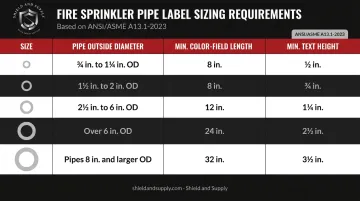
For pipes under 0.75″ OD, permanent legible hanging tags are the recommended approach.
Placement
A13.1 requires markers at these specific locations:
- At all valves and flanges
- On both sides of wall, floor, and ceiling penetrations
- Adjacent to every change in pipe direction or branch
- At regular intervals on straight runs — place labels frequently enough that anyone entering any section of a mechanical space can identify the pipe type without searching
Labels should be positioned at the normal angle of approach: below the pipe centerline for overhead pipes, above centerline for pipes at or below eye level. The goal is immediate readability without repositioning or craning to see the label.
Creating Compliant Labels On-Site
Pre-printed labels from general suppliers often don't match system-specific content requirements. "FIRE SPRINKLER WATER" at one site may need to read "AUTOMATIC SPRINKLER – 175 PSI" at another. Shield and Supply's LabelTac® industrial label printers and LabelSuite™ software let facilities print custom ANSI/ASME A13.1-compliant markers on demand, in the correct white-on-red color scheme, sized for any pipe diameter.
Both printers ship with LabelSuite™ software at no extra cost and carry a full lifetime warranty:
- LabelTac® Pro X ($1,299.99) — handles 0.5″ to 4″ wide supply rolls, covering smaller-diameter sprinkler branch lines
- LabelTac® 9 ($3,999.00) — supports 4″ to 9″ wide stock for larger mains
Vinyl supply rolls are rated for 5–10 years indoors or outdoors and are scratch- and chemical-resistant, making them reliable in the mechanical rooms and industrial environments where pipe labeling gets the most exposure.
NFPA 13 Component Signs: What the Standard Explicitly Requires
NFPA 13's signage requirements operate at the component level — separate from pipe-content markers, and each serving a distinct compliance function.
Valve Identification Signs
Under §16.9.11, every control, drain, venting, and test connection valve needs a permanently marked, weatherproof metal or rigid plastic sign — not a vinyl pipe marker — secured with corrosion-resistant wire or chain. These signs identify which zone the valve controls and, where multiple valves exist, cross-reference where other valves are located.
Hydraulic Design Information Signs
NFPA 13 §29.4 requires a permanently marked sign at every system riser, alarm valve, dry pipe valve, and preaction valve. Required information includes:
- Design area location and size
- Discharge density and flow/pressure demand
- Occupancy or commodity classification
- Hose stream allowance
- Installing contractor name
A general information sign (§29.6.2) covers up to 20 required fields including facility name, flow test data, antifreeze details, and corrosion treatment information. When both signs are needed, §29.6.3 allows combining them into a single plate — reducing hardware while maintaining full compliance.
The Combined Compliance Picture
Each standard covers a different layer of the system:
| Standard | What It Governs | Format |
|---|---|---|
| NFPA 13 §16.9.11 | Valve and component identification | Weatherproof metal or rigid plastic signs |
| NFPA 13 §29.4–29.6 | Hydraulic design data at risers and valves | Permanently marked data plates |
| ANSI/ASME A13.1 | Pipe-content identification | Color-coded vinyl markers with text and arrows |
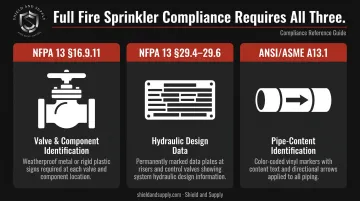
A fully compliant fire sprinkler system requires all three. Valve signs without pipe markers, or pipe markers without hydraulic design plates, leave gaps that AHJ inspectors will flag during review.
Consequences of Non-Compliant or Missing Labels
The $500,000 Example
The Sprinkler Age incident illustrates the stakes clearly. A missing control valve sign meant responders couldn't locate a second valve during an active emergency. By the time the situation was resolved, the property owner faced over $500,000 in damage.
The sprinkler system existed. The water was available. The failure was identification — the absence of a sign NFPA 13 explicitly requires.
According to NFPA's research on sprinkler system performance, one of the leading reasons sprinkler systems fail to operate effectively is the system being shut off before a fire — a risk that incomplete valve identification directly compounds.
Regulatory and Legal Exposure
Missing or non-compliant labels create several categories of risk:
- Inspection failures — AHJs can reject a system during acceptance testing or annual inspection, requiring corrective action before approval
- Contractor liability — if a system failure is linked to absent or incorrect labeling, the installing contractor faces legal exposure
- Insurance complications — building owners may face claim challenges if post-incident investigation reveals labeling deficiencies
- Emergency response degradation — first responders entering an unfamiliar facility rely on pipe markers and valve signs to make fast decisions; unlabeled systems slow every action
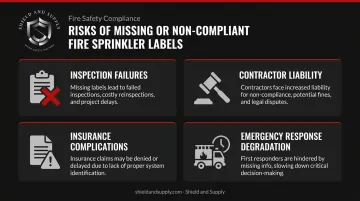
Each of these risks carries costs that dwarf the price of a compliant label. For facilities managing NFPA 13 compliance, having the right printing equipment and label materials on hand removes the most preventable failure point in the chain.
Frequently Asked Questions
Does NFPA 13 require pipe labels?
NFPA 13 requires identification signs on valves and system components but does not define a pipe marker color, size, or placement format. In practice, most AHJs and project specifications require ANSI/ASME A13.1-compliant pipe markers on fire sprinkler piping as a condition of approval.
What ANSI standard applies to fire sprinkler pipe marking?
ANSI/ASME A13.1-2023 (Scheme for the Identification of Piping Systems) covers industrial and commercial pipe marking in the US. It defines color categories, text content, label sizing, and placement requirements for all pipe types — including fire-quenching systems.
What color should fire sprinkler pipe labels be?
Under ANSI/ASME A13.1, fire-quenching system pipes — including automatic sprinkler supply lines — must use white text on a red background. This distinguishes them from other water lines (white on green) and compressed air lines (white on blue).
Where should pipe markers be placed on a fire sprinkler system?
Place markers at all valves and flanges, on both sides of wall/floor/ceiling penetrations, adjacent to every direction change or branch, and at regular intervals along straight pipe runs. Labels should be positioned for easy visibility from the normal angle of approach.
What information must be included on a fire sprinkler pipe label?
At minimum: the name of the pipe contents (such as "FIRE SPRINKLER WATER" or "AUTOMATIC SPRINKLER") and a directional flow arrow. Including operating pressure and temperature is optional but recommended for additional clarity.
What happens if pipe labels are missing during a fire inspection?
The AHJ can fail the system and require corrective action before issuing approval. Missing labels also expose installing contractors and building owners to liability if the system fails during an emergency.