Introduction
Arc flash kills and injures workers across manufacturing plants, warehouses, and industrial facilities every day. OSHA estimates 5 to 10 arc-flash explosions occur daily in the United States, and more than 3,600 disabling electrical contact injuries happen annually. The label on an electrical panel is often the only warning a worker gets before interacting with energized equipment.
NEC 2026 Section 110.16 governs arc-flash hazard markings on service equipment and feeder-supplied electrical equipment in non-dwelling settings. Arc-flash labeling has been in the Code since 2002, but the 2026 edition is the most prescriptive version yet, specifying exactly what data must appear on every label.
Many facilities are still operating under the older 2023 language — and the gap between the two versions is significant.
This article breaks down the specific content requirements introduced in 2026, identifies which equipment is covered, and outlines what facilities need to do to come into compliance.
Key Takeaways
- NEC 2026 removes the 1,000-amp threshold, expanding which equipment requires a compliant arc-flash label
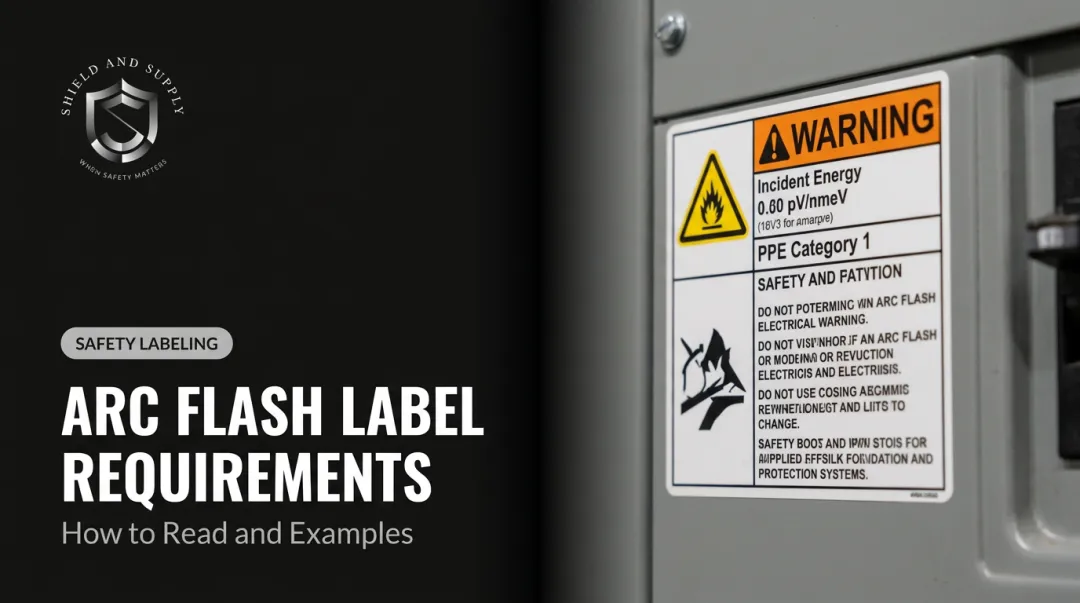
- Every label must include four elements: nominal system voltage, arc-flash boundary, available incident energy or PPE level, and assessment date
- The requirement applies to new installations and major modifications — not retroactively to all existing equipment
- Label values come from an arc-flash risk assessment — NEC defines what to display, NFPA 70E defines how to calculate it
- Labels must meet durability requirements under NEC Section 110.21(B)
What Is NEC 2026 Section 110.16 Arc-Flash Hazard Marking?
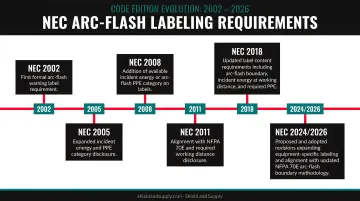
Section 110.16 has been part of the NEC since the 2002 edition, when it first required field markings to warn qualified workers of potential arc-flash hazards before they worked on energized equipment. The original scope covered switchboards, panelboards, industrial control panels, and motor control centers in non-dwelling occupancies.
The section has tightened with each code cycle:
- 2017: Added prescriptive requirements for higher-amperage equipment
- 2023: Lowered the amperage threshold
- 2026: Eliminated the threshold entirely and embedded explicit label content requirements directly into the Code
Before a qualified worker opens a panel, switchboard, or motor control center, the label tells them the energy level they may face, the distance at which they are at risk, and the minimum PPE required. That information enables a life-safety decision before work begins — not during it.
The 2026 changes convert what was previously a flexible, judgment-based standard into a verifiable checklist — one with specific, codified label content that inspectors can confirm on sight.
How NEC 2026 Changed Arc-Flash Labeling Requirements
The 2023 Baseline
Under NEC 2023, Section 110.16 had a two-part structure:
- 110.16(A) — a general arc-flash warning requirement applied to a broad range of equipment, but without specifying what the label had to say
- 110.16(B) — a more prescriptive requirement covering service equipment and feeder-supplied equipment rated 1,000 amps or more, requiring the date the label was applied and reference to applicable industry practices (meaning NFPA 70E)
The practical result: a 400-amp feeder-supplied panelboard in a manufacturing facility didn't require a content-specific arc-flash label under 110.16(B). The 2023 Code relied on "applicable industry practice" rather than spelling out exactly what label data was required.
What the 2026 Edition Changes
According to EC&M's analysis of the 2026 NEC, three things changed:
- The 1,000-amp threshold is gone — the detailed marking requirement now applies to covered equipment regardless of amperage rating
- The A/B structure is consolidated — the two-part section becomes a single unified requirement
- Four specific label content elements are now explicitly required — replacing the vague "applicable industry practice" language with a direct list
This shifts compliance verification from a judgment call to a checklist. An inspector can now look at a label and confirm whether all four required elements are present, with no need to cross-reference NFPA 70E.
Alignment with NFPA 70E — and One Key Difference
The 2026 NEC language closely mirrors NFPA 70E Article 130.5(H), which has long guided arc-flash labeling in safety standards. One gap persists: NFPA 70E requires the working distance to be included when listing incident energy values, but NEC 2026 does not list working distance as a separate required label element. Facilities following NFPA 70E for worker safety should still include it — the NEC minimum is not the ceiling.
Retroactivity
The NEC is not retroactive. The 2026 requirements apply to new installations and major modifications after a jurisdiction adopts the edition — not to all existing equipment in a facility. The 2026 NEC was issued by the NFPA Standards Council on August 20, 2025 and became effective September 9, 2025 for governmental adoption.
State timelines vary. Massachusetts adopted the 2026 NEC effective April 24, 2026; Washington state has slated its adoption for December 31, 2026. Verify your jurisdiction's timeline before planning compliance activities.
The 4 Required Elements of a Compliant Arc-Flash Label
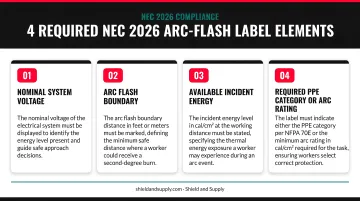
NEC 2026 Section 110.16 requires every arc-flash marking on covered equipment to include four specific elements. Each one serves a distinct function — together, they give workers the information they need to assess risk before touching energized equipment.
1. Nominal System Voltage
This is the rated voltage of the electrical system at the point of the equipment — for example, 480V or 208V. Workers use it to confirm they are working on the correct system and to cross-check voltage against their task authorization. Voltage level also influences arc-flash energy magnitude and PPE selection, so it factors into decisions at multiple points during the job.
2. Arc-Flash Boundary
The arc-flash boundary is the distance from energized equipment at which an unprotected worker could receive a second-degree burn — defined as the point where incident energy equals 1.2 cal/cm². This tells workers how far unprotected personnel must stay back and defines the zone where arc-rated PPE is required.
3. Available Incident Energy or Minimum Required PPE Level
Facilities have two compliant options here:
- Incident energy value, expressed in cal/cm² at a specific working distance and calculated through an arc-flash study — workers use this to verify their PPE's arc rating is adequate
- Minimum PPE category required, which can be determined via an arc-flash study or the task-based table method in NFPA 70E
Listing the incident energy value is the stronger option: it lets workers verify PPE adequacy against a specific number rather than a broad category, which matters when conditions at the panel differ from when the study was run.
4. Date the Assessment Was Completed
This date is a compliance and safety trigger. NFPA 70E requires arc-flash risk assessments to be reviewed at intervals not exceeding five years, and any time significant changes are made to the electrical distribution system.
The date on the label tells workers and inspectors when the underlying data was last validated. For facilities managing multiple panels across a site, it also creates a visible accountability record that simplifies audit preparation.
Which Equipment Must Carry Arc-Flash Labels Under Section 110.16
NEC 2026 Section 110.16 explicitly names the following equipment types:
- Switchboards
- Switchgear
- Enclosed panelboards
- Industrial control panels
- Meter socket enclosures
- Motor control centers (MCCs)
The requirement applies to equipment likely to require examination, adjustment, servicing, or maintenance while energized. Equipment that is always de-energized before access is not the target of this provision.
Section 110.16 explicitly excludes dwelling units. Residential panels in single-family and multi-family homes are not covered. The requirement applies in commercial, industrial, and institutional settings — manufacturing plants, warehouses, data centers, and similar facilities.
NEC 110.16 targets specific equipment types, not production machines broadly. However, if a machine incorporates an industrial control panel that is likely to be serviced while energized, that panel is covered under the section. When the equipment type is ambiguous, labeling is the safer and more defensible choice. NFPA 70E and OSHA requirements may impose separate arc-flash hazard communication obligations regardless of NEC scope.
How the Arc-Flash Risk Assessment Connects to Label Compliance
The 2026 NEC tells facilities what must appear on the label. It does not specify how to calculate the values. That distinction has a significant practical consequence.
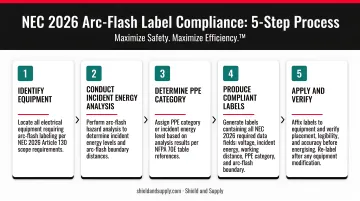
Arc-flash boundary and incident energy values can only be accurately determined through a documented arc-flash risk assessment. NFPA 70E Article 130 and IEEE 1584-2018 govern the methodology, providing mathematical models for determining hazard distance and incident energy based on system fault current, overcurrent protective device characteristics, and equipment configuration.
In plain terms: a facility cannot produce a compliant NEC 2026 label without first completing or updating an arc-flash study. The label is the output; the study is the prerequisite.
This shift changes what inspectors can verify. Under NEC 2023, an inspector could confirm whether a label existed. Under 2026, they can also confirm whether the four required data elements are present. Inspectors may begin asking whether label data is backed by a documented risk assessment, which makes accurate record-keeping more critical than it has been before.
Arc-flash labels must be updated whenever system conditions change. Common triggers include:
- Transformers are added or replaced
- Overcurrent device settings are changed
- Generation sources are added (solar, backup generators, etc.)
- Fault current levels change due to utility or system modifications
The assessment date on the label makes these obligations visible. A label showing a 2018 assessment date on a panel modified twice since then is a compliance gap that's straightforward to identify during an inspection.
Common Misconceptions and Steps to Achieve Compliance
Three Misconceptions Worth Correcting
"Our equipment has a label, so we're compliant." A label missing one or more of the four required elements does not satisfy NEC 2026 Section 110.16 — even if it met the 2023 standard. The new requirements are more specific, and existing labels may need to be updated for new installations or modifications.
"We comply with NFPA 70E, so our NEC labeling is covered." NFPA 70E compliance supports NEC compliance, but the two standards have separate enforcement mechanisms. The NEC carries inspection authority; NFPA 70E does not. Both matter, but they are not interchangeable.
"NEC 2026 is retroactive — we need to relabel everything immediately." Adoption is jurisdiction-dependent, and the requirement applies to new installations and major modifications. Verify when your state adopts NEC 2026 before treating all existing equipment as non-compliant.
Practical Compliance Steps
- Audit existing labels against the four required elements — nominal system voltage, arc-flash boundary, incident energy or minimum PPE level, and assessment date
- Confirm your jurisdiction's NEC 2026 adoption timeline before setting compliance deadlines
- Schedule an arc-flash risk assessment update if your last study is approaching five years or if system changes have occurred since
- Verify label durability — per NEC 110.21(B), labels must be resistant to moisture, chemicals, and UV where applicable, and must remain legible for the life of the equipment
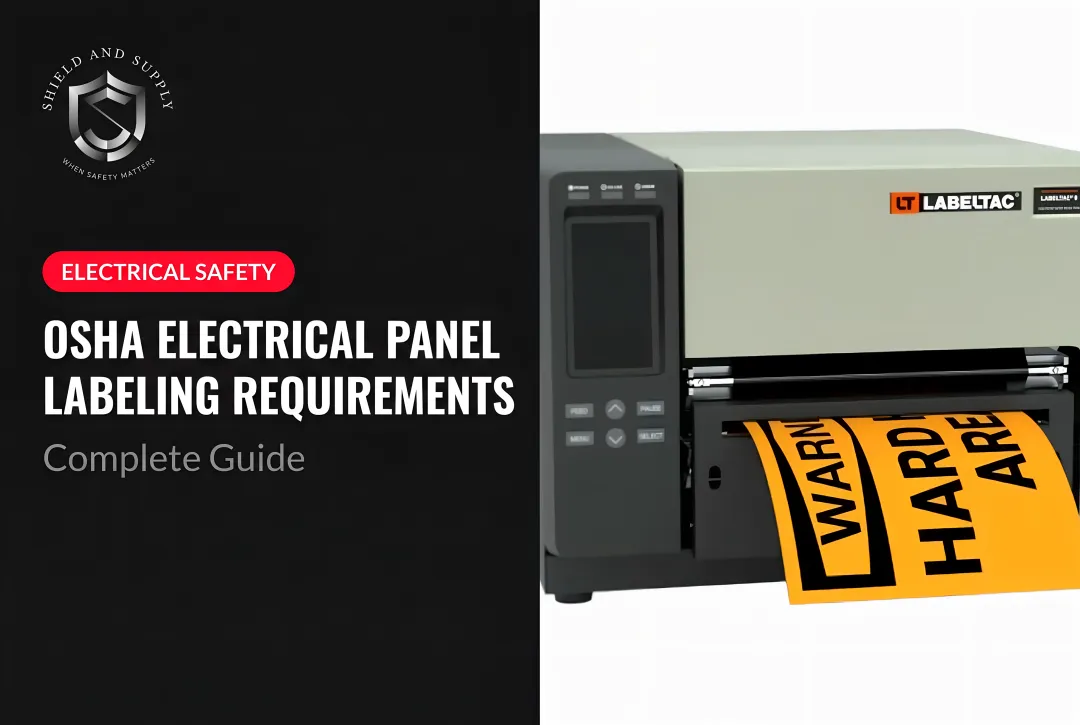
- Produce compliant labels in-house after your assessment is complete, using industrial-grade label printers and software
Shield and Supply's LabelTac® industrial label printers — the LabelTac Pro X (1/2" to 4" labels) and LabelTac 9 (4" to 9" for larger-format signage) — are designed for industrial environments where durability is non-negotiable. Both include LabelSuite™ labeling software at no additional cost, so safety managers can produce site-specific, compliant arc-flash labels in-house without outsourcing each update. For questions about label materials and supply options, contact Shield and Supply at 877-514-0727 or info@shieldandsupply.com.
Frequently Asked Questions
What are the requirements for arc-flash labeling under NEC 2026?
NEC 2026 Section 110.16 requires permanent arc-flash markings on switchboards, switchgear, enclosed panelboards, industrial control panels, meter socket enclosures, and MCCs in non-dwelling settings likely to be serviced while energized. Each label must include nominal system voltage, arc-flash boundary, available incident energy or minimum PPE level, and the assessment date.
Do control panels need arc-flash labels?
Yes. Industrial control panels are explicitly listed in NEC 2026 Section 110.16 as equipment requiring arc-flash hazard marking, provided they are in a non-dwelling setting and are likely to require examination, adjustment, servicing, or maintenance while energized.
Does a typical industrial machine require an arc-flash label?
NEC 110.16 targets specific equipment types rather than production machines broadly. If a machine incorporates an industrial control panel that is likely to be serviced while energized, that panel is covered. NFPA 70E and OSHA requirements impose separate arc-flash hazard communication obligations regardless of NEC scope.
Does the NEC require an arc-flash study?
The NEC doesn't mandate an arc-flash risk assessment by name, but the required label data — arc-flash boundary and incident energy — can only be accurately determined through one. NFPA 70E Article 130 and IEEE 1584 provide the methodology, making a study a practical prerequisite for compliance.
Is arc-flash labeling required by OSHA?
OSHA has no arc-flash labeling standard equivalent to NEC 110.16, but enforces hazard communication through 29 CFR 1910.335 and the General Duty Clause. Because OSHA recognizes NFPA 70E as a compliance framework for electrical safety, arc-flash labeling consistent with NFPA 70E and the NEC directly supports OSHA compliance.
What are the biggest changes in NEC 2026 regarding arc flash?
Three key changes in Section 110.16: the 1,000-amp threshold was removed, expanding which equipment requires a label; four explicit label content elements replace the vague "applicable industry practice" standard; and the two-part A/B structure was consolidated into a single unified section more closely aligned with NFPA 70E Article 130.5(H).