Many installers treat these markings as background noise. That's a problem. Misreading a single element — confusing pipe schedule with size, or missing an NSF-61 mark on a potable water line — can cause system failures, code violations, or serious health hazards.
This guide breaks down each segment of the marking string, explains the key ASTM standards and NSF certification codes, covers color stripe conventions, and flags the most common misreading mistakes.
Key Takeaways
- PVC pipe markings read left to right: manufacturer → material code → nominal size → schedule/pressure rating → certifications → ASTM standard number
- The material code (e.g., PVC 1120, CPVC 4120) tells you the resin type and pressure class — not just whether it's PVC or CPVC
- NSF-14 certifies structural integrity
- NSF-61 (or NSF-pw) certifies the pipe is safe for drinking water contact
- Schedule refers to wall thickness — SCH 40 and SCH 80 share the same outside diameter, but SCH 80 has a thicker wall and higher pressure rating
- Color stripes (blue, green, purple) signal intended use but do not replace the printed marking string
How to Read a PVC Pipe Marking String Step by Step
Markings repeat at intervals not exceeding 5 feet along the pipe's length, per Uni-Bell's marking requirements — so you can always find a complete, readable section. Orient the pipe so the text reads left to right, then decode each segment in order.
Segment 1: Manufacturer Name
The first element is the manufacturer's name, brand, or logo. Use it to pull spec sheets, quality documentation, or third-party certification records when needed.
Segment 2: Material Designation Code
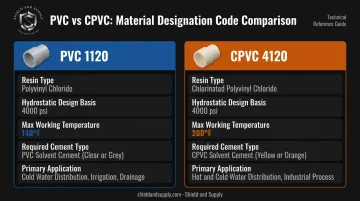
The material designation is a four-character alphanumeric code defined under ASTM D1784. The logic:
- First two characters — material type (PVC = 11 or 12; CPVC = 41)
- Last two characters — hydrostatic design basis class
PVC 1120 (the most common designation) means Type I, Grade I, with a hydrostatic design basis of 2,000 psi. Charlotte Pipe identifies PVC 1120 with cell class 12454, making it the standard choice for pressure lines.
CPVC 4120 signals chlorinated PVC, a different material with a higher maximum working temperature (up to 200°F for some Corzan CPVC products, versus 140°F for standard PVC). CPVC requires its own solvent cement per ASTM F493. Using standard PVC cement on CPVC joints is a common and costly mistake that produces unreliable bonds.
Segment 3: Nominal Pipe Size
Nominal pipe size (NPS) is listed in inches but does not equal the actual outside diameter. This distinction matters when selecting fittings.
| Nominal Size | Actual OD |
|---|---|
| 1/2 in. | 0.840 in. |
| 3/4 in. | 1.050 in. |
| 1 in. | 1.315 in. |
| 1-1/2 in. | 1.900 in. |
| 2 in. | 2.375 in. |
| 4 in. | 4.500 in. |
Fittings are sized by nominal, not measured OD. Measuring the pipe with calipers and treating that number as the pipe size leads to wrong fitting selection.
Segment 4: Schedule or Pressure Rating
Schedule describes wall thickness relative to nominal size. The practical comparison at 1-inch nominal (73°F):
| Schedule | OD | Wall Thickness | Pressure Rating |
|---|---|---|---|
| SCH 40 | 1.315 in. | 0.133 in. | 450 psi |
| SCH 80 | 1.315 in. | 0.179 in. | 630 psi |
Because OD is identical, fittings for SCH 40 and SCH 80 are interchangeable — but the pipes themselves are not equivalent for pressure applications.
Some irrigation and pressure-rated lines use SDR (Standard Dimension Ratio) instead of schedule. SDR is the ratio of outside diameter to wall thickness. A lower SDR number means a thicker wall and higher pressure rating, and all diameters within a specific SDR series share the same pressure rating. ASTM D2241 governs SDR pressure-rated PVC pipe.
Segment 5: Certifications and ASTM Standard
The final segment is the most compliance-critical. It contains certification marks followed by the governing ASTM standard number. Match this to the pipe's intended application before purchasing or installing.
Key codes to recognize:
- NSF-14 — structural/performance certification for plastic piping components
- NSF-61 or NSF-pw — health-effects certification for potable water contact
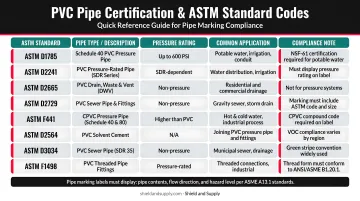
- ASTM D1785 — rigid PVC pressure pipe (SCH 40, 80, 120)
- ASTM D2241 — SDR pressure-rated PVC pipe
- ASTM D2665 / D2729 — drain, waste, vent, and sewer pipe (non-pressure)
Key Codes and Standards Found on PVC Pipe Markings
ASTM Standards at a Glance
Each ASTM number defines a specific application. They are not interchangeable.
| ASTM Standard | Application | Pressure-Rated? |
|---|---|---|
| D1785 | Rigid PVC SCH 40, 80, 120 pressure pipe | ✅ Yes |
| D2241 | SDR pressure-rated PVC pipe | ✅ Yes |
| D2665 | PVC drain, waste, and vent pipe | ❌ No |
| D2729 | PVC sewer pipe and fittings | ❌ No |
| F441/F441M | CPVC SCH 40 and 80 pressure pipe | ✅ Yes |
Using D2729-marked sewer pipe in a pressure water service application is both a code violation and a safety hazard. IPC Section 605.3 requires water service pipe to conform to NSF-61 and listed water-service standards — D2729 satisfies neither requirement.
NSF-14 vs. NSF-61
These two marks are frequently confused but serve distinct purposes:
- NSF-14 covers mechanical and performance requirements for plastic piping system components. A pipe can carry NSF-14 without NSF-61.
- NSF-61 certifies that the pipe will not leach harmful contaminants into drinking water above health-based limits. This mark is required for any potable water supply line under most US plumbing codes.
- NSF-pw is shorthand for the same potable water certification — treat it as equivalent to NSF-61 when reading a print line.
Production Date Codes
Most manufacturers include a production record code that identifies the plant, production line, and date of manufacture. No universal format applies across all brands, so check the manufacturer's documentation to decode a specific code.
Date codes matter for two reasons:
- Verify compliance and warranty eligibility — manufacture date establishes pipe age for both
- Assess UV exposure risk — Charlotte Pipe recommends storing pipe under a ventilated, non-transparent cover outdoors. Permanent outdoor installations should be painted with water-based latex to block UV degradation. Inspect any pipe showing surface discoloration before installation.
PVC Pipe Color Stripes and What They Signal
Color stripes give you a quick visual cue about a pipe's intended use — but they're not standardized across every manufacturer. No single federal mandate governs stripe colors for all PVC pipe in the US, so the same color can mean different things depending on who made the pipe.
Common conventions (US practice):
- Blue stripe — potable (drinking) water
- Green stripe — wastewater (per Westlake's municipal line; not universal for "reclaimed")
- Purple/violet stripe — reclaimed non-potable water (California's Los Angeles Regional Water Board requires recycled water piping to be purple or distinctively wrapped)
- White or no stripe — general-purpose DWV (drain, waste, vent)
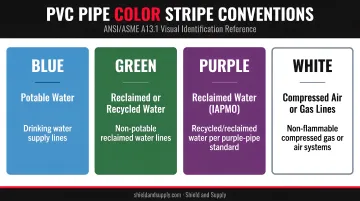
Critical point: In industrial and facility settings, pipes get painted, insulated, or fouled over time. A blue stripe hidden under two coats of plant paint tells you nothing. Treat the printed marking string as the authoritative reference. Color is supporting context, not proof of compliance.
Common Mistakes When Reading PVC Pipe Markings
Confusing Nominal Size with Actual OD
Measuring the outside of a 1-inch PVC pipe gives you 1.315 inches — not 1.000 inch. Installers who select fittings based on a caliper measurement rather than the nominal size printed on the pipe will pull the wrong parts. Fittings are always sized by nominal, matching the marking on the pipe.
Treating SCH 40 and SCH 80 as Interchangeable
They share the same OD, so fittings fit either pipe. But the wall thickness, pressure rating, and inside diameter differ. Using SCH 40 in an application specified for SCH 80 can cause failure under pressure — the pipe will fit the fittings, and nothing in the physical assembly will alert you to the error until it fails.
Missing or Misreading the ASTM/NSF Codes
Misreading ASTM or NSF codes carries the most serious consequences. Common errors include:
- Installing D2729 sewer pipe on a potable water supply line — no pressure rating, no NSF-61, code violation
- Missing NSF-61 on a drinking water line — may pass visual inspection but fails health compliance
- Using a DWV-rated pipe (D2665) in a pressure application because the schedule "looks right"
Check the ASTM number against the application before purchase, not after installation.
Ignoring Date Codes on Stored or Salvaged Pipe
Old pipe pulled from storage or salvaged from another job may look fine. Always check the production date code — if the pipe was stored outdoors without UV protection, inspect for surface chalking, discoloration, or brittleness before using it.
There's no single universal rejection threshold, but Charlotte Pipe's storage guidance is direct: outdoor-stored pipe needs UV protection. When in doubt, don't use it.
Keeping Pipe Markings Readable in Industrial Facilities
In manufacturing plants and warehouses, the original manufacturer markings on installed PVC pipe frequently become inaccessible — buried under insulation, obscured by paint, or unreachable in congested pipe runs. When that happens, maintenance teams and emergency responders can't rely on the print line to identify what's flowing through the system.
The practical solution is supplemental pipe labeling applied at regular intervals and at every key access point. ASME A13.1-2023 is the governing standard for aboveground pipe identification in industrial, commercial, and institutional facilities — it establishes a common system for identifying pipe contents, flow direction, and hazard characteristics.
For facilities teams building or updating a pipe identification program, Shield and Supply's LabelTac® Pro X ($1,299.99) and LabelTac® 9 ($3,999.00) industrial label printers handle everything from single-pipe replacements to facility-wide labeling rollouts:
- LabelTac® Pro X — handles 1/2" to 4" wide vinyl labels; rugged industrial chassis with expanded ribbon capacity; includes LabelSuite™ software (a $299.99 value)
- LabelTac® 9 — handles 4" to 9" wide labels for larger diameter pipes; processes up to 2,500 labels per day; suited for high-volume facility labeling programs
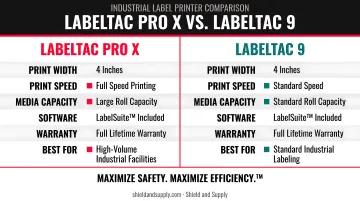
Both printers ship with LabelSuite™ Design and Print Software — a desktop application (PC or Mac via USB or Ethernet) pre-loaded with industrial labeling content. Supply rolls last 5–10 years indoors or outdoors, and thermal transfer ribbons deliver scratch- and chemical-resistant print for harsh environments.
Every LabelTac® printer includes a full lifetime warranty covering parts and labor — so the investment covers the equipment long-term, not just the initial installation.
ASME A13.1 recommends labeling at intervals no greater than 25–50 feet, plus at every valve, fitting, and wall penetration — an interval that's easy to meet with in-house printing capability.
Frequently Asked Questions
How do I read PVC pipe markings to tell the pipe's type, size, schedule, and manufacture date?
Read left to right: manufacturer name → material code (e.g., PVC 1120) → nominal size in inches → schedule (SCH 40 or SCH 80) → certification marks and ASTM standard number. The production date code, which identifies plant, line, and manufacture date, typically appears at or near the end of the string — format varies by manufacturer.
What codes or standards apply to PVC pipe?
The main ASTM standards are D1785 (rigid pressure pipe, SCH 40/80/120), D2241 (SDR pressure pipe), D2665 (DWV pipe), and D2729 (sewer pipe). NSF-14 covers structural/performance certification; NSF-61 certifies potable water safety.
What does NSF-61 mean on a PVC pipe?
NSF-61 certifies that the pipe's materials will not leach harmful contaminants into drinking water above health-based limits. It is required for any PVC pipe used in potable water supply lines under most US plumbing codes. "NSF-pw" on a print line carries the same meaning.
What is the difference between Schedule 40 and Schedule 80 PVC?
Both schedules share the same outside diameter, so fittings are interchangeable — but SCH 80's thicker wall means a smaller inside diameter and a higher pressure rating. A 1-inch SCH 40 is rated to 450 psi; the same size in SCH 80 reaches 630 psi. Fitting compatibility does not mean pressure equivalence.
What is the purple primer that plumbers use on PVC pipe?
Purple primer is a solvent-based cleaner and conditioner applied before PVC cement. It softens the pipe and fitting surfaces so the cement can form a chemical weld. The purple color signals to inspectors that primer was applied before cementing.
What is the healthiest plumbing material for drinking water?
PVC, CPVC, copper, and PEX-A are all common potable water options in the US. For any material, the NSF-61 or NSF-pw mark is what matters — it confirms independent third-party testing for drinking water safety regardless of pipe type.