Spreadsheets and paper binders can't answer that question reliably anymore. As OSHA enforcement tightens heading into 2026 — and compliance requirements grow more complex — digital safety management has become the operational backbone of audit-ready programs.
This guide covers the 7 best OSHA compliance software solutions for 2026: what each platform does well, who it's built for, and how to pick the right fit for your facility size and industry.
Key Takeaways
- OSHA compliance software centralizes training records, inspection logs, incident reports, and regulatory documentation — replacing error-prone manual processes
- The 7 platforms reviewed span mobile-first inspection tools to full enterprise EHS suites for multi-site operations
- Key selection factors: automated reminders, mobile access, OSHA 300 log automation, integration capability, and scalable pricing
- All seven tools are suited for US-based industrial, manufacturing, and warehouse environments
- Physical compliance still matters: GHS labels, pipe markers, and floor signs remain required under OSHA's HazCom and facility standards
What Is OSHA Compliance Software and Why It Matters in 2026
OSHA compliance software is a digital platform that centralizes safety training records, certifications, inspection logs, incident reports, and regulatory documentation required under OSHA standards — replacing the disconnected mix of spreadsheets, shared drives, and paper files that most facilities still rely on.
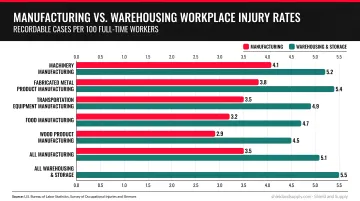
The financial stakes make the upgrade easy to justify. Beyond the per-violation penalties above, consider the operational exposure: warehousing and storage facilities logged 4.8 total recordable cases per 100 full-time workers in 2024, while manufacturing came in at 2.7 per 100 workers. Untracked incidents and expired certifications don't stay hidden — they surface as citations.
Regulatory complexity is also increasing. OSHA's Hazard Communication Standard update published May 20, 2024 — aligning HCS with GHS Revision 7 — introduced compliance deadlines kicking in by early 2026. Affected areas include:
- Safety Data Sheets (SDSs)
- Labels and chemical inventories
- Employee training workflows
Software that can't track and flag these requirements in real time puts your facility behind the curve.
The 7 platforms below address exactly these gaps — here's how they compare.
7 Best OSHA Compliance Software Solutions in 2026
These selections were evaluated on feature depth, ease of deployment for industrial teams, mobile accessibility, and fit for US-based manufacturing, construction, and warehouse operations. Each entry includes pricing, standout capabilities, and the specific use case it serves best — so you can match the tool to your environment, not just a general checklist.
SafetyCulture (iAuditor)
SafetyCulture is a mobile-first EHS platform widely adopted in manufacturing, construction, and warehouse operations. Its large global template library and reported use in over 50 million inspections across 80+ countries reflect broad market trust and deployment at scale.
For field-heavy operations, the platform works fully offline during mobile inspections, captures photo and video evidence in real time, and pushes corrective action assignments the moment an issue is logged.
| Category | Details |
|---|---|
| Key Features | Digital inspection checklists, incident reporting, corrective action tracking, training management, safety observations |
| Best For | Field teams and multi-site operations needing mobile-first inspection workflows |
| Pricing | Free plan: $0 for teams up to 10 (5 active templates). Premium: $24/seat/month (billed annually) or $29/month. Enterprise: custom pricing. |
Intelex
Intelex is an enterprise-grade EHS management platform with a long track record serving large industrial and manufacturing organizations. Over 1,400 organizations use the platform globally, with strong adoption in complex multi-site manufacturing environments.
Its depth in OSHA recordkeeping goes further than most platforms — automated 300/300A/301 log generation, robust audit trail capabilities, and regulatory change management make it a strong fit for complex multi-site programs where documentation gaps carry serious risk.
| Category | Details |
|---|---|
| Key Features | OSHA 300 log automation, incident management, audit management, training tracking, document control |
| Best For | Large enterprises and multi-location industrial facilities with complex compliance requirements |
| Pricing | Safety Essentials starts at $44/user/month (minimum 25 users, billed annually). Advanced and Enterprise: quote-based. |
VelocityEHS
VelocityEHS brings enterprise-level safety management within reach of mid-market industrial companies, with strong capabilities in chemical management and hazard communication — areas directly in scope with OSHA's 2024 HazCom update.
Its SDS Management solution (formerly MSDSonline) provides access to millions of SDSs, with over 20,000 documents added automatically each week. For manufacturing and chemical-handling facilities working through GHS Revision 7 alignment, that automated update infrastructure is a real operational advantage.
| Category | Details |
|---|---|
| Key Features | Chemical/SDS management, HazCom compliance, risk assessment, incident management, training |
| Best For | Manufacturing and chemical-handling facilities needing integrated HazCom and OSHA compliance |
| Pricing | Modular, quote-based. Contact VelocityEHS for pricing. |
Cority
Cority is a comprehensive EHS and occupational health platform used by large industrial enterprises in heavy manufacturing, energy, and related sectors. Verdantix named it a leader in their 2025 Green Quadrant EHS Software report, describing it as a "formidable all-round EHS solution."
Its Cortex AI layer includes 14 agents covering 30+ EHS use cases — from voice-to-text incident capture to image-based hazard analysis — and its occupational health module (covering fit testing and medical surveillance) goes deeper than most competitors.
| Category | Details |
|---|---|
| Key Features | Occupational health, industrial hygiene, incident management, environmental tracking, analytics dashboards |
| Best For | Large enterprises in heavy industry, manufacturing, and energy needing full EHS suite coverage |
| Pricing | Enterprise, quote-based. Contact Cority for pricing. |
ComplianceQuest
ComplianceQuest is built natively on Salesforce — a direct advantage for manufacturers and regulated industries already running on Salesforce infrastructure. The platform combines quality and safety modules (CAPA, audits, training/LMS, incident management) in a single environment, with AI-driven compliance insights through its CQ.AI Agents layer.
For organizations where safety and quality programs overlap, running both in a single environment cuts the integration overhead that typically comes with multi-vendor EHS setups.
| Category | Details |
|---|---|
| Key Features | Safety incident management, audit management, training/LMS, CAPA, chemical management, document control |
| Best For | Mid-to-large manufacturers and regulated industries already using Salesforce |
| Pricing | Quote-based. Pricing varies by users, modules, sites, and integrations. |
Procore (Safety Module)
Procore is the dominant project management platform in US construction, and its dedicated safety module is purpose-built for site safety compliance — not an afterthought add-on. Subcontractor credential tracking, pre-built OSHA safety forms, real-time site observation tools, and toolbox talk management are all tightly woven into the project workflow.
For construction companies managing OSHA compliance across active job sites with rotating subcontractor crews, that integration between safety and project management is a structural advantage that standalone EHS tools don't offer.
| Category | Details |
|---|---|
| Key Features | Safety observations, incident reporting, toolbox talks, subcontractor credential tracking, inspection checklists |
| Best For | Construction companies and industrial contractors managing OSHA compliance across active job sites |
| Pricing | Custom quote-based. Contact Procore for pricing. |
Field1st
Field1st is an AI-powered safety management platform designed specifically for field-heavy industries: utilities, construction, contract services, and similar operations where frontline adoption determines whether a safety program actually works.
The platform focuses where legacy EHS tools often fall short: frontline usability. AI-driven hazard prediction, voice-enabled mobile reporting, and photo-based hazard detection are built for supervisors in the field. As a newer platform, it doesn't carry the feature sprawl of enterprise incumbents — that's by design.
| Category | Details |
|---|---|
| Key Features | AI hazard prediction, mobile incident reporting, safety checklists/templates, corrective action tracking, compliance dashboards |
| Best For | Utilities, contract services, and field-heavy operations needing mobile-first AI safety management |
| Pricing | Custom, based on users, modules, and deployment scale. Contact Field1st for pricing. |
Key Features to Look for in OSHA Compliance Software
Not all platforms are equal. These are the features that matter most for industrial, manufacturing, and warehouse environments.
Automated Training and Certification Tracking
Expired certifications are one of the most preventable citation triggers. Hazard Communication (29 CFR 1910.1200) is OSHA's #2 most cited standard in FY2025 — and for manufacturing specifically, powered industrial truck (forklift) operator certification (29 CFR 1910.178) ranks among the top citations.
Look for platforms that send automated reminders at 90/60/30/7-day intervals before expiration, not just a single notification. Verify that the system tracks both initial training completion and recertification cycles for each worker.
Mobile Inspection and Audit Tools
Your hazard identification process is only as good as your documentation speed. Key capabilities to verify:
- Photo and video capture during walkthroughs
- GPS tagging on inspection records
- Offline functionality for areas without reliable connectivity
- Real-time corrective action assignment directly from the mobile interface
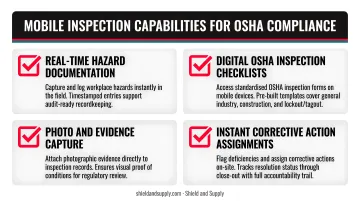
Delays between hazard identification and corrective action assignment are where near-misses become incidents.
OSHA Recordkeeping Automation
Manual Form 300 preparation is a consistent compliance error source. Look for:
- Built-in OSHA 300, 300A, and 301 log generation
- ITA (Injury Tracking Application) integration for electronic submission
- 5-year record retention management (OSHA's required retention period)
Note: Establishments with 100+ employees in high-hazard industries must submit both 300 and 301 data to the ITA by March 2 each year — not just the 300A summary.
Physical Labeling Compliance
Software manages the digital layer of compliance. The physical layer is equally required — and equally audited. OSHA's HazCom standard and facility safety regulations mandate proper labeling for:
- GHS chemical labels and Safety Data Sheets
- Pipe markers and lockout/tagout tags
- Arc flash and NFPA hazard labels
- 5S floor marking and aisle delineation
For facilities that need on-demand label printing rather than outsourcing to print vendors, Shield and Supply's LabelTac® printers and bundled LabelSuite™ software handle this physical compliance layer directly — covering GHS labels, arc flash, pipe markers, and floor marking from a single in-house system. Both printers include LabelSuite™ at no additional cost and carry a full lifetime transferable warranty.
How We Chose the Best OSHA Compliance Software
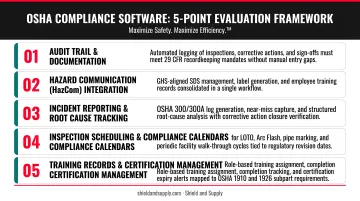
Not every OSHA compliance platform is built for industrial environments. The evaluation framework prioritized criteria that reflect how safety work actually gets done on the floor:
- Feature coverage against core OSHA requirements: training tracking, incident reporting, inspection management, OSHA 300 log automation
- Ease of deployment for industrial teams, not just enterprise IT departments
- Mobile accessibility — required for facilities where safety work happens on the floor, not at a workstation
- Integration capability with existing HRIS, ERP, and operations tools
- Scalability from single-site operations to complex multi-facility programs
Two common buyer mistakes to avoid: choosing a platform too complex for your current team size (adoption suffers), or choosing one too limited to scale with multi-site growth (you'll replace it in 18 months).
Ultimately, consistent use by frontline safety staff matters more than feature count. A sophisticated platform that nobody opens doesn't prevent a single citation.
Conclusion
OSHA compliance in 2026 requires more than good safety intentions. It demands systems that proactively track certifications, automate OSHA recordkeeping, and keep your team inspection-ready before an OSHA compliance officer shows up — whether that visit is programmed or unprogrammed.
The 7 platforms reviewed here serve distinct operational needs:
- SafetyCulture for mobile-first teams and multi-site inspection workflows
- Intelex and Cority for large enterprises with deep EHS requirements
- VelocityEHS for chemical-handling and HazCom-intensive operations
- ComplianceQuest for Salesforce-integrated manufacturers
- Procore for construction and industrial contractors
- Field1st for field-heavy operations prioritizing frontline adoption
Before committing, assess scalability, integration fit, and mobile usability — and involve your frontline safety staff in the evaluation. Their adoption determines your ROI.
Software handles the recordkeeping and audit trail. The physical side — GHS labels, pipe markers, lockout/tagout tags, arc flash labels, and facility floor marking — needs its own solution. Visit Shield and Supply to explore LabelSuite™ and LabelTac® printing solutions designed for industrial labeling and OSHA compliance requirements.
Frequently Asked Questions
What is the best compliance management platform for 2026?
It depends on organization size and complexity. SafetyCulture suits smaller teams with its free tier and strong mobile tools, while Intelex or Cority are better fits for large industrial enterprises running multi-site programs.
What is the difference between OSHA and GHS?
OSHA is the US federal agency that enforces workplace safety standards. GHS (Globally Harmonized System) is a UN-developed international framework for chemical classification and labeling. OSHA adopted GHS principles into its Hazard Communication Standard in 2012 and updated the standard again in 2024 to align with GHS Revision 7.
What are OSHA's 3 most cited violations?
According to OSHA's FY2025 Top 10 Most Frequently Cited Standards, the top three are: Fall Protection (29 CFR 1926.501), Hazard Communication (29 CFR 1910.1200), and Ladders (29 CFR 1926.1053). OSHA compliance software directly supports citation prevention for all three through inspection management, HazCom training tracking, and corrective action workflows.
What are the 4 phases of compliance?
The four phases are: identification (recognizing which OSHA requirements apply), implementation (putting training, controls, and documentation in place), monitoring (tracking ongoing compliance status), and improvement (using incident and inspection data to close gaps). OSHA compliance software supports all four phases.
How much does OSHA compliance software cost?
Pricing ranges from $0 (SafetyCulture's free plan for teams up to 10) to enterprise quote-based models. Intelex's Safety Essentials starts at $44/user/month with a 25-user minimum. Most enterprise platforms require a custom quote. For context, a single serious OSHA violation carries a maximum penalty of $16,550, which puts even mid-market software costs in perspective.
Does OSHA compliance software replace a safety manager?
No. Software handles administrative tasks like tracking certifications, generating OSHA logs, and sending reminders, but it doesn't replace the judgment, hazard assessment expertise, and safety culture leadership a qualified safety professional brings. The real benefit is freeing your safety manager to focus on higher-value work.