Introduction
Walk into almost any warehouse in North America and you'll see steel uprights and horizontal beams stacked ceiling-high with pallets. At a glance, it all looks the same. It isn't.
The global warehouse racking market was valued at USD $10.02 billion in 2022, with an 8.5% annual growth rate projected through 2030. More facilities are installing, expanding, and reconfiguring racking than ever before. Yet many warehouse managers can't identify exactly what type of racking they have — and that gap creates real risk.
Wrong component purchases, mismatched uprights and beams, missing load placards, and OSHA non-compliance all trace back to one root cause: unidentified rack systems.
This guide covers the four main racking types found in North American warehouses, how to visually identify each one, and what to verify before you buy components, expand a system, or put new labels on your bays.
Key Takeaways
- The four main rack types — teardrop/roll-formed, structural steel, drive-in/drive-through, and cantilever — each serve different loads, workflows, and storage densities.
- Start identification at the upright: punch hole shape, connection mechanism, and steel construction method are the fastest visual cues.
- Never mix components without verification; incompatible parts can cause structural failure and void load ratings.
- Rack type drives everything downstream: load limits, inspection frequency, labeling requirements, and OSHA compliance.
What Is Warehouse Racking — and Why Does Identifying the Type Matter?
Warehouse racking is a structural storage system composed of vertical upright frames and horizontal load-bearing beams, allowing palletized goods — and in some cases loose cartons or bins — to be stored vertically and retrieved in sequence. It's how facilities multiply usable storage volume without expanding their footprint.
Most systems share three core components:
- Uprights — the vertical frames that carry the load to the floor
- Beams — horizontal bars that support pallets between two uprights
- Decking or supports — wire mesh, wood, or steel panels that create the shelf surface
The components look similar across brands and styles — but they are not interchangeable. Hole patterns, connector dimensions, steel grades, and frame geometries vary between manufacturers and racking types, sometimes dramatically.
Why Identification Is More Than a Purchasing Exercise
Knowing your rack type isn't just about ordering the right replacement beam. The downstream consequences of misidentification include:
Each of those unlabeled bays is a compliance gap — and accurate identification is the first step toward placards that meet ANSI MH16.1 requirements.
The Main Types of Warehouse Racking and Their Identifying Features
Racking systems vary based on storage density, load weight, SKU volume, floor space, and forklift access requirements. Here's how to tell them apart.
Teardrop (Roll-Formed Selective) Racking
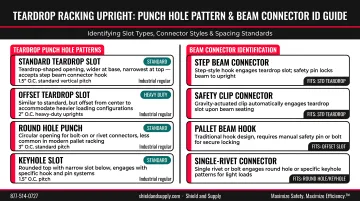
Teardrop racking is the most common pallet rack style in North America. It's a roll-formed steel system where beams connect to uprights via riveted connectors that slot into teardrop-shaped or tapered rectangular keyhole punches, spaced on 2-inch centers. Installation is typically tool-free.
How to identify it:
- Upside-down teardrop or tapered rectangular punch holes on upright columns
- Beams snap in via riveted studs — no bolts required
- Roll-formed (lighter gauge) steel construction vs. structural C-channel
Teardrop racking traces back to Interlake's original pallet rack patents, including US4729484A (1986). Because the design was widely adopted, many manufacturers — including UNARCO, Ridg-U-Rak, and Steel King SK2000 — produce teardrop-compatible components. Cross-brand compatibility exists, but always verify hole dimensions and connector spacing before mixing.
Best fit for:
- Selective picking environments with individual pallet access
- Multi-SKU operations needing flexible layout reconfiguration
- Facilities of any size, from small warehouses to large distribution centers
Limitations: Sacrifices storage density — every pallet position requires direct aisle access. Not ideal for bulk, single-SKU deep-lane storage.
Structural Steel Racking
Structural racking is fabricated from hot-rolled structural steel channels. Uprights and beams bolt together rather than snapping via clip connections, creating a rigid frame capable of handling higher impact loads and harsh operating conditions.
How to identify it:
- Heavy-gauge C-channel or tube uprights (noticeably heavier than roll-formed)
- Bolted or T-bolt beam connections — no snap-in connectors
- Larger, heavier overall frame profile
Ridg-U-Rak's structural uprights use steel with 50,000 psi minimum yield and a 1.92 safety factor. Steel King's SK2500 tubular columns use 55,000 psi minimum steel, with up to 44 times more resistance to torsional forklift impact than open-back roll-formed columns, which matters in facilities with frequent forklift traffic.
Best fit for:
- High-traffic facilities with frequent forklift impact exposure
- Cold storage and freezer applications
- Heavy pallet loads and advanced systems (drive-in, AS/RS, multi-level pick modules)
Limitations: Higher upfront cost; bolted connections are more labor-intensive to adjust, making reconfiguration slower and costlier than teardrop systems.
Drive-In and Drive-Through Racking
These are high-density storage systems where forklifts physically enter the rack structure to place or retrieve pallets. Drive-in racks have a single entry point (LIFO — last in, first out). Drive-through racks have entry points at both ends (FIFO — first in, first out).
How to identify it:
- Lane-based continuous rail structure running deep into the rack (no individual beam levels per pallet)
- No cross-aisles between storage positions
- Wide structural uprights spaced to accommodate forklift entry
- Forklift drives inside the rack bay, not alongside it
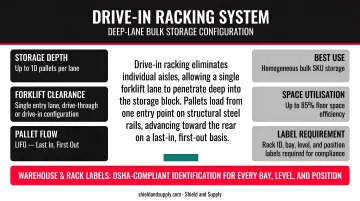
Drive-in systems require fewer aisles and can increase storage density by up to 75% compared to selective racking. That density gain comes at the cost of selectivity — you access lanes, not individual pallets.
Best fit for:
- High-volume, low-SKU operations
- Cold storage, beverage, building materials, and seasonal goods
Trade-offs: Reduced accessibility, complex inventory rotation, poorly suited for perishables requiring strict FIFO management (in drive-in configurations) or operations with many distinct SKUs.
Cantilever Racking
Cantilever systems are purpose-built for long, bulky, or irregularly shaped items that can't sit on standard pallet beams. Instead of beams spanning two uprights, horizontal arms extend outward from a single central column or tower, leaving the front completely open and unobstructed.
How to identify it:
- Arms protrude from a single column — no beams connecting two upright frames
- No traditional pallet rack decking
- Available in single-sided (wall-mounted) or double-sided (freestanding) configurations
Steel King's cantilever racks reach freestanding heights up to 30 feet, with arm lengths up to 8 feet and 4-inch vertical adjustment increments. Arm capacity varies significantly by size and extension length. A Ridg-U-Rak CAS-04 arm handles 5,225 lb at 24 inches but drops to 2,100 lb at 60 inches. Load planning is critical.
Best fit for: Lumber, pipe, steel bar, carpet, furniture, plywood, structural members — industries including manufacturing, construction supply, and retail building centers.
Limitations: Not suitable for standard palletized goods; typically requires specialized forklift attachments or manual loading.
How to Identify the Racking System You Already Have
If you're working with an existing installation and need to confirm the rack type, follow this three-step process.
Step 1: Inspect the Punch Hole Pattern
The shape, size, and spacing of holes on the upright columns is the most reliable visual identifier. Common patterns include:
| Hole Pattern | Typical Style |
|---|---|
| Tapered teardrop / keyhole | Teardrop/roll-formed selective |
| Rectangular slotted | Ridg-U-Rak original slotted style |
| Round or diamond | Proprietary styles (varies by manufacturer) |
| Bolted / no punched holes | Structural steel racking |
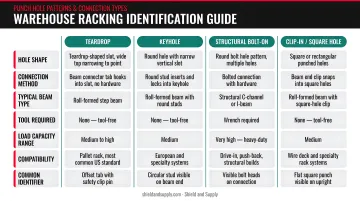
Compare the hole shapes against a manufacturer identification chart — most major suppliers publish these online.
Step 2: Examine the Beam Connection
Once you've looked at the uprights, check how the beams attach:
- Snap-in riveted studs → roll-formed teardrop
- Bolted connections → structural racking
- T-bolt mechanism → UNARCO T-bolt style
- Spring-loaded hooks with locking pins → Ridg-U-Rak slotted style
The connection type often narrows the manufacturer alongside the style category.
Step 3: Check for Manufacturer Markings and Color Codes
Many manufacturers use consistent color schemes across their product lines. Look for paint colors, stickers, or stamped part numbers on uprights and beams. If a label or part number is present, record it — this is the quickest way to verify compatibility with any new components.
After Identification: Label Everything
Once you've confirmed the rack type, ensure every active bay is properly labeled with load capacity placards, location identifiers, and safety notices. ANSI MH16.1 requires load plaques on all industrial steel storage rack installations — minimum 50 square inches — displaying maximum unit load per level, maximum total load per bay, and related data.
Shield and Supply's LabelTac® industrial label printers with LabelSuite™ software let warehouse teams print custom, durable rack labels on demand. The LabelTac® Pro X handles standard rack labels from ½" to 4" wide; the LabelTac® 9 prints larger bay and column signage from 4" to 9" wide. Both include a full lifetime warranty and LabelSuite™ software at no additional cost, so you can bring any newly identified racking system into full ANSI compliance without delays.
How to Choose the Right Racking Type — and What to Verify Before Expanding
Evaluate Five Factors Before Purchasing
- Product type and weight — palletized standard goods vs. long, bulky, or irregularly shaped items
- Storage density needs — single-SKU high-volume deep storage vs. multi-SKU selective access
- Picking frequency — how often pallets are pulled per shift affects which system is practical
- Floor space and ceiling height — available square footage and vertical clearance constrain your options
- Forklift type and aisle width — your existing equipment determines what rack access configurations are feasible
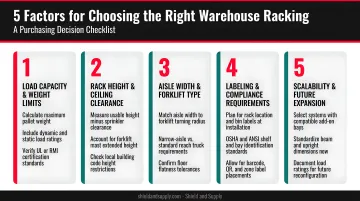
Once you've narrowed down your racking style, the next step is verifying that your components will actually work together safely.
The Compatibility Warning You Can't Ignore
The RMI advises against mixing components from different manufacturers without engineering approval. This applies even within the same broad style category — a teardrop beam from one manufacturer may appear compatible with another brand's upright but have different hole spacing or connector dimensions that change the load rating.
Before purchasing components to add to or repair an existing system:
- Confirm identical connector hole patterns and spacing
- Verify load ratings carry over to the mixed configuration
- Get engineering documentation if combining brands
- Treat used racking with extra scrutiny — rack designed for non-seismic areas can collapse if relocated to a seismic region, per RMI guidance
Common Selection Mistakes
- Choosing structural steel when teardrop would suffice — adds cost with no operational benefit
- Buying what's available rather than what fits your actual workflow and picking patterns
- Selecting a system that can't expand modularly, which forces a full replacement when inventory grows
Conclusion
Teardrop, structural, drive-in, and cantilever racking each serve different operations — and each is identifiable through specific visual markers: punch hole shapes, beam connection types, and steel construction methods. Getting those details right matters more than most facilities realize until an inspection or a load failure makes it unavoidable.
Rack identification feeds directly into load safety, OSHA compliance, and inventory accuracy. Once you know your rack type, you can label each bay with the correct load capacity, keep inspections on schedule, and verify compatibility before adding new sections. Those steps — identification, then labeling, then ongoing verification — are what turn a warehouse full of steel into a system that holds up under scrutiny.
Frequently Asked Questions
What are the different types of warehouse racking?
The four main categories are selective/teardrop (roll-formed), structural steel, drive-in/drive-through, and cantilever. Each suits different load requirements and storage density needs: teardrop for flexible selective access, structural for heavy-duty environments, drive-in for high-density single-SKU storage, and cantilever for long or irregularly shaped items.
Does warehouse racking need to be certified?
OSHA doesn't mandate a specific racking certification, but rack systems must meet safe load requirements under 29 CFR 1910.176 and should be installed per manufacturer specifications and ANSI MH16.1. RMI offers a voluntary R-Mark certification program for manufacturers demonstrating compliance with ANSI MH16.1, MH16.3, and MH26.2 standards.
How do I identify what type of pallet racking I have?
Start by inspecting the punch hole shape on the upright columns — teardrop, slotted, round, or bolted connections each indicate a different style. Check the beam-to-upright connection mechanism next, then look for manufacturer markings, part numbers, or color codes stamped or labeled on the steel.
Can different pallet rack styles be mixed together?
Some teardrop-compatible systems allow cross-brand mixing, but many proprietary styles do not. Always verify hole pattern dimensions, connector spacing, and load ratings first. Per RMI guidance, components from different manufacturers require engineering approval — mixing without it can cause structural failure.
What is the most common type of warehouse racking?
Teardrop (roll-formed selective) racking holds 45% of warehouse racking revenue in North America, making it by far the most widely used system. Its versatility, tool-free adjustability, and broad cross-brand compatibility have made it the default choice for most warehouse configurations.
How often should warehouse racking be inspected?
RMI recommends annual formal inspections, with monthly checks for high-traffic areas and quarterly for medium-risk zones. Damaged components — bent uprights, dislodged beams, missing safety clips — must be pulled from service immediately. After any forklift collision or seismic event, inspect the affected bays before resuming use.